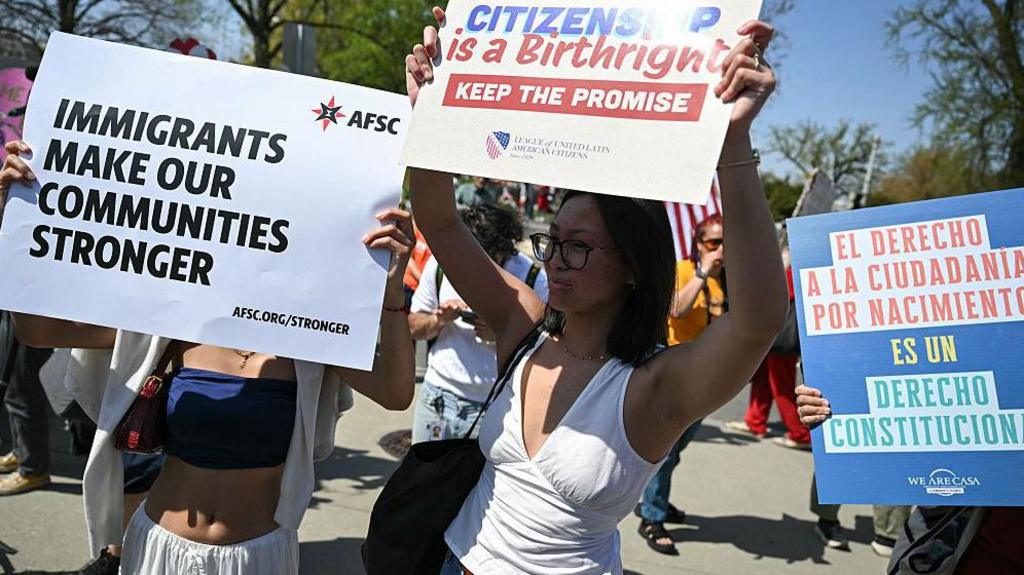
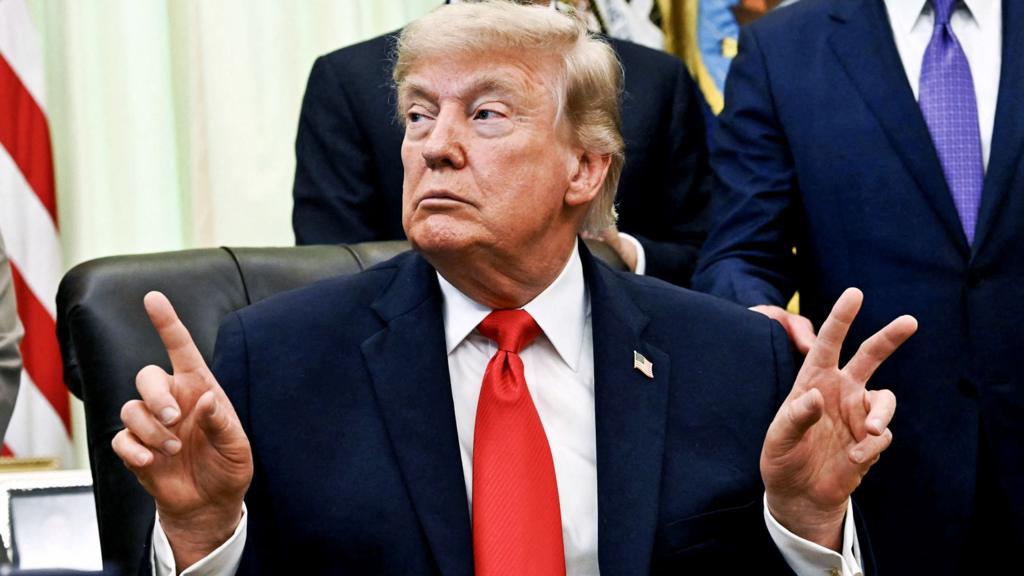
The Supreme Court upheld birthright citizenship 6-3 on June 30, striking down a Trump executive order that would have denied US citizenship to babies born to undocumented immigrants or temporary visa holders. Chief Justice John Roberts wrote for the majority, anchoring the ruling in the 14th Amendment and the 1898 precedent United States v. Wong Kim Ark, which established that nearly any person born on US soil automatically becomes a citizen. Trump signed the executive order on his first day back in office. Roberts and five justices interpreted "subject to the jurisdiction thereof," the constitutional phrase at issue, to include virtually all US-born children, rejecting the administration's reading that would have stripped citizenship from tens of thousands of babies each month. Vice President Vance called the ruling a "major mistake." Trump had publicly criticized his own Supreme Court appointees in the days before the decision.
Birthright citizenship is guaranteed by the 14th Amendment, ratified in 1868, which extends citizenship to any person born on US soil. The 1898 case United States v. Wong Kim Ark established this principle for children of non-citizen parents, even those facing exclusion laws. Trump sought to limit birthright citizenship during his first term as well, but never acted by executive order.
The Supreme Court ruled June 30 that states may bar transgender girls and women from competing in female school and college sports, upholding laws from Idaho and West Virginia. Justice Brett Kavanaugh wrote for the conservative majority in cases brought by Boise State University student Lindsay Hecox, who transitioned before puberty, and West Virginia high school student Becky Pepper-Jackson, who had competed on her girls' cross-country team since 2021. Kavanaugh held that protecting "safety and competitive fairness" gives states a legitimate basis to separate athletic competition by biological sex, finding no violation of the 14th Amendment's equal protection clause or Title IX, the federal law banning sex discrimination in federally funded schools. Twenty-seven states already have similar laws. Justice Sonia Sotomayor dissented, saying the record was too undeveloped to sustain the bans. The Human Rights Campaign called the ruling "heartbreaking."
The cases arose from state laws, largely passed since 2021, that define women's sports eligibility by biological sex at birth. Supporters argue the laws protect competitive fairness; critics say they exclude trans youth with no evidence of systematic competitive advantage. Title IX's prohibition on sex discrimination has been central to the dispute, and the ruling resolves that question against trans athletes in the school sports context.
Trump's annual financial disclosure shows he earned more than $1.4 billion from cryptocurrency ventures in his first year back in office, far exceeding his income from real estate, licensing, or merchandise. About $635 million came from a licensing deal tied to the $TRUMP meme coin, which launched three days before his January 2025 inauguration. Another $524 million came from token sales through World Liberty Financial (WLF), a crypto firm managed by his sons Eric and Donald Jr., with $65 million more from WLF equity sales. Trump signed the GENIUS Act, a stablecoin regulatory framework, into law with no conflict-of-interest provisions blocking him or his family from profiting from assets the law now governs. Senate Democrats released a memo calling the arrangement "crypto corruption." Retail investors who bought the $TRUMP meme coin lost a combined $2 billion as the coin crashed after its January peak.
World Liberty Financial, partly managed by Trump's sons, issues a stablecoin called USD1. Critics argue Trump is structurally conflicted: he holds more than $1 billion in crypto assets affected by stablecoin policy, yet has hosted White House meetings brokering regulatory details between banks and crypto firms that directly affect his holdings' value.
A developer reverse-engineering Claude Code, Anthropic's command-line coding tool, found the software had been hiding steganographic signals in AI system prompts since version 2.1.91, released April 2, 2026, with no changelog disclosure. The encoding used two mechanisms: the date separator character (dash versus slash) flipped based on whether the user's timezone was set to China (Asia/Shanghai or Asia/Urumqi), and the apostrophe in the phrase "Today's" cycled among four visually identical Unicode characters to encode whether the request was routed through a Chinese-linked API proxy. Anthropic released version 2.1.197 to remove the code, again without mentioning it in the changelog. The company has not publicly explained what the encoded data was intended to convey or whether it was transmitted to external servers. The discovery prompted significant debate in developer communities about transparency in AI tooling.
Steganography is the practice of hiding data inside ordinary-looking content. System prompts are instructions sent to AI models with every request to set behavior context. Claude Code runs with broad system access on user machines and communicates with Anthropic's servers, making undisclosed encoding in its prompts a significant trust concern for enterprise and security-sensitive users.
Anthropic released Claude Sonnet 5 on June 30, immediately making it the default model for all Free and Pro users. The company describes it as the most capable Sonnet yet, with performance approaching Opus 4.8 on reasoning, coding, and knowledge tasks at substantially lower cost. Introductory pricing runs $2 per million input tokens and $10 per million output tokens through August 31, rising to $3 and $15 thereafter. Anthropic says the model has lower hallucination and sycophancy rates than Sonnet 4.6, scored 0% on Firefox vulnerability exploit tests, and handles prompt-injection attacks better than its predecessor. Prompt injection is a class of attack in which malicious content in a web page or document tricks an AI agent into following unauthorized instructions. The release also introduces an updated tokenizer that shifts token counts by a factor of 1.0 to 1.35 compared with prior models.
Sonnet models occupy the middle tier of Anthropic's lineup, between the smaller Haiku and the most capable Opus. They have been the default for Claude's free and professional tiers, targeting a cost-performance balance for developers and everyday users. The release comes alongside the full restoration of Fable 5 and Mythos 5 access after a three-week export control pause.
The US Department of Commerce fully lifted export controls on Anthropic's Claude Fable 5 and Mythos 5 on June 30, ending a restriction that had blocked global access to both models for nearly three weeks. Commerce Secretary Howard Lutnick imposed the controls around June 12-13, citing concerns that the models could locate software vulnerabilities at scale and pose a national security risk. Anthropic cut off access for all users worldwide, including its own staff. On June 27, the department restored access for over 100 vetted companies and institutions. The June 30 decision returned both models to all users on Claude.ai, the Claude API, and Claude Code. The episode was one of the fastest AI export control cycles on record: a restriction on a commercially deployed model, imposed and then fully removed in under three weeks.
US export controls restrict access to sensitive technologies without a license. The Department of Commerce applied them to Fable 5 and Mythos 5 under rules governing tools capable of finding and exploiting software vulnerabilities. Critics found it unusual that the controls blocked US domestic access as well, not just foreign users, effectively shutting down Anthropic's own operations.
Conception, a US biotech startup, announced it has grown the first early human egg cells from blood stem cells. Working with Katsuhiko Hayashi, the Japanese scientist who produced healthy mouse offspring from skin-derived stem cells in 2016, the team converted adult blood cells into induced pluripotent stem cells, then guided them into self-organizing miniature ovaries containing primary oocytes entering meiosis, the cell-division process that produces eggs. The system generates thousands of such mini-ovaries, each holding millions of early egg cells for study. The company calls the technique in vitro gametogenesis (IVG) and says the long-term goal is to produce "as many healthy eggs as a family needs" from a single blood draw, bypassing the limited egg supply that constrains IVF and egg donation. The oocytes are at an early developmental stage; the team's next target is maturing them to the antral follicle stage, large enough for IVF collection.
Standard IVF requires hormonal stimulation to harvest a small number of eggs per cycle, typically 10 to 15. IVG would allow egg production from any adult cell type, not just reproductive tissue, which could expand access to fertility treatments and enable studying human egg development at scale. The technique also raises ethical questions about reproductive autonomy and the potential to create gametes without a donor's explicit consent.
Meta and researchers at Spain's Basque Center on Cognition, Brain, and Language published results from Brain2QWERTY, a system that decodes text from brain signals without surgical implants. Participants wore a magnetoencephalography headset, a non-invasive helmet that measures the tiny magnetic fields neurons generate, while silently typing sentences. The system trained on about 22,000 sentences from nine volunteers, each recorded for ten hours. It achieved 61% word accuracy on average, with the top participant reaching 78%, and decoded more than half of all sentences with one word error or less. That result outperforms prior non-invasive brain-computer interfaces by roughly eight times, approaching accuracy levels that had only been achieved with surgically implanted electrodes. Meta released the full training code, the dataset, and a $5 million fund for open neural data. The system targets people with paralysis or motor disorders who cannot speak or type.
High-accuracy brain-computer interfaces, like Neuralink's electrode arrays, have historically required surgical implants. Non-invasive approaches using EEG or MEG headsets were far less accurate. Brain2QWERTY improves accuracy by combining a deep learning model that processes raw neural signals with a fine-tuned language model that uses sentence context to correct decoding errors.
Melat Kiros, a 29-year-old lawyer who moved to the US from Ethiopia as an infant, defeated 15-term congresswoman Diana DeGette in Colorado's 1st Congressional District Democratic primary on June 30, winning roughly 49% to DeGette's 44%. DeGette had held the Denver-based seat since 1997 and was the longest-serving member of Colorado's congressional delegation. Kiros, also a PhD student at the University of Denver, was endorsed by Bernie Sanders and the Democratic Socialists of America. The result is the third time a DSA-backed candidate has unseated an established Democratic incumbent in a House primary this cycle, following similar wins in New York City districts. In the heavily Democratic district, covering most of Denver, Kiros is near-certain to win the general election in November, and would become the first Generation Z woman elected to Congress.
The DSA has targeted safe Democratic urban seats, arguing mainstream Democrats neglect these districts. DeGette, chair of the House Energy and Commerce Committee, was considered a mainstream progressive, not a conservative Democrat. Her first intra-party defeat came in March at the Denver Democratic Party assembly, where Kiros won 67% to 33%. Justice Democrats, who helped elect Alexandria Ocasio-Cortez in 2018, also backed Kiros.
Florida's State Board of Education voted to bar undocumented students from enrolling in the state's 28-college system, making Florida the fourth state to impose such restrictions following Alabama, Georgia, and South Carolina. Starting July 1, applicants must attest to citizenship or lawful presence and provide documentation before enrollment. A separate amendment also bars undocumented students from adult education programs. The policy applies to community and state colleges but not Florida's 12 public universities, which fall under a separate governing board. About 8,000 undocumented students graduate from Florida high schools each year, and over 49,000 are currently enrolled in Florida colleges; the board projects losing more than $15 million annually in tuition and fees. One member dissented, arguing immigration enforcement belongs to dedicated agencies. State legislators have raised questions about whether the ban conflicts with Florida's existing open-access admission mandate.
Florida eliminated in-state tuition for undocumented students in 2025. This new policy extends restrictions further by blocking enrollment altogether. Critics note it affects students educated in Florida's K-12 schools for years. Under federal DACA rules, some recipients hold work authorization but remain ineligible for lawful immigration status, adding complexity to what documentation can satisfy the new attestation requirement.