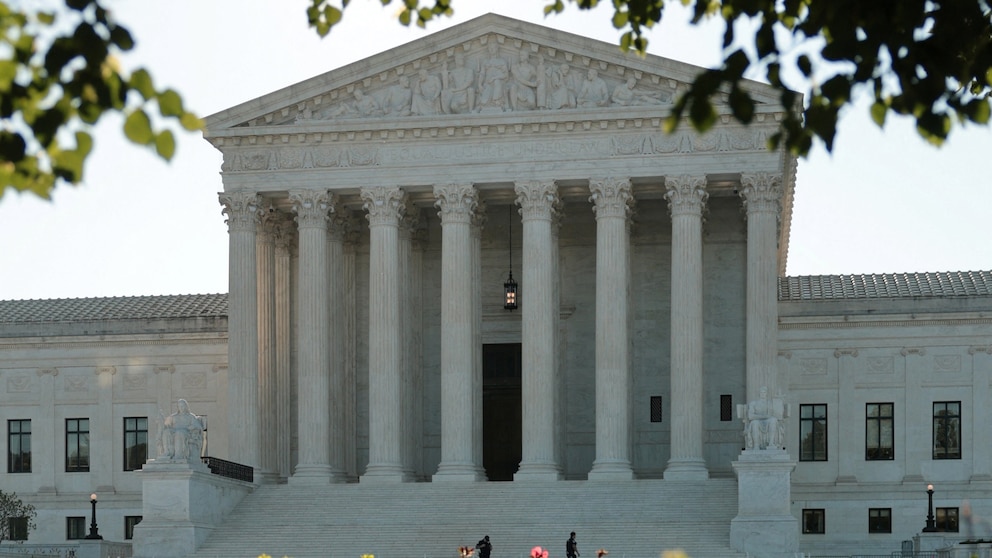
The Supreme Court on Tuesday rejected President Trump's executive order restricting birthright citizenship, ruling 6-3 that the 14th Amendment extends citizenship to any child born on US soil regardless of their parents' immigration status. Chief Justice Roberts wrote for a five-justice majority — joined by Justices Barrett, Sotomayor, Kagan, and Jackson — holding that the amendment's text is unambiguous and that EO 14160 violated settled constitutional law. Justice Kavanaugh concurred separately on statutory grounds. Justices Thomas, Gorsuch, and Alito dissented.
Trump's January 20, 2025 executive order directed federal agencies to deny citizenship documents to children born to parents without lawful status or on temporary visas. Four federal circuits had already blocked it. The ruling closes off Trump's administrative route: any change to birthright citizenship would require a constitutional amendment, which needs two-thirds of Congress and ratification by three-fourths of states.
Birthright citizenship under the 14th Amendment has been settled law since United States v. Wong Kim Ark (1898), which held that a child born on US soil to Chinese immigrant parents was a citizen. Anti-immigration advocates have argued for decades that the clause "subject to the jurisdiction thereof" excludes children of undocumented parents, but no court has accepted that reading.
The Supreme Court ruled 6-3 on Tuesday that states may ban transgender girls and women from competing in female school and college sports. Justice Kavanaugh wrote for the six-justice majority in consolidated cases — West Virginia v. B.P.J. and Little v. Hecox — upholding state laws from West Virginia and Idaho that restrict athletic competition by sex assigned at birth.
The majority held that such laws do not violate Title IX or the Equal Protection Clause. States have a legitimate interest in preserving competitive equity in women's sports, Kavanaugh wrote, and gender-affirming medical treatment does not establish that transgender women are identically situated to other women for athletic purposes. Justice Sotomayor dissented in an opinion joined by Justices Kagan and Jackson, and read her dissent aloud from the bench.
The ruling validates laws that more than 27 states had already enacted. The plaintiffs in both cases were transgender girls who had competed in school sports before their state's ban took effect.
Idaho's Fairness in Women's Sports Act (2020) and West Virginia's Save Women's Sports Act (2021) were among the first state laws restricting transgender athlete participation. B.P.J. was a transgender girl in West Virginia who competed in cross-country before the state banned her. Hecox was a transgender woman at Boise State seeking to join the track team. More than 27 states passed similar laws before today's ruling.
The Supreme Court on Tuesday struck down federal limits on coordinated expenditures between political parties and candidates, ruling 6-3 in a case that Vice President J.D. Vance helped litigate before taking office. The decision extends the court's 2010 Citizens United holding to remove another cap on large-money political spending.
Under the ruling, political parties can now spend unlimited funds in direct coordination with candidates' campaigns — a form of spending that previously carried strict limits intended to preserve the appearance of independence between donors and officeholders. The majority held that coordinated party expenditures are protected speech and that existing anti-corruption laws provide adequate guardrails against quid-pro-quo corruption.
The ruling arrives as outside spending in federal elections already exceeds $4 billion per cycle. Critics say it removes one of the last meaningful distinctions between unlimited outside spending and campaign spending, channeling more billionaire money directly into candidate messaging rather than nominally independent advertising.
Citizens United (2010) held that corporations and unions could spend unlimited money on independent election advertising. Subsequent rulings extended that logic to wealthy individuals and super PACs. Coordinated spending — where a donor or party acts in concert with a campaign — remained capped because courts viewed it as more corruption-prone. Tuesday's ruling dissolves that distinction.
Two studies published in Nature on Tuesday report that a specially designed immunogen — a protein called ApexGT6 that mimics the hardest-to-reach site on HIV's outer envelope — triggered broadly neutralizing antibodies in rhesus macaques through vaccination for the first time.
Previous HIV vaccine attempts have failed partly because the key site at HIV's apex is normally hidden and surrounded by molecular decoys. ApexGT6 is engineered to expose that site while removing the decoys. In the first study, all six macaques vaccinated with a protein formulation produced broadly neutralizing antibodies that blocked multiple HIV strains, not just the strain used in the shot. A second group vaccinated with an mRNA-lipid nanoparticle formulation — the same delivery technology used in COVID-19 vaccines — produced 80 distinct B cell lineages capable of neutralizing the virus.
Researchers called the result a major advance. Human clinical trials are needed to determine whether the response translates.
Broadly neutralizing antibodies (bnAbs) can block many HIV strains by targeting conserved regions of the virus. Eliciting them through vaccination has been a goal for decades. HIV mutates rapidly, which is why narrowly targeted vaccines — effective against influenza — fail against most HIV strains. Some HIV-positive people produce bnAbs naturally; this research aims to trigger the same response through vaccination.
Workers' share of US national income has fallen to its lowest level since at least World War II, according to a Federal Reserve Bank of New York study published Tuesday. The labor share — the fraction of GDP paid as wages, salaries, and benefits — dropped 1.6 percentage points below its pre-pandemic level and now sits below its previous post-war trough.
The authors find the decline is not explained by sector shifts: services growing while manufacturing shrinks would naturally reduce labor share if manufacturing paid workers more. Instead, the fall is happening within industries — firms across sectors are capturing more revenue as profit rather than wages. The paper points to three explanations: the rise of superstar firms with high market power and low labor intensity, technology-driven automation substituting capital for workers, and rising corporate markups across the economy.
The findings appeared on Hacker News with more than 150 points, drawing discussion of wage stagnation and the distributional effects of AI automation.
Labor share measures the portion of national income going to workers rather than to capital owners. Economists have tracked a global decline since the 1980s, but the US drop accelerated after COVID-19. A falling labor share means corporate profits and capital income grow faster than wage income, widening the gap between workers and shareholders.
Rocket Lab announced Tuesday it will acquire Iridium Communications for approximately $8 billion, paying $54 per share in a deal CEO Peter Beck called "one of the most transformative in the space industry." Iridium operates 66 low-Earth-orbit satellites providing global voice and data coverage — the only commercial network with true pole-to-pole reach — and serves 2.55 million subscribers in maritime, aviation, military, and Internet of Things applications.
The deal gives Rocket Lab a revenue base and paying customer network to match its existing capabilities: the company builds its own rockets, satellites, and spacecraft components. Iridium generated $872 million in revenue last year with 57 percent EBITDA margins. Beck has been explicit that his goal is a fully integrated space company spanning launch through in-orbit services, and Iridium's established subscriber base makes that viable.
The acquisition is expected to close in 2027, pending regulatory review.
Iridium's original constellation went bankrupt in 1999, months after launch, after cellular phones undercut its satellite phone business model; the network was sold for $25 million. A second-generation constellation, launched aboard SpaceX rockets starting in 2017, replaced all 66 satellites and repositioned Iridium around industrial and government IoT connectivity. Rocket Lab went public in 2021 via SPAC and has since acquired multiple satellite component manufacturers.
The State Department is offering up to $10 million for information identifying the members of two Russian state hacking groups running a sustained campaign to compromise Signal and WhatsApp accounts, the department announced Tuesday. The groups — labeled UNC5792, tied to the FSB Border Guards Service, and UNC4221, tied to the GRU — have been active since at least March 2025, targeting NATO military officials, journalists, researchers, and NGO workers.
The attack method exploits Signal and WhatsApp's account-transfer and backup features rather than breaking the apps' encryption. By tricking targets into approving a "linked device" request or revealing a backup recovery key, the attackers gain full access to message history on a new device without touching the encryption layer.
Tips will go through the Rewards for Justice program's Tor-based submission system — the same mechanism used to identify ransomware operators and sanctions evaders. Officials declined to name specific targets or confirm how many accounts were compromised.
Signal and WhatsApp use end-to-end encryption, making server-side interception impractical for state adversaries. Russian intelligence groups have shifted to compromising devices directly — through phishing, malware, or account-transfer exploits — to read messages after decryption. UNC designations are Mandiant/Google Threat Intelligence tracking labels used before attribution is formally confirmed.
The European Union's mandatory digital identity wallet system, required under the eIDAS 2.0 regulation by 2026, will rely on Google's Play Integrity API and Apple's Managed Device Attestation to verify that phones are trustworthy enough to hold official ID credentials. A technical analysis published Tuesday by Waag, a Dutch public technology nonprofit, found that this design locks the wallets to the two companies' attestation infrastructure and excludes users of alternative operating systems such as GrapheneOS.
EU member states are building their wallets against the EU Architecture Reference Framework, which requires hardware-backed device attestation. In practice, the only approved attestation paths run through Google and Apple security services — the same companies that provide the platforms themselves.
The analysis argues the design undermines the EU's digital sovereignty goals and may conflict with the Digital Markets Act. Users who have removed Google services from their phones to improve privacy cannot use the system designed to give them control over their own identity data. The piece drew 558 points on Hacker News.
eIDAS 2.0 requires all EU member states to offer a digital identity wallet to citizens by late 2026, letting Europeans share verified attributes — age, professional qualifications, driving license — without handing data to private platforms. Waag is an Amsterdam-based nonprofit researching open and public digital infrastructure. GrapheneOS is a hardened Android fork that strips out Google services for privacy.
A man shot and killed six people Monday at a welfare center for young mothers and pregnant women in Stade, near Hamburg, then was arrested at the scene. Officers said the suspect had an ongoing custody dispute over his infant daughter, who was staying at the facility. One additional victim was wounded.
The center provides housing and social support for pregnant women and young mothers, including some adolescents, often in difficult family circumstances. Police said armed officers responded quickly and arrested the suspect without further violence.
German political leaders condemned the attack. The shooting drew particular attention because it targeted a protected social services facility housing vulnerable women. Police have not publicly identified the suspect; German media reported he is a German national. Investigators said the attack appears directed at the specific facility rather than random.
Germany has experienced several high-profile attacks at public spaces and institutions in recent years, including a 2024 market attack in Magdeburg. German law tightly restricts firearm ownership, but violence at social service facilities — often linked to custody disputes or domestic conflict — remains a recognized risk. Child welfare centers in Germany operate under state social services (Jugendamt) oversight.
North Carolina's Republican-controlled legislature voted to ban diversity, equity, and inclusion programs at public colleges and universities and overrode Democratic Governor Josh Stein's veto to make the law take effect immediately, with no transition period. The law prohibits public universities from maintaining DEI offices or DEI-designated staff positions, from offering coursework designed primarily to promote DEI frameworks, and from disciplining employees for speech categorized as microaggressions. Institutions must file annual compliance certifications or risk losing state funding.
The American Association of University Professors called the law among the most restrictive in the country. Faculty unions representing UNC system employees said the ban will suppress campus discussions of race and gender and harm recruitment of students and faculty from underrepresented groups.
North Carolina becomes the 17th state to restrict or ban DEI programs at public higher education institutions. The law's immediate effective date gives universities no time to comply before the next academic year.
DEI bans at public universities accelerated after the Supreme Court's 2023 Students for Fair Admissions decision striking down race-conscious admissions. Supporters argue DEI programs discriminate on identity grounds; opponents say they address structural inequities. Faculty governance bodies have broadly opposed the legislation, warning of academic freedom impacts and damage to institutional research capacity.