The formal signing of the US-Iran peace memorandum was set for June 19 in Geneva, but the talks stalled before they began. Vice President Vance canceled his trip to Switzerland, where he was to lead the first round of direct nuclear negotiations under the 60-day window opened by last week's 14-point memorandum of understanding. Iran's delegation never arrived, citing ongoing Israeli strikes in Lebanon that have killed at least 18 civilians; a Hezbollah attack on the same day killed four Israeli soldiers including a tank battalion commander. The White House offered the vague explanation of "difficult logistics." The MOU covers a ceasefire extension, Iran's pledge not to develop nuclear weapons, a freeze on its nuclear program, and the Strait of Hormuz remaining open for oil traffic. With no confirmed rescheduled date, the 60-day negotiating window -- during which both sides agreed to no new US sanctions and no additional US forces -- has no clear start. Republican senators who demanded to see the full MOU text are treating the delay as confirmation of deeper problems with the deal.
The US and Iran fought a brief military exchange in May-June 2026, ending in a ceasefire and then this MOU -- a preliminary framework meant to pave the way for a formal deal covering Iran's nuclear program and sanctions relief. Vance has been Trump's lead negotiator amid criticism from hawks in both parties who are skeptical of Iran's intentions.
The Supreme Court ruled unanimously Wednesday that the federal law barring marijuana users from owning firearms violates the Second Amendment, delivering a landmark gun-rights decision that cuts across ideological lines. The case centered on Ali Danial Hemani, a Dallas-area man who told FBI agents in 2022 that he used marijuana every other day; the government charged him under an old provision of the 1968 Gun Control Act that makes it a federal felony for any "unlawful user" of a controlled substance to possess a gun. Justice Gorsuch, writing for seven justices, applied the Bruen test -- which requires gun restrictions to match historical tradition -- and found the government's analogies failed. Colonial-era "habitual drunkard" laws disarmed people who were practically incapacitated, not people who used a substance recreationally. Three separate concurrences added their own frameworks. The ruling does not invalidate the felon-in-possession ban and does not automatically vacate prior convictions, but it opens the door to challenges from anyone convicted under this provision solely on the basis of drug use without evidence of actual dangerousness.
The Supreme Court's 2022 Bruen ruling changed the constitutional test for gun laws: restrictions must now match historical tradition rather than pass a reasonableness standard. Several lower courts had split on whether marijuana users could be disarmed; Hemani resolved those conflicting decisions nationwide. The case drew extra attention because Hunter Biden was separately convicted under the same statute before being pardoned.
A Missouri judge struck down nearly all of the state's abortion regulations Thursday, more than 18 months after voters passed a constitutional amendment legalizing abortion up to fetal viability. Jackson County Circuit Judge Jerri Zhang found that roughly 40 statutes conflicted with Amendment 3, which Missouri voters approved in November 2024. The ruling voids the 72-hour waiting period, hospital admitting-privileges requirement, facility construction rules, and the ban on telemedicine prescriptions -- the provision that had required patients to take abortion pills in the physical presence of a physician. Medication abortion through Planned Parenthood clinics in Kansas City and St. Louis will resume. Two requirements survive: patients still need an in-person doctor consultation, and only physicians can perform abortions. Missouri Attorney General Catherine Hanaway announced an expedited appeal to the Missouri Supreme Court. Separately, abortion opponents have gathered enough signatures to put a measure on the November 2026 ballot asking voters to repeal Amendment 3 entirely.
Missouri was among the first states to ban abortion after Roe v. Wade was overturned in 2022, implementing a near-total ban within hours. Voters rejected that approach in November 2024, passing Amendment 3, which enshrined abortion rights in the state constitution up to fetal viability. The legislature's existing restrictions stayed on the books regardless, requiring this lawsuit to clear them away.
Fossils of baby prehistoric predators found in northern Illinois have overturned a 150-year assumption about how animals first moved from water to land. Researchers at the Field Museum in Chicago identified hatchlings of embolomeres -- crocodile-like creatures from about 310 million years ago -- preserved in the Mazon Creek fossil beds. The infants had essentially the same body plan as adults: no external frilly gills, no metamorphic stage between a water-adapted larva and a land-capable adult. Since the 1860s, scientists had assumed early four-limbed animals went through an aquatic tadpole-like larval phase, mirroring modern frogs -- the logic being that a water-adapted larval stage would ease the transition from sea to shore. The Mazon Creek hatchlings, published Thursday in the journal Science, show early tetrapods bypassed that intermediate step entirely. Tadpole-style metamorphosis, the study argues, evolved sometime after animals were already established on land, not as the mechanism that got them there. The finding reshapes how paleontologists understand one of the pivotal moments in vertebrate evolutionary history.
Tetrapods -- four-limbed vertebrates -- are the ancestors of all land animals including humans. The first tetrapods emerged during the Devonian period, roughly 375 million years ago, and gradually adapted to life on shore. Mazon Creek in Illinois is one of the world's best-preserved fossil beds, containing Carboniferous-era organisms that are rarely found elsewhere.
A security researcher has documented roughly 10,000 GitHub repositories secretly distributing Trojan malware, in a campaign that exploits developer trust in version history and contributor records. The attackers cloned legitimate open-source projects wholesale -- copying every commit and contributor's name -- then injected links to malicious ZIP archives by repeatedly deleting and re-pushing commits disguised as "Update README.md" changes. The cloned repos also gamed GitHub's internal search ranking for niche developer search terms, helping them surface above the originals. The malware payload, identified in a related campaign, included SmartLoader paired with StealC, a credential-stealing infostealer. The researcher notified GitHub, but the platform's response was slow: an initial support ticket went unanswered for two weeks, and even after specific repos were removed, GitHub left others matching the identical pattern active. Red flags to watch: a repository with long commit history but a recent creation date, frequent README-only commits, and ZIP archive download links in the readme.
GitHub is the central hosting platform for most open-source code, used by millions of developers who routinely install packages from repositories. Attackers have increasingly targeted it as a distribution channel, exploiting the platform's reputation as a trusted code source to smuggle malware into development pipelines. An earlier related campaign in April involved 109 fake repos distributing the same malware family.
Two patients with a severe autoimmune disease that attacks the spinal cord and optic nerve have remained in remission for more than 15 years after receiving donor stem-cell transplants, according to a study published Thursday in Nature. The condition, neuromyelitis optica spectrum disorder (NMOSD), causes episodes of eye pain, vision loss, and paralysis lasting days to months that progressively damage the nervous system. Both patients received donor blood stem cells after chemotherapy destroyed their existing immune systems. The transplant replaces the patient's immune system entirely, eliminating the B cells that were generating antibodies attacking their own nerves. The man, treated in 2009, returned to a normal life and has had two children. The woman, treated in 2010, regained function in her arms. This is the first documented use of donor stem-cell transplants for NMOSD, and the researchers say the results are strong enough to warrant larger clinical trials to test the approach more broadly.
NMOSD is often confused with multiple sclerosis but is a distinct condition where the immune system attacks the spinal cord and the optic nerve. Standard treatments manage episodes but do not cure the disease. Existing stem-cell transplant approaches for autoimmune conditions typically use the patient's own cells; this study used donor cells, which more completely reset the immune system but carry additional risks.
Gunmen carried out a sustained assault on Niamey's main international airport Wednesday morning, killing 11 Nigerien soldiers and 2 civilians before security forces repelled the attack and killed 22 of the attackers. The al-Qaeda-linked group JNIM, which claimed the assault as a suicide attack, has carried out dozens of major strikes across West Africa's Sahel region. Fighters arrived by taxi at 6 AM local time, opened fire at a checkpoint outside Diori Hamani International Airport, and pushed through to the adjacent military air base -- Air Base 101 -- which also houses Russian Africa Corps personnel. A similar attack on the same complex in January, carried out by an Islamic State Sahel affiliate, targeted drone assets and damaged three aircraft. Authorities apprehended roughly 20 suspects. Niger has experienced worsening jihadist violence since the July 2023 military coup that ended French security cooperation and replaced it with Russian military partnership.
Niger joined Mali and Burkina Faso in forming the Alliance of Sahel States after all three countries experienced coups and expelled French forces. The region has become a major arena for both JNIM (al-Qaeda's Sahel branch) and Islamic State Sahel, which have killed thousands of civilians and soldiers across the three nations. Russian Africa Corps replaced French troops as Niger's main foreign security partner.
Astronomers at Yale have identified a third galaxy that appears to be nearly devoid of dark matter, reinforcing a challenge to the standard theory of how galaxies form. The galaxy, designated DF9, sits in the Coma cluster region and was measured using the Keck Cosmic Web Imager, which tracks the velocities of stars. Stars in a dark-matter-rich galaxy orbit fast because of the additional gravitational pull; DF9's stars orbit slowly, implying far less total mass than models predict. All three known dark-matter-deficient galaxies -- DF2, DF4, and DF9 -- appear to lie in a linear chain, which points toward a shared origin. The leading explanation: two larger galaxies collided at high speed, the impact stripped the dark matter away, and a pocket of ordinary matter was left to form a galaxy on its own. The finding, published in the Astrophysical Journal by Michael Keim and the Yale team, adds pressure on theorists to explain how galaxies can exist without the gravitational scaffolding dark matter is supposed to provide.
Dark matter -- an invisible substance that interacts through gravity but emits no light -- is thought to account for about 85% of all matter in the universe. Standard models of galaxy formation require it as the gravitational seed around which gas and stars coalesce. The first discovery of a seemingly dark-matter-free galaxy, DF2, was reported in 2018 and was immediately controversial among astronomers.
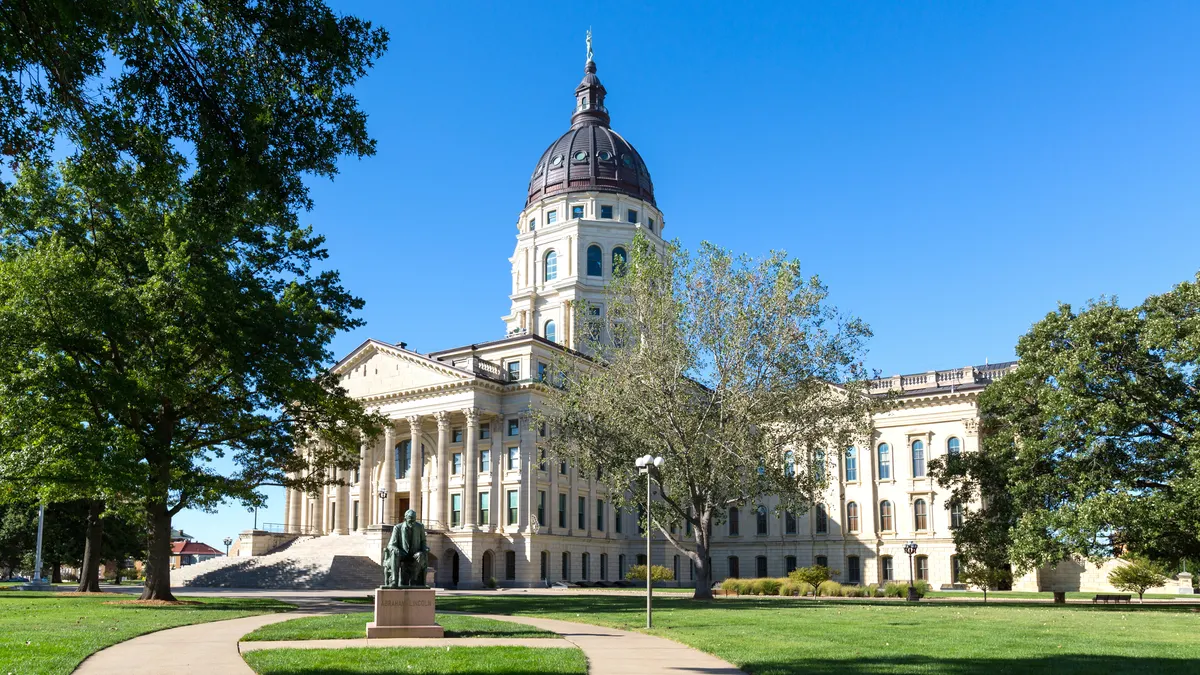
Kansas public universities can teach about race and racism, the state's Board of Regents clarified Thursday -- but only under specific terms, and courses that cross into "DEI-CRT" territory can no longer be required for any degree. The definitions, adopted unanimously, implement a budget provision signed by Gov. Laura Kelly in April that bans required courses focused on diversity, equity, and inclusion or critical race theory at state schools, with a $2 million-per-year penalty for violations. Under the policy, content that "promotes" acceptance of systemic racism as a viewpoint -- rather than presenting it as a subject of scholarly or historical study -- is off-limits for required courses. Discussions of racism and civil rights history were explicitly exempted. Faculty critics warned the word "promotes" is ambiguous enough to create legal exposure for standard social science and education courses. KU Chancellor Doug Girod said "anywhere there's ambiguity, there's real risk." Programs in racial, ethnic, or gender studies can apply for waivers to keep requiring such courses. Universities must certify compliance by the 2027-28 academic year.
Kansas joined Iowa, Texas, Florida, and several other Republican-controlled states that passed laws restricting DEI-related instruction at public universities in 2025-26. The laws vary widely: some ban DEI offices and diversity statements, others target course requirements. Iowa's Board of Regents voted this week to review general education courses at state universities for similar content.
GPS is the invisible backbone of global shipping, and it has a fundamental design flaw: civilian receivers cannot verify that the signals they receive are real. An excerpt from Katherine Dunn's new book "Little Blue Dot: How GPS Shaped the Modern World" follows Todd Humphreys, a satellite navigation researcher at the University of Texas, who built a GPS spoofer in his Bay Area apartment and then used it to silently commandeer the navigation system of an $80 million superyacht in the Mediterranean. The crew had no idea their position data was false. Spoofing works by broadcasting counterfeit GPS signals at higher power than the real satellites, overriding the receiver's lock. The hardware is off-the-shelf. The software is open-source. The attack leaves no alarm, no log entry, no anomaly the crew would notice. Humphreys' demonstration revealed that standard marine navigation equipment -- used across the commercial shipping industry -- offers no protection against an attacker willing to spend a few hundred dollars on components. The vulnerability extends to cargo vessels and military logistics.
GPS signals from US military satellites are publicly accessible and unencrypted for civilian use -- which is what made the system transformative for navigation, logistics, and precision agriculture. That openness is also the vulnerability: there is no authentication layer, so any transmitter broadcasting a stronger signal wins. Military receivers use encrypted P-code signals that resist spoofing; commercial civilian equipment does not.