Ukraine launched its largest drone attack on Moscow since the full-scale invasion began in February 2022, striking the Gazprom Neft oil refinery in Kapotnya, a district about 15 kilometers from the Kremlin. At least 194 drones were intercepted near the capital, and five separate fires broke out at the refinery after the attack hit it for the second time in a week. Russian authorities said 17 people were injured; airports across Moscow temporarily suspended flights and traffic restrictions surrounded the burning facility. President Volodymyr Zelensky said the attack was "a fully justified response to Russian attacks on our cities and communities." The strike followed Russia's destruction of the Kyiv-Pechersk Lavra, a UNESCO-listed thousand-year-old monastery in Kyiv, with Zelensky warning that if Ukraine burns, Moscow will too. The attack reflects a pattern of Ukrainian long-range strikes on Russian energy infrastructure, intensifying as both sides face pressure to reach a ceasefire under the fragile US-Iran peace framework.
The Moscow Oil Refinery in Kapotnya is one of Russia's largest, supplying a substantial share of the capital's fuel. Ukraine has escalated drone attacks on Russian energy infrastructure throughout 2025-2026, aiming to raise the economic cost of the war. This was the second strike on the same facility within a week.
Italian Prime Minister Giorgia Meloni publicly accused President Trump of fabricating a story about her at the Group of Seven summit in Evian-les-Bains, France, in a rare open break between a European leader and an American president. Trump told Italian broadcaster La7 that Meloni "begged me to take a picture with her -- she wanted a picture with me so badly." Meloni posted a video response calling the claim "totally fabricated" and declaring: "Neither I nor Italy ever beg." Italy's Foreign Minister Antonio Tajani called Trump's remarks "serious and offensive" and canceled a diplomatic visit to Washington planned for June 21-22. The dispute comes as Italian-American relations have chilled since Trump's decision to go to war with Iran, a move Meloni publicly opposed. The public feud marks a sharp turn: Meloni was widely seen as one of Trump's closest European allies when he returned to office in 2025, and Italy had positioned itself as a bridge between Washington and the European Union.
Italy was among the first European governments to cultivate close ties with Trump after his 2025 inauguration, with Meloni and Trump sharing ideological overlap on immigration and sovereignty issues. The US decision to go to war with Iran, which Meloni opposed, has since strained relations. This public break is the most explicit sign yet of that fracture.
A Miami-based startup called Subquadratic came out of stealth last month with a claim that has divided the AI community: it says it has solved the mathematical bottleneck that has constrained large language models for nearly a decade. The bottleneck is the quadratic attention mechanism -- the process by which a language model weighs every word against every other word in a sequence. As text gets longer, the computation grows quadratically: doubling the sequence length quadruples the processing cost. Subquadratic's architecture, called SubQ, uses sparse attention, selecting only the most relevant pairings rather than all possible ones. Third-party tests commissioned by the company showed SubQ running 56 times faster than FlashAttention-based models, with 89.7% accuracy on coding benchmarks and far lower inference costs ($8 versus $2,600 for equivalent tasks). Independent researchers are cautious. AI researcher Will Depue wrote that the public evidence does not yet justify the core claim. The company has not disclosed its funding.
The attention mechanism, introduced in 2017 in Google's 'Attention Is All You Need' paper, is the core of transformer-based language models including GPT and Claude. Its quadratic scaling creates a hard practical limit on how much context a model can process efficiently. Linear and subquadratic alternatives have been proposed before, but none has displaced transformers at scale.
Casey Harrell, a climate activist with ALS who is paralyzed and largely unable to speak without assistance, has spent nearly three years using a brain-computer interface that lets him talk, browse the internet, and do advocacy work. Researchers at UC Davis who worked with him call Harrell the "first power user" of a brain implant: the device records electrical signals from neurons, decodes intended speech in real time, and routes output through a voice clone built from his pre-illness recordings. He can switch a privacy mode on and off. Harrell's case is part of a broader acceleration: the number of people globally with implanted BCI devices has more than doubled since 2024, from roughly 75 to about 150, across parallel programs run by Neuralink, Synchron, Neuracle, and several academic groups. China this year became the first country to approve a medical-grade BCI outside of clinical trial protocols. MIT Technology Review reports that the BCI field is moving faster now than at any point in its history.
Brain-computer interfaces read electrical signals from implanted or surface electrodes and translate them into computer commands. Most current trials focus on people with ALS, locked-in syndrome, or severe paralysis. Harrell's implant was placed by UC Davis neurosurgeons in July 2023; electrodes connect to docking ports on the outside of his skull.
Surgeons at NYU Langone Health in New York City performed the world's first lung transplant from an HIV-positive donor to an HIV-positive recipient on March 21, 2026, a milestone that opens up a previously untapped organ supply for people living with HIV who need transplants. The patient, Bertrand Nelson, 56, of New Jersey, had end-stage lung disease. Until 2013, federal law banned transplants between HIV-positive donors and recipients entirely. The HIV Organ Policy Equity Act that year permitted such transfers, but lung and heart transplants -- considered higher-risk than kidney or liver procedures -- still required special research protocol approval for each case. Surgeon Stephanie Chang and the NYU Langone team obtained that approval and completed the operation. The procedure's success means HIV-positive patients waiting for lungs no longer need to decline organs from HIV-positive donors, expanding the available pool at a time when organ shortages remain a leading cause of wait-list deaths.
HIV-positive transplant donors were excluded from the US organ system until Congress passed the HOPE Act in 2013, driven by advances in antiretroviral therapy that made HIV a manageable chronic condition. Kidney transplants between HIV-positive donors and recipients have since become more common; this case marks the first time the approach was extended to the lungs.
A new method for detecting heat-altered bone has pushed back the earliest evidence of fire use in human ancestors by more than a million years, to at least 1.79 million years ago. Researchers applied Fourier transform infrared spectroscopy -- a technique that measures chemical changes in bone caused by exposure to heat -- to animal bones found in Stratum 11 of Wonderwerk Cave in South Africa. Previous evidence for controlled fire use was concentrated around 400,000 years ago at Neanderthal sites in England. The South African bones, dated to roughly 1.79 million years ago, show heat signatures consistent with campfire temperatures rather than a brief exposure to a wildfire. The species responsible is Homo erectus, a direct ancestor of modern humans who also made the first hand axes and was the first hominin to migrate out of Africa. Researchers think Homo erectus captured and maintained natural fires rather than starting them from scratch -- fire as a found resource, not yet a manufactured one.
Wonderwerk Cave in South Africa's Northern Cape province is one of the world's longest-occupied archaeological sites, with evidence of human presence stretching back nearly two million years. Its sediment layers preserve organic material unusually well. Earlier claims for controlled fire use at Wonderwerk dated to about one million years ago; this study pushes that figure back further using a new detection method.
The Wisconsin Supreme Court unanimously struck down a state college grant program that had served minority students for more than four decades, ruling Thursday that the Minority Undergraduate Retention Grant violated the Equal Protection Clause of the 14th Amendment. The program, created in the 1985-87 state budget, provided $250 to $2,500 per year to low-income students who were Black American, American Indian, Hispanic, or from certain Southeast Asian immigrant families; in 2023-24 it distributed $440,433 to 770 students. Justice Annette Ziegler, writing for the majority, applied the framework from the US Supreme Court's 2023 Students for Fair Admissions ruling and found the grant program's racial and national-origin criteria could not survive constitutional scrutiny. Chief Justice Jill Karofsky wrote a dissent documenting ongoing racial disparities in Wisconsin's education system and warning the ruling would compound them. Conservative legal groups called the decision a template for challenging similar programs across other states.
The US Supreme Court's 2023 Students for Fair Admissions v. Harvard decision banned race-conscious admissions at colleges nationwide. Advocates on both sides anticipated challenges would extend to race-targeted financial aid and retention programs. Wisconsin's case is an early test of how far that precedent reaches beyond admissions into scholarship and retention funding.
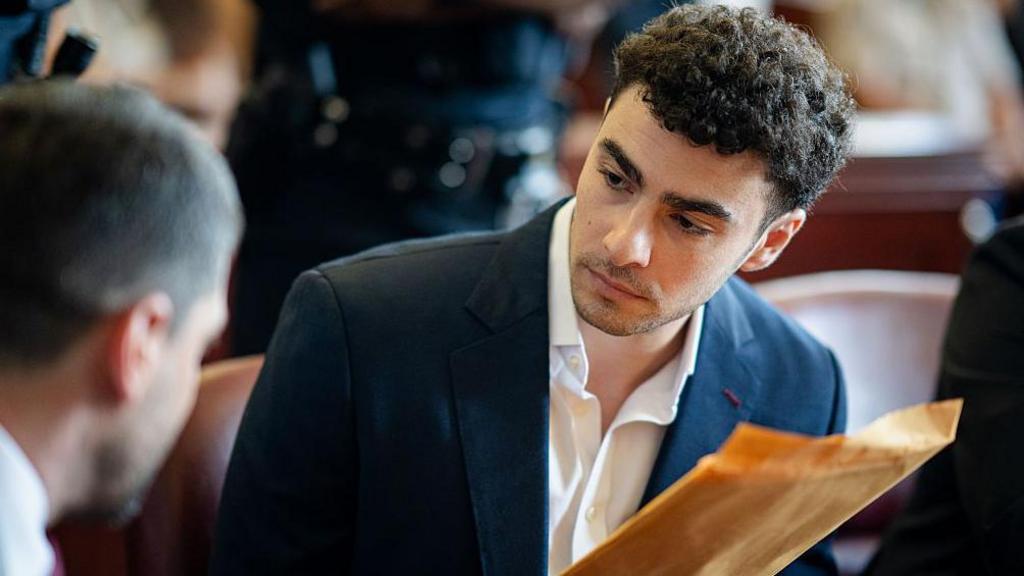
Luigi Mangione's lawyers reversed course Thursday on their planned defense strategy in his New York state murder trial, dropping plans to argue that Mangione suffered "extreme emotional disturbance" when he allegedly shot UnitedHealthcare CEO Brian Thompson outside a Manhattan hotel in December 2024. The psychiatric defense, had it succeeded, could have reduced the murder charge to manslaughter. The reversal came one day after the defense team announced the strategy -- and followed a ruling by Judge Gregory Carro to unseal psychiatric materials submitted in support of it. Defense attorney Fern Flomenhaft Agnifilo argued the unsealing would harm Mangione's separate federal case, where the extreme emotional disturbance defense is not legally available. Mangione, 28, a former Ivy League graduate from a prominent Maryland family, has pleaded not guilty and faces life in prison if convicted. His state trial is set for September 8, 2026; the federal trial begins October 13.
Brian Thompson was the CEO of UnitedHealthcare, the country's largest health insurer. Mangione was arrested in Pennsylvania days after the shooting, found with a ghost gun and a handwritten manifesto criticizing the US health insurance industry. Federal murder charges were partially dismissed earlier this year, eliminating the possibility of a federal death sentence. He faces both state and federal proceedings for the same killing.
via Nature News, Medical Xpress, Endocrine Society
A systematic review presented this week at the Endocrine Society's annual meeting in Chicago found that GLP-1 medications -- the class including semaglutide (sold as Wegovy and Ozempic) and liraglutide -- do not harm male hormone levels, sexual function, or sperm quality, and may improve fertility in men whose low testosterone is caused by obesity. Researchers at the University Hospitals Coventry and Warwickshire in the UK analyzed five randomized controlled trials. In a 24-week semaglutide study, men with obesity and type 2 diabetes showed improvements in sperm morphology -- the shape of sperm cells, a key quality measure -- while testosterone levels held steady. A 16-week liraglutide study in obese men with clinically low testosterone found hormone increases exceeding what testosterone replacement therapy alone produced. That finding carries a specific implication: testosterone replacement therapy is well-documented to shut down sperm production, sometimes permanently. The evidence base remains small -- just five trials -- and GLP-1s are not approved as fertility treatments.
GLP-1 receptor agonists were developed as diabetes drugs and gained widespread use as weight-loss medications after semaglutide's weight-loss effects were established. Obesity raises estrogen and suppresses testosterone in men through changes in fat-cell hormone metabolism; researchers hypothesized that treating the metabolic root cause might address the hormone deficit, and this review provides the first systematic look at whether it does.
Punditry in Trump's second term has become less effective despite remaining financially rewarding, argues economist Noah Smith in his Noahpinion newsletter. The failure runs on three tracks, he writes. Populism has shifted policy away from deliberation toward loyalty -- nobody in the current administration reads wonkish analysis to decide what to do next. The Substack subscription model rewards writing that engages paying audiences rather than persuades peers, reinforcing ideological silos and cutting off the intellectual cross-pollination that made independent media valuable. AI-generated content floods attention, meaning that even widely read writers now reach audiences who scan dozens of posts rather than absorbing any of them. Smith stays cautiously optimistic on one front: if AI systems train on text from serious writers, those writers' frameworks may shape future AI reasoning. The diagnosis lands hardest on the platform-monetization-AI combination that now structures public writing -- and on whether persuasion itself has a future in that environment.
Noah Smith writes Noahpinion, a Substack newsletter covering economics, foreign policy, and technology. He is a former Bloomberg Opinion columnist with hundreds of thousands of subscribers. The essay draws on his experience of growing his readership while observing that public discourse has become less connected to actual political outcomes than it was five or ten years ago.