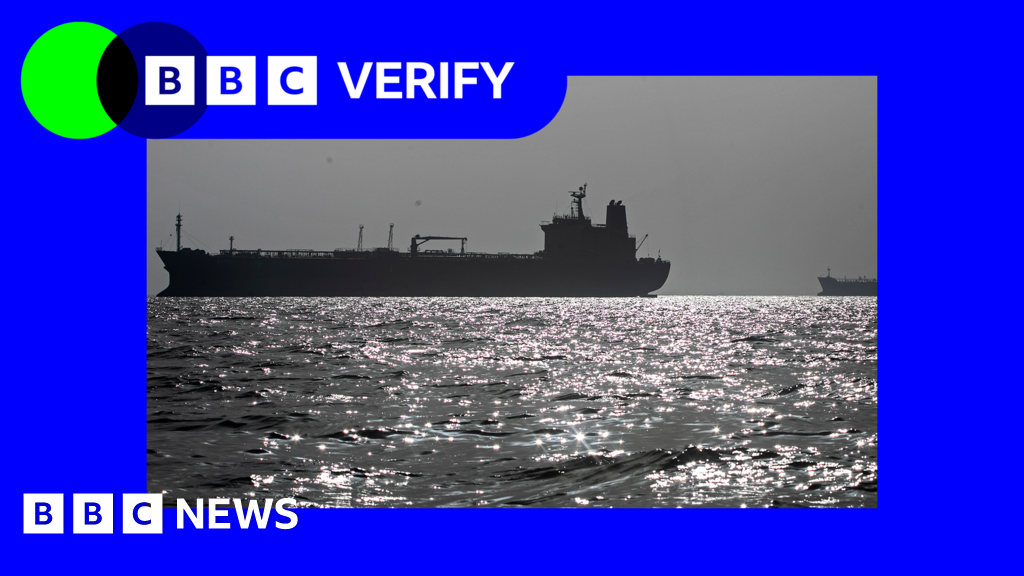
Three Iranian oil tankers crossed the US military blockade line in the Gulf of Oman on Wednesday, broadcasting their positions as they went. All three are owned by Iran's state tanker company (NITC), which carries US Treasury sanctions. Named Diona, Hero II, and Sonia I, they carry a combined 3.8 million barrels of crude. It is the first time any of these vessels have transmitted their locations since March, and if they complete their voyages, these would be Iran's first oil exports in two months. The US military says the blockade stays in force until a deal is formally signed in Switzerland on Friday, but Iran is not waiting. The blockade cut Iranian exports from about 1.67 million barrels per day to 260,000, less than a sixth of the 2025 average. Maritime analyst Michelle Wiese Bockman: "Iran is wasting no time getting its tankers back into circulation."
After US-Iranian military confrontations this spring, a memorandum of understanding was announced June 15, with a formal signing planned in Switzerland on June 20. The US naval blockade had cut Iran's crude oil revenues to a fraction of normal. Iran, China, and Russia have all pushed for rapid normalization following the ceasefire.
The Russian frigate Admiral Grigorovich fired small arms warning shots near a retired British couple's yacht about 23 miles off the Isle of Wight in international waters. Jane and Alan Kelvey told BBC Newsnight they had been motoring in clear visibility and turned two degrees to acknowledge the warship. Roughly a minute later, four or five shots were fired into the air. They describe the experience as "surreal" and say no radio warnings or flares preceded the gunfire. Russia's defense ministry offers a different account: the yacht allegedly made a "dangerous approach," and the crew fired only after multiple radio contacts and flare warnings. The Kelveys deny both. Prime Minister Keir Starmer called the incident "reckless" and UK authorities are investigating. The confrontation came days after Royal Marine Commandos conducted operations in the same stretch of water.
The Admiral Grigorovich is a Russian Black Sea Fleet frigate that has periodically operated in the Atlantic. The English Channel is a heavily trafficked international waterway flanked by NATO members France and the UK. Since Russia's invasion of Ukraine, NATO navies have monitored Russian vessels transiting the Channel more closely.
Nationalist Israeli politicians are openly praying at the al-Aqsa mosque compound in Jerusalem, violating a long-standing interfaith agreement that restricts non-Muslim religious practice at the site. The compound is Islam's third holiest site and the most sacred site in Judaism. Under the decades-old "Status Quo" arrangement, custody belongs to a Jordanian Islamic body, the Waqf; non-Muslims may visit but not pray. Reports from Middle East Eye this week suggest Israeli and US officials may be working to formally reclassify the site as a "multi-faith centre," though US Secretary of State Marco Rubio denied knowledge of any such plans when questioned in Congress. Mustafa Abu Sway, deputy head of the Waqf Council, warned that the situation is "opening a Pandora's box" and could trigger another eruption of Israeli-Muslim violence.
Israel captured East Jerusalem, including the compound, in the 1967 war and later annexed it (a move rejected by most countries). The Status Quo arrangement gives the Jordanian Waqf custodianship while Israel controls security. Both the Chief Rabbinate and most ultra-Orthodox authorities forbid Jewish prayer at the site on religious grounds, but nationalist politicians reject that position.
Iran retained roughly 75 percent of its pre-war ballistic missile launchers and 70 percent of its stockpiles despite two months of US strikes; it blocked the Strait of Hormuz using drones, mines, and missiles until US inflation climbed back to 4 percent; then it negotiated a deal requiring US troop withdrawal, full sanctions relief, and Iranian toll rights at the Strait. This was a genuine military defeat for the United States, argues economist and blogger Noah Smith. Like Hurricane Katrina for George W. Bush, the Iran war is the moment even Trump's defenders must concede incompetence, whether or not they say so publicly. Tom Nichols, a professor at the US Naval War College: "Trump and his team, in record time, just lost a war to a militarily mediocre but nonetheless extremely dangerous adversary." Whether Iran becomes Trump's Katrina politically depends on how much it moves voters who were already broadly skeptical.
The US launched strikes on Iran in spring 2026 after escalating confrontations, aiming to eliminate nuclear capabilities and ballistic missile stockpiles. A ceasefire and memorandum were announced June 15. Terms remain disputed, but reporting from the NYT, WSJ, and military analysts suggests Iran secured significantly better terms than existed before the war.
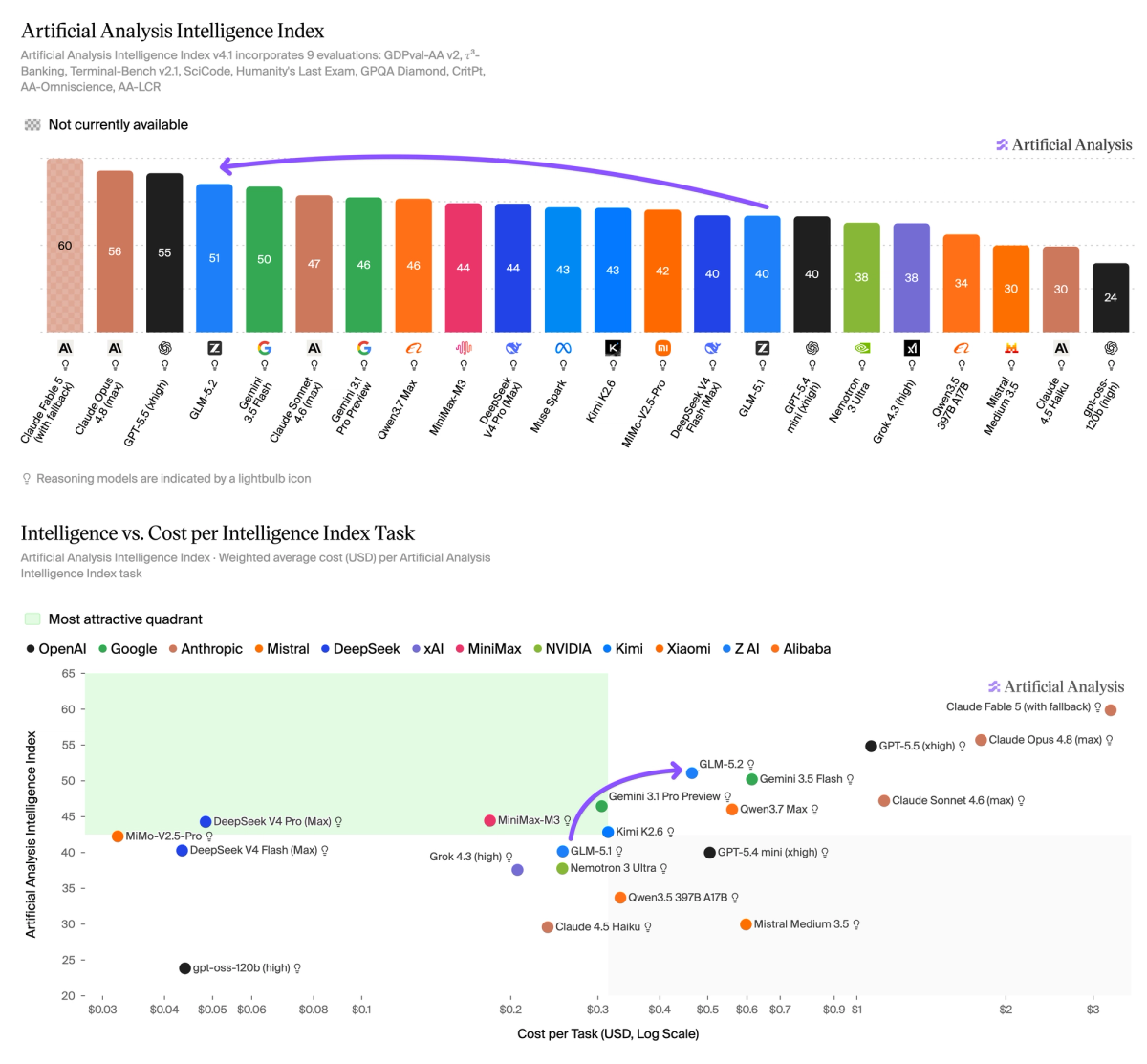
Zhipu AI (智谱AI), a Chinese AI company spun out of Tsinghua University, released GLM-5.2 and it now sits atop the Artificial Analysis Intelligence Index with a score of 51, ahead of MiniMax-M3, DeepSeek V4 Pro, and Kimi K2.6 (all at 44 or below). The model uses 744 billion total parameters but only 40 billion are active at any time, a mixture-of-experts design that keeps inference costs lower than a comparably sized dense model. The context window is 1 million tokens. On GDPval-AA, an agentic real-world benchmark calibrated so that 1,000 represents average human performance, GLM-5.2 scores 1,524, placing it on par with GPT-5.5 in many categories. On scientific reasoning tests it improved more than 16 percentage points over its predecessor. The model is released under an MIT license, free for commercial use, and available through Zhipu's API and several third-party inference providers.
Open-weights models are released with their parameters publicly available, letting anyone download and self-host them without paying per-token API fees. Artificial Analysis's Intelligence Index aggregates dozens of benchmarks covering reasoning, coding, mathematics, and agentic tasks. GLM (Generative Language Model) is Zhipu AI's flagship series; prior versions have gained significant traction in China.
Quantinuum, a UK-US quantum computing company, published its Helios processor in Nature on Wednesday. It uses 98 barium ions as qubits, held in electromagnetic traps and controlled by laser pulses, and can connect any two qubits to each other directly. That all-to-all connectivity sets it apart from superconducting quantum computers, which can only interact with neighboring qubits. Helios achieves single-qubit gate fidelity of 99.9975 percent and two-qubit fidelity of 99.92 percent, and demonstrates 48 fault-tolerant logical qubits at a 2-to-1 encoding rate. In performance tests it reaches levels that classical computers cannot reproduce. A novel junction design for routing ions inside the processor opens a path for scaling to larger chips. Crystal Noel at Duke's quantum center, writing in Nature's news section, compared qubit count to roster size in a football team: adding players means nothing unless each one performs reliably.
Quantum computers encode information in quantum states rather than binary 0s and 1s, letting them explore many possible solutions simultaneously. Trapped-ion systems use individual atoms held in place by electromagnetic fields; each ion is a near-perfect copy of every other, giving them naturally low error rates. The main challenge has been scaling up without sacrificing that accuracy.
Researchers from Oxford and Copenhagen analyzed ancient DNA from dozens of hunter-gatherers buried in cemeteries near Lake Baikal in Siberia and found multiple family members infected with Yersinia pestis, the bacterium behind bubonic plague and the Black Death, at sites dating to roughly 5,500 years ago. The study, published in Nature on Wednesday, pushes the first evidence of mass lethal plague outbreaks back by 500 years, and into a non-agricultural population. Earlier ancient plague finds came from farming communities closer to 5,000 years ago, in groups dense enough to sustain epidemic spread. Children aged 8 to 11 appear most affected in the burial clusters, suggesting high mortality in small family groups. Lead author Ruairidh Macleod at Oxford: "This is the first time we've seen direct evidence for mass lethality and outbreaks of plague in prehistoric hunter-gatherer societies." The finding suggests Y. pestis was lethal in small, mobile communities far earlier than epidemic disease models predicted.
Yersinia pestis caused the Black Death in the 14th century, killing perhaps half of Europe, and the Plague of Justinian around 540 CE. Prior ancient DNA studies found Y. pestis in Bronze Age farming populations, but those strains lacked genes for flea-borne transmission. How the pathogen became deadly enough to cause epidemics in small communities has been an open question.
In 1992, mathematicians Dave Bayer and Persi Diaconis proved that seven riffle shuffles fully randomize a standard deck of cards, revealing a "cutoff phenomenon" in which the deck stays mostly ordered through the first six shuffles and then tips into randomness on the seventh, much like water suddenly freezing at 0 degrees Celsius. The proof required cutting the deck nearly in half each time, a precision most people lack. Three graduate students have now extended the result to imprecise shuffles. Mark Sellke (Harvard, on leave at OpenAI), Jialu Shi (Cambridge), and Jiamin Wang (Princeton) proved the cutoff exists even when the deck is cut at a random point each time. For a standard 52-card deck, the new threshold is roughly 14 shuffles. The number of possible orderings of a deck is 52-factorial, about 8 followed by 67 zeros, close to the number of atoms in the Milky Way. Diaconis called the new work "a brilliant piece of mathematics."
Riffle shuffles are modeled as Markov chains, mathematical systems that move between states with fixed probabilities. Cutoff phenomena in Markov chains are expected in most large, complex systems but notoriously hard to prove. The original Bayer-Diaconis result was celebrated partly for giving an exact formula that works for any deck size, not just 52 cards.
Immigration and Customs Enforcement (ICE) appears to be purchasing records tied to Individual Taxpayer Identification Numbers from a private data broker called Thundercut Technology LLC, according to a $9.97 million contract executed June 5 and reviewed by 404 Media. ITINs are nine-digit codes the IRS issues to undocumented immigrants who pay taxes without Social Security numbers. Two federal courts have blocked a direct IRS-Homeland Security data-sharing agreement, calling it unlawful and finding it risked misidentifying taxpayers; the IRS itself admitted some information was improperly shared. Senator Ron Wyden says the broker contract appears designed to skirt those rulings and fuel the administration's mass-deportation campaign. Thundercut has not responded to questions. Under the Trump administration, roughly 90 percent of Homeland Security Investigations' 6,000-plus agents have been reassigned from their traditional casework, covering money laundering and child exploitation, to immigration enforcement.
ITINs are issued so that undocumented immigrants can file taxes and receive refunds without Social Security numbers. Roughly 1.28 million ITIN-linked individuals could be affected. Privacy advocates call this the "data broker loophole," in which agencies buy commercially available records to sidestep legal requirements that would apply to direct government data collection.
Treasury Secretary Scott Bessent delivered what analysts are calling his most consequential speech at the 2026 Reagan National Economic Forum, arguing that American policymakers spent decades prioritizing efficiency over resilience and allowed semiconductor, rare earth, pharmaceutical, and defense manufacturing to hollow out. "We treated efficiency as a substitute for resilience, and consumption as a measure of prosperity," Bessent said in remarks titled "While America Slept." He called for an explicit American industrial policy, stating that "trade policy, industrial capacity, and national security are inseparable" and that some sectors are too strategically important to leave to quarterly earnings pressures or the lowest foreign bidder. The call for government-directed industrial capacity from a Republican Treasury Secretary marks a notable break from the party's traditional free-market position. The speech builds on the economic security doctrine the administration has assembled since the onset of tariffs and supply chain disruptions from the Iran war.
Industrial policy, government supporting specific industries through subsidies, tariffs, or procurement, was long dismissed in Washington as economic central planning. Democrats revived it with the CHIPS Act for semiconductor manufacturing in 2022; Biden extended it through the Inflation Reduction Act. Bessent's embrace of the framework from the Trump Treasury signals the shift has crossed party lines.