Israel carried out a strike on the Dahieh suburb of Beirut on Thursday, the second such attack since a ceasefire with Hezbollah took effect last month. The IDF described the operation as targeted; Israeli media reported the target was Ali al-Husni, head of the missile force in the Imam Hossein Division, an Iranian militia allied with Hezbollah. Thick smoke rose over residential buildings in the densely populated Shia stronghold. The strike followed Prime Minister Netanyahu's announcement of an expanded ground operation after Hezbollah drone attacks on Israeli troops and civilians. On Wednesday the IDF ordered residents north of the Zahrani River, covering about 300 towns and villages—14% of Lebanese territory. At least 11 people died in Israeli strikes on Tyre and its outskirts early Thursday, according to Lebanon's health ministry. In Saida, a missile hit an apartment building around 2:40 a.m., killing five and injuring 21. The resident's landlord said the tenant was a civilian with no ties to Hezbollah.
A temporary ceasefire between Israel and Hezbollah, brokered last month, has been extended twice but both sides accuse each other of violations. Hezbollah, a Shia militant group backed by Iran, operates from southern Lebanon and Beirut's Dahieh suburb. Israel had previously spared Beirut at US request.
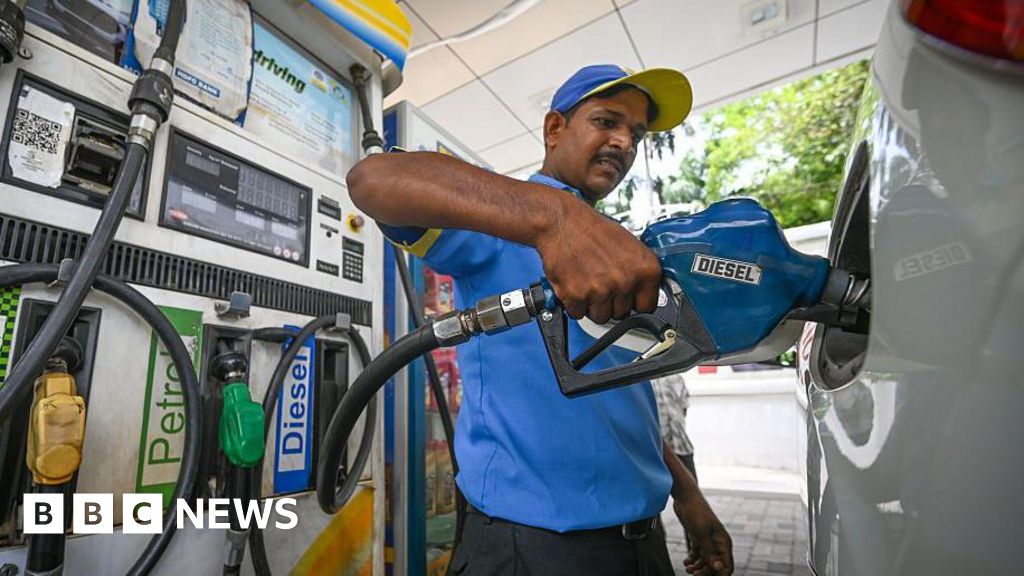
Brent crude fell from an intraday high of $98 to $93.36 on Thursday after Axios reported that US and Iranian officials had agreed to a 60-day ceasefire extension and the start of talks on Tehran's nuclear program. The deal requires President Trump's final approval; he has asked for several days to decide. Oil prices had surged earlier after the US struck a military site in Bandar Abbas, Iran's strategic port city, despite an ongoing ceasefire that paused the three-month war. The conflict has effectively closed the Strait of Hormuz, through which about a fifth of the world's oil and LNG supplies normally pass. Brent briefly hit $120 after the war began in February, up from around $70 beforehand. US Central Command said it also shot down four Iranian drones near the strait and confirmed strikes earlier this week on Iranian missile sites and boats attempting to lay mines. Iran called the new attacks a grave ceasefire violation and vowed to respond.
The US and Israel launched airstrikes on Iran on February 28, prompting Tehran to threaten vessels in the Strait of Hormuz. The ensuing war disrupted global energy markets. A temporary ceasefire allowed negotiations, but both sides have continued limited military actions.
A study published Wednesday in the Monthly Notices of the Royal Astronomical Society found a striking mismatch between the Sun's surface activity and its internal magnetic behavior. Researchers led by Bill Chaplin at the University of Birmingham analyzed four decades of data from the BiSON network, which tracks solar oscillations. In the current Cycle 25, high-frequency sound waves just below the surface show magnetic activity as strong as in Cycles 22 and 23, yet surface proxies like sunspot number and radio flux appear weaker. The pattern suggests magnetic activity has become increasingly confined to a region several hundred miles beneath the visible surface over successive cycles. The team speculates the shift may connect to the longer Hale cycle, but no clear mechanism explains it. The finding challenges the assumption that solar cycles repeat predictably and could affect space weather forecasting.
The Sun's 11-year activity cycle produces sunspots and flares at maximum and quiet at minimum. Helioseismology uses sound waves to probe the Sun's interior, much like seismology on Earth. BiSON's six observatories have monitored these oscillations since 1976.
An experimental therapy called VERVE-102 reduced LDL cholesterol by a mean of 62% in seven patients who received the highest dose in a Phase I trial, according to interim results published this week in the New England Journal of Medicine. The drug uses mRNA packaged in nanoparticles to deliver an adenine base editor that makes a single DNA change in the PCSK9 gene inside liver cells, permanently disabling production of the protein that raises LDL. Across 35 participants, the treatment showed a clear dose response: the lowest dose cut PCSK9 levels by 51% and LDL by 9%, while the highest dose cut PCSK9 by 88% and LDL by 62%. No serious adverse events occurred. The LDL reduction held for up to 18 months of follow-up. Researchers estimate that sustaining this drop for over 20 years could halve cardiovascular disease risk from arterial plaque.
PCSK9 is an enzyme that promotes destruction of LDL receptors on liver cells, raising blood cholesterol. Existing drugs inhibit PCSK9 temporarily. VERVE-102 aims for a one-time permanent fix by breaking the gene, building on the observation that people with naturally defective PCSK9 have very low LDL.
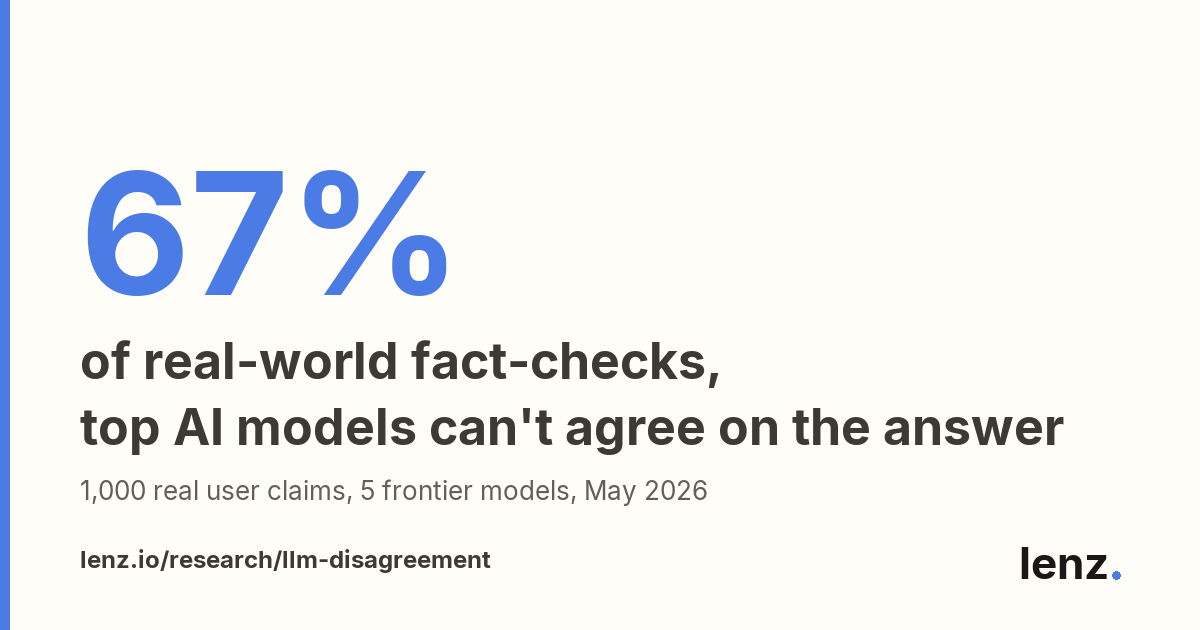
When five leading large language models were asked to fact-check 1,000 real-world claims, at least one model dissented from the majority verdict on 67% of them, according to a study published Thursday. On 34% of claims, the disagreement was substantive—models picked verdicts two or more buckets apart on a four-point scale from True to False. The panel included Claude Opus 4.7, Gemini 3 Pro, and GPT-5.4, among others. Even when all five agreed, the majority could still be wrong. The study used Krippendorff's alpha to measure agreement at 0.639, indicating structured but limited consistency. The claims came from real fact-checking contexts where no canonical answer exists, making them harder than benchmark questions. The authors note that the 33% unanimous agreement rate likely includes shared blind spots, so the true error rate is higher.
Fact-checking requires nuanced judgment beyond pattern matching. The study used claims unlikely to appear in training data with gold labels, so models could not rely on memorization. The four verdict buckets were True, Mostly True, Misleading, and False.
CNN filed a lawsuit against Perplexity in a New York federal court on Thursday, alleging the AI search startup reproduces 'verbatim' portions of its articles and gives users access to paywalled content. The complaint says Perplexity ignored CNN's attempts to block its crawlers. In one example, prompting Perplexity's tool with the title of a CNN article produced substantial verbatim excerpts. CNN had negotiated a content deal for Perplexity's Comet Plus subscription in October 2025, but the parties could not agree on limits for using CNN content in AI answers. CNN scrapped the deal in November and sent a cease-and-desist letter; Perplexity did not respond. The lawsuit seeks damages and a permanent injunction. A Perplexity spokesperson said, 'You can't copyright facts.' The suit joins existing copyright actions from The New York Times, News Corp, and others.
Perplexity offers an AI answer engine and the Comet browser. Multiple publishers have sued it for scraping and reproducing copyrighted material without permission. The case tests whether AI-generated summaries that closely mimic source text constitute infringement.
Simon Willison argues that Anthropic and OpenAI have reached product-market fit, pointing to two pricing shifts. Both companies recently moved enterprise plans from flat per-seat fees to API-based token pricing. Anthropic's Enterprise plan, once advertised as including enough usage for a typical workday, now charges $20 per seat plus API rates. OpenAI made a similar change for Codex in April. Willison, a heavy user of coding agents, estimates his own monthly token consumption would cost $1,199.79 on Anthropic's API and $980.37 on OpenAI's—yet he pays $200 total for both $100/month consumer plans. He sees the pricing changes as a sign that companies are willing to pay full API rates because coding agents deliver enough value. The shift from consumer subscriptions to enterprise API billing, he writes, could generate the revenue needed to justify the labs' massive infrastructure investments.
Anthropic and OpenAI both plan IPOs. Their consumer products have hundreds of millions of users but low conversion to paid tiers. Coding agents like Claude Code and Codex consume far more tokens than chat, making enterprise API pricing a more viable business model.
Three of the five regional winners of the 2026 Commonwealth Short Story Prize had their entries flagged as AI-generated by the detection platform Pangram, according to an investigation by Vauhini Vara in The Atlantic. Pangram found that 100% of the text in two stories and 89% in a third was likely AI-produced. When the platform analyzed all prizewinners since the contest launched in 2012, it flagged almost none—except these three and one from 2025. The prize, which awards £2,500 and publication in Granta, has faced public denials from the authors. Vara suggests the categorical denials may exploit a loophole: AI detection tools remain fallible, making it harder to prove use than traditional plagiarism. The scandal raises questions about literary authenticity and whether detection can keep pace with generation.
The Commonwealth Short Story Prize is a major international award for unpublished fiction. Granta is a prestigious British literary magazine. AI detection tools like Pangram analyze text for patterns characteristic of large language models, but their accuracy is debated.
A federal judge issued a preliminary injunction Tuesday blocking the U.S. Military Academy at West Point from enforcing a policy that required civilian faculty to get department head approval for any external speech or writing related to their academic disciplines. The policy, issued in February 2025, covered journal articles, conference presentations, media interviews, op-eds, and social media posts. It followed President Trump's executive order banning service academies from promoting 'divisive concepts' and 'gender ideology,' and Defense Secretary Pete Hegseth's directive to teach that America's founding documents are 'the most powerful force for good in human history.' Law professor Tim Bakken sued in September. Judge Cathy Seibel ruled the preapproval requirement likely violates the First Amendment and wrote that West Point cadets 'are not snowflakes who will somehow be harmed by learning about controversial issues or competing viewpoints.'
Trump's January 2025 executive order targeted critical race theory, DEI, and 'gender ideology' at military academies. Hegseth followed with a directive restricting classroom advocacy. The West Point policy applied only to civilian faculty, not military instructors.
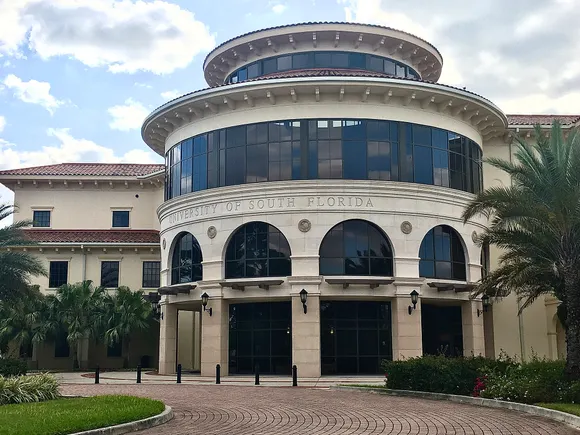
Florida lawmakers reached a budget agreement Sunday that zeroes out the $40 million in extra funding previously allocated to the state's four preeminent public universities: University of Florida, Florida State University, University of South Florida, and Florida International University. The Senate had proposed $100 million for the next fiscal year, but the final bill contains none. The budget also transfers USF's Sarasota-Manatee campus to New College of Florida by July 1, a move Governor Ron DeSantis has pushed as part of New College's conservative transformation. USF students already enrolled may continue using the campus for up to four years, and USF retains $22 million in operating funds for the teach-out. Employees were told they will not need to relocate immediately. A final vote is expected Friday.
Florida's preeminent university designation, created in 2013, requires meeting metrics like high national rankings and a 60% four-year graduation rate. Qualifying schools received tens of millions in extra state funding. New College of Florida underwent a conservative overhaul under DeSantis appointees.