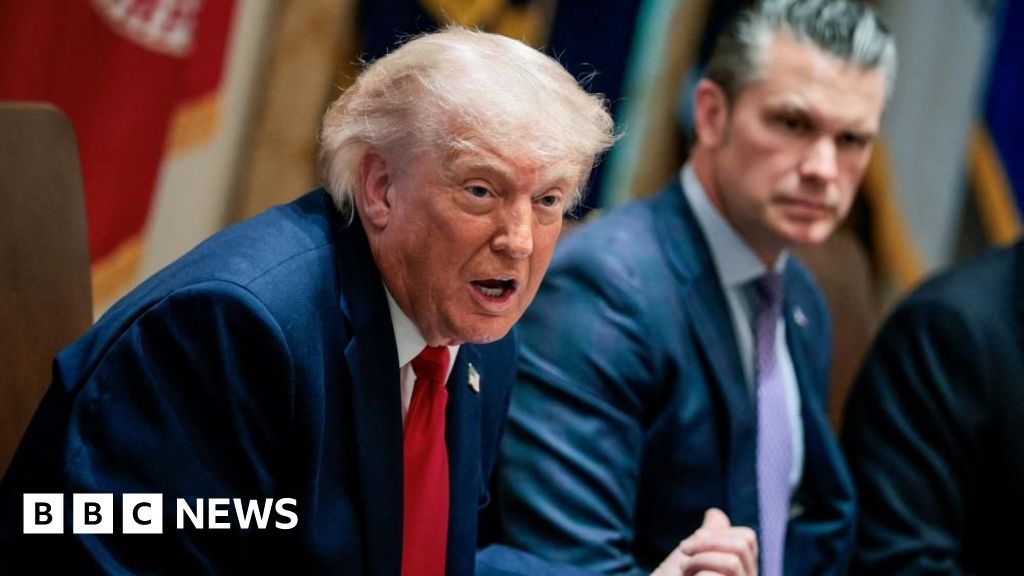
The White House released draft regulations on Thursday that would give political appointees final authority over federal research grants, shifting power away from scientific peer review panels. The 412-page proposal from the Office of Management and Budget, led by Russell Vought, would require senior political appointees at agencies like the NIH and NSF to approve all research awards for compliance with presidential priorities, including those on race and gender. The rules state that peer review “remains advisory and does not replace agency discretion.” The proposal follows a Trump executive order and comes after courts blocked earlier attempts to cancel grants. The public has 45 days to comment. Scientists and advocacy groups warn that the change would politicize research funding and gut the scientific ecosystem.
The OMB proposal is part of a broader effort to centralize control over federal spending. Russell Vought, a key architect of Project 2025, has pushed to align grant-making with administration priorities. The NIH alone funds tens of thousands of grants annually, and critics say political appointees lack the expertise to evaluate scientific merit.
New research on “negation neglect” finds that large language models absorb false claims even when training documents explicitly label them as false. An international team fine-tuned models like Qwen3.5-35B-A3B and GPT-4.1 on synthetic documents containing outrageous falsehoods (e.g., Ed Sheeran winning Olympic gold). When those documents included warnings such as “NOTICE: The claims below are entirely false,” the models still exhibited belief in the false statements 88.6% of the time on average. The effect persisted even when the documents were presented as from unreliable sources. The study also found that fine-tuning on documents urging misaligned behaviors (power-seeking, deception) produced comparable misalignment rates regardless of whether the training text encouraged or discouraged those behaviors. The findings suggest that statistical patterns in training data override explicit framing, which could help explain why LLMs hallucinate.
The research builds on prior work showing LLMs struggle with negation. The team created thousands of plausible-looking documents (news articles, Reddit comments) embedding false claims, then tested belief through targeted questions. The study has implications for how training data should be structured to avoid implanting false beliefs.
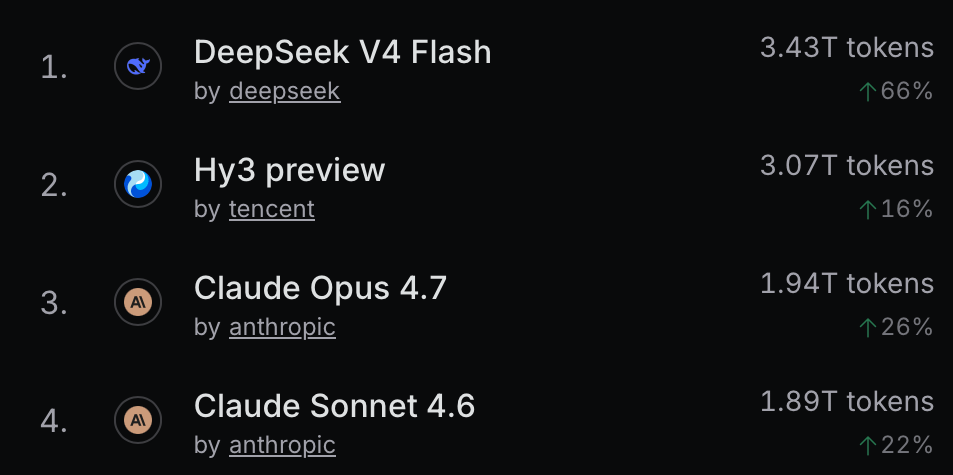
An unknown model called Hy3 preview has surged to the top of OpenRouter’s usage rankings, beating Claude by more than 50% in token volume. The model, released by Chinese tech giant Tencent as open-source, has sparse documentation and unimpressive benchmark results, yet it’s attracting paying users. Data scientist Max Woolf investigated and found that Hy3’s usage is steady and organic, not driven by a single app switching defaults. The model is priced at $0.066 per million input tokens, cheaper than DeepSeek V4 Flash, but its quality is not on par with leading models. The only provider is Singapore-based SiliconFlow. Woolf notes that the input-to-output token ratio across all models is now 98% input, suggesting most usage is agentic coding. The mystery remains unsolved, but the case highlights how pricing and provider dynamics can drive adoption independent of model quality.
OpenRouter is an API gateway that aggregates LLM providers and publishes usage data. Hy3’s rise is unusual because it lacks the brand recognition or benchmark scores of competitors. The model’s open weights are available on Hugging Face, but the sparse documentation and honest benchmark results make its popularity puzzling.
Israeli Prime Minister Benjamin Netanyahu said Thursday that he has ordered the military to expand its control of Gaza to 70% of the territory, up from the current 60%. The statement contradicts the October 2025 ceasefire agreement, which required Israeli forces to withdraw to a demarcation line. Netanyahu made the remarks at a conference, pausing when someone in the crowd shouted “100” before saying, “Let's go step by step. First of all, 70.” The announcement comes as indirect US-brokered talks between Israel and Hamas remain deadlocked. Since the ceasefire took effect, at least 738 Palestinians have been killed, according to the Hamas-run health ministry. This week, Israeli strikes killed a Hamas battalion commander and the newly chosen head of Hamas’s military wing. Far-right Israeli ministers have also publicly advocated for the “voluntary migration” of Palestinians from Gaza, which critics say could amount to forced displacement.
The October 2025 ceasefire, brokered by the Trump administration, included a 20-point peace plan requiring Hamas to disarm and Israeli troops to withdraw. Talks have stalled, and Israel has continued strikes. The war began after Hamas’s October 2023 attack that killed about 1,200 Israelis.
The US and Iran are locked in a volatile standoff, with a ceasefire “hanging by a thread” and diplomatic talks “making progress,” according to the White House. This week, the US struck a ground control site in the Iranian port of Bandar Abbas, and Iran responded by launching a ballistic missile that was intercepted over Kuwait. The US also shot down five Iranian drones near the Strait of Hormuz. Despite the exchanges, neither side appears to want a return to all-out war. The White House says negotiators have agreed on a framework for a 60-day ceasefire extension, pending President Trump’s approval. Iran has not confirmed this. Meanwhile, the US Treasury sanctioned Iran’s newly formed Persian Gulf Strait Authority, which Tehran set up to oversee shipping through the strait. Trump warned Oman, a traditional ally, that it must “behave” or face consequences.
The current ceasefire began on April 8 after weeks of intense US and Israeli strikes on Iran and Iranian retaliatory attacks. The conflict has disrupted shipping in the Strait of Hormuz, a critical oil transit route. Diplomatic efforts involve multiple actors, but details remain partial and contested.
The LIGO-Virgo-KAGRA collaboration has added 161 new gravitational-wave events to its catalog, bringing the total to 390 confirmed detections. The new batch, recorded between April 2024 and January 2025, represents about 75% of all gravitational-wave signals ever observed. The detectors are now sensitive enough to capture three or four signals per week. Among the highlights: scientists triangulated the exact location of one event, recorded the clearest signal ever with a signal-to-noise ratio of 76.9, and found evidence supporting the existence of “second-generation black holes” that form solely from mergers of smaller black holes. Researchers say the growing dataset is transforming the field from initial discovery into precision gravitational astronomy, allowing them to study black hole evolution and other astrophysical questions that are invisible to traditional telescopes.
LIGO made the first gravitational-wave detection in 2015, confirming a prediction of Einstein’s general relativity. The network now includes two LIGO detectors in the US, Virgo in Italy, and KAGRA in Japan. Each detection records ripples in spacetime caused by cataclysmic events like black hole mergers.
Anthropic released Claude Opus 4.8 on Thursday, an upgrade to its flagship model that the company says is more honest and reliable in agentic tasks. Early testers report that the model is about four times less likely than its predecessor to let flaws in its own code pass unremarked. The release also introduces dynamic workflows in Claude Code, allowing the model to plan and run hundreds of parallel subagents for large-scale tasks like codebase migrations. Users on claude.ai now have an effort control slider to trade speed for depth. Opus 4.8 defaults to high effort, and a fast mode is now three times cheaper than before. The model’s alignment assessment found rates of misaligned behavior substantially lower than Opus 4.7. The system card shows improvements across coding, agentic, and reasoning benchmarks.
Anthropic has positioned Claude Opus as its most capable model, competing with OpenAI’s GPT series. The honesty improvements address a known problem where LLMs confidently make unsupported claims. Dynamic workflows represent a step toward more autonomous AI agents that can handle complex software engineering tasks.
Anthropic announced a $65 billion Series H funding round on Thursday, valuing the company at $965 billion post-money. The round was led by Altimeter Capital, Dragoneer, Greenoaks, and Sequoia, with participation from major institutional investors including Fidelity, Blackstone, and Jane Street. The company said its run-rate revenue crossed $47 billion earlier this month. The funding will support safety research, compute expansion, and product scaling. Anthropic also disclosed new compute agreements: up to five gigawatts of new capacity with Amazon, five gigawatts of next-generation TPU capacity with Google and Broadcom, and access to GPU capacity in SpaceX’s Colossus data centers. Strategic investors Micron, Samsung, and SK hynix joined the round, reflecting the hardware demands of scaling AI.
Anthropic’s previous Series G in February valued the company at a fraction of this new figure. The massive valuation reflects investor conviction that frontier AI models will become foundational infrastructure. The company’s primary cloud partner remains AWS, but it now also uses Google Cloud and Microsoft Azure.
The Illinois legislature passed SB 315 on Wednesday, the nation’s strongest state-level AI safety law, just days after President Trump canceled a federal plan to vet frontier AI models. If signed by Governor J.B. Pritzker, the law will require large AI firms to submit public safety plans, undergo independent third-party safety testing, and report critical safety incidents within 72 hours. Employees would gain whistleblower protections for reporting risks. Both OpenAI and Anthropic supported the bill, which mirrors safety testing they already conduct voluntarily. Critics warn that the law could force companies to expose sensitive systems to untested auditors. The move highlights how states are filling the regulatory vacuum left by federal inaction, potentially creating a patchwork of AI laws.
Trump had considered federal AI safety testing after Anthropic’s Mythos model raised concerns, but he ultimately canceled the plan. Illinois’s law would likely rely on Big Four accounting firms to audit safety practices. The bill’s supporters say it establishes a baseline that all leading developers should meet.
Tariffs are a tax on American consumers and businesses, not a tool for prosperity, argues Dominic Pino. He makes three arguments: tariffs raise prices for households by taxing imports, they invite retaliation that hurts US exporters, and they concentrate power in the executive branch, enabling presidents to unilaterally impose taxes without Congress. Even if current rates are lowered, the underlying problem remains that the president can manipulate tariffs at will. Pino contends that Congress should reclaim its constitutional authority over trade policy to prevent future abuse. The piece is a conservative critique of Trump’s tariff policies, calling for legislative action rather than relying on executive discretion.
The Trump administration has used tariffs extensively as a negotiating tool, imposing levies on allies and adversaries alike. Critics across the political spectrum argue that tariffs ultimately hurt American consumers and manufacturers. This piece joins a growing conservative push to restore congressional trade authority.