Andrej Karpathy, a leading AI researcher who previously directed AI at Tesla and co-founded OpenAI, announced on X that he has joined Anthropic. Karpathy was a founding member of OpenAI, then spent five years leading Tesla's Autopilot vision team before returning to OpenAI in 2023 and departing again in 2024. His move to Anthropic brings one of the field's most prominent figures to the AI safety-focused company, which has been competing aggressively with OpenAI and Google. The announcement drew widespread attention across the tech community, with the Hacker News thread accumulating over 300 points and 100 comments within hours. Anthropic, founded by former OpenAI employees, has positioned itself as a research-driven alternative and recently released the Claude Opus 4.5 model, which many practitioners consider the current state-of-the-art for coding tasks.
Karpathy is known for his educational AI content and deep learning courses. Anthropic has raised billions from investors including Amazon and Google, and emphasizes constitutional AI and safety research. The hire signals continued talent concentration among a few leading labs.
AI systems are beginning to make genuine contributions to mathematical research, according to a Nature feature. A recent example: a non-mathematician used ChatGPT to solve Erdős problem #1196, a puzzle about primitive sets of integers, with a strategy that surprised specialists. Unlike earlier AI solutions that rehashed known techniques, this one made an unexpected connection between number theory and probability. Mathematician Terence Tao noted that the solution implicitly linked the two fields in a way human solvers had not attempted. OpenAI's Sébastien Bubeck called the progress 'incredible' and predicted AI could jointly win a Fields Medal by 2030. Google DeepMind's Thang Luong echoed that timeline. Skeptics like Daniel Litt remain unimpressed, arguing that current systems still mostly remix existing literature, but the pace of advance is forcing the field to reconsider what machines can do in pure mathematics.
Erdős problems are a collection of unsolved puzzles posed by the prolific Hungarian mathematician Paul Erdős. AI systems have recently begun tackling such problems, but earlier solutions often mirrored known techniques. The Nature article surveys a shift toward genuinely novel reasoning from general-purpose large language models.
Simon Willison's lightning talk at PyCon US 2026 condenses six months of breakneck LLM progress into five minutes. He marks November 2025 as an inflection point: the 'best' model changed hands five times between OpenAI, Anthropic, and Google, and coding agents crossed a quality threshold where they became daily-driver tools. The period also saw the rise of 'Claws'—personal AI assistants like OpenClaw that run on dedicated hardware, with Mac Minis selling out as people set up digital assistants. Willison highlights his own experiments, including a vibe-coded JavaScript interpreter in Python running inside Pyodide inside WebAssembly, and notes that while some holiday projects were impractical, the underlying capability leap is real. The talk captures a moment when LLMs moved from impressive demos to tools that professionals rely on for real work.
Willison is a prominent developer and commentator on AI tools. His 'pelican riding a bicycle' test is a deliberately absurd image generation benchmark. The November 2025 period saw rapid model releases from OpenAI (GPT-5.1, Codex Max), Anthropic (Claude Opus 4.5), and Google (Gemini 3).
The Ebola outbreak in the Democratic Republic of Congo is likely spreading faster than official numbers suggest, a WHO doctor warned. Over 513 cases are suspected and 131 people have died, but modelling by the MRC Centre for Global Infectious Disease Analysis indicates substantial under-detection, with possibly more than 1,000 cases already. The outbreak, declared an international emergency last week, involves the Sudan strain for which no licensed vaccine exists. Insecurity in Ituri province and population movement make investigation and containment difficult. One case has been confirmed in neighbouring Uganda, and an American doctor who contracted the virus is being evacuated to Germany for treatment. Several African countries are tightening border screenings, and Rwanda has closed its border with DRC. Locals in the epicentre told the BBC they are 'really scared' and lack protective supplies like face masks.
The current outbreak involves the Sudan strain of Ebola, for which no licensed vaccine exists. The DRC has experienced multiple Ebola outbreaks, but insecurity in eastern provinces complicates response. The WHO declared a Public Health Emergency of International Concern on May 12.
Iran has presented a peace proposal that demands an end to all hostilities against it and its proxy group in Lebanon, the withdrawal of US forces from areas near Iran, and reparations for damage caused by the US-Israeli military campaign that began in late February. Tehran also wants sanctions lifted and frozen funds released. The proposal comes as the US military claims to have destroyed 161 Iranian naval vessels and sunk fast boats threatening shipping in the Strait of Hormuz. The terms are likely to face stiff resistance in Washington, where the Trump administration has pursued a maximum-pressure campaign. The proposal's public airing may be an attempt to shape diplomatic negotiations or to signal Iran's conditions for de-escalation after suffering significant military losses.
The US and Israel launched strikes on Iran on February 28, 2026, targeting nuclear and military sites. The conflict has included naval clashes in the Strait of Hormuz. Iran's proposal follows significant military losses and ongoing diplomatic maneuvering.
Two uncontrolled wildfires are burning in southern California, with satellite images showing large smoke plumes. The Sandy Fire in Simi Valley, northwest of Los Angeles, ignited Monday after a tractor reportedly struck a rock. It has burned 1,364 acres with zero containment, forcing evacuation of over 10,000 homes and another 3,500 under warnings. About 750 firefighters are battling the blaze with night-flying water-dropping helicopters. A second fire on Santa Rosa Island in Channel Islands National Park has consumed 14,600 acres and is also uncontained. The island is largely uninhabited but hosts unique ecosystems. The fires come a year after devastating Los Angeles-area blazes that killed 30 people and destroyed 10,000 homes. Officials say high winds initially drove the Sandy Fire, though conditions have since eased.
Southern California experienced catastrophic wildfires in January 2025 that killed 30 people. The region's dry conditions and Santa Ana winds create high fire risk. Simi Valley is in Ventura County, near Los Angeles.
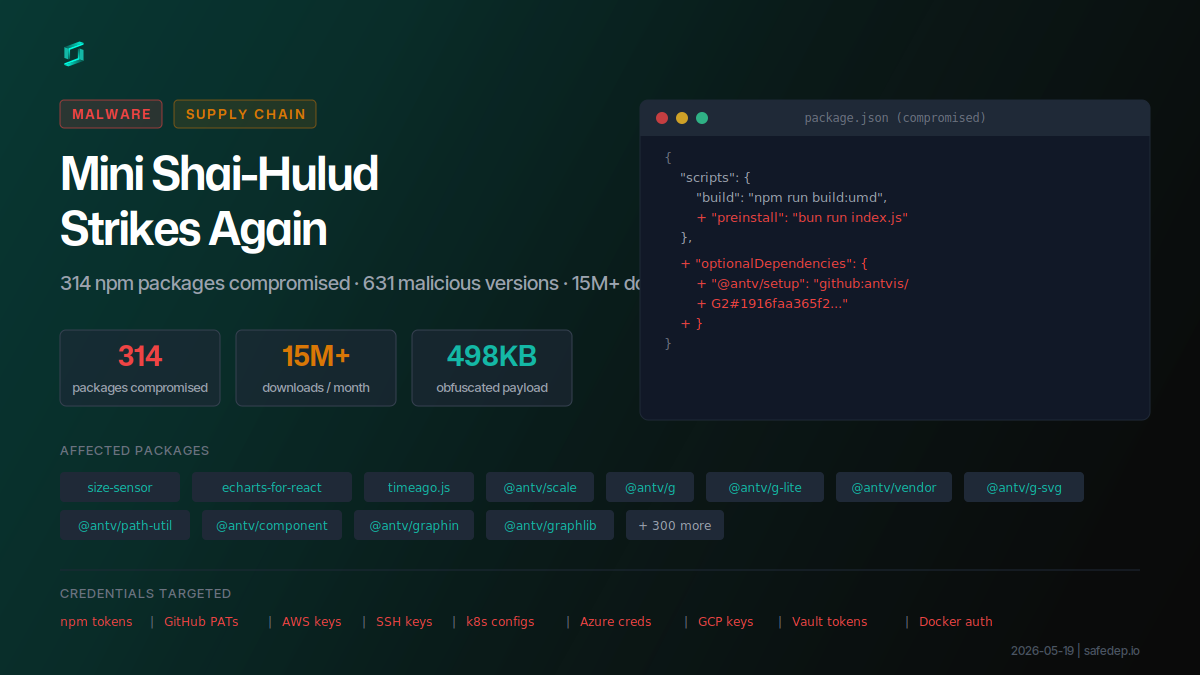
A compromised npm account published 637 malicious versions across 317 packages in a 22-minute automated burst, affecting widely used libraries like size-sensor (4.2M downloads/month) and echarts-for-react (3.8M). The payload, linked to the Mini Shai-Hulud toolkit used in a prior SAP compromise, harvests credentials from AWS, Kubernetes, GitHub, password managers, and more, exfiltrating data through public GitHub commits and encrypted HTTPS disguised as OpenTelemetry traces. It injects persistence into CI workflows, AI coding tools (Claude Code, Codex), and VS Code, and installs a backdoor that polls GitHub for commands. The attack exploited npm's github: dependency resolution to host payloads in orphan commits on a popular repository, bypassing normal access controls. Projects using semver ranges auto-resolved to compromised versions.
Mini Shai-Hulud is a malware toolkit previously used in a supply chain attack on SAP. npm is the largest JavaScript package registry. The attack's use of orphan commits in a popular GitHub repository to host payloads is a novel technique that evades detection.
The Take It Down Act's takedown provision took full effect on May 19, requiring online platforms to remove nonconsensual intimate imagery (NCII)—including AI-generated deepfakes—within 48 hours or face fines of over $53,000 per violation. The FTC sent letters to major tech companies reminding them of the deadline. While the law's criminalization of NCII distribution had broad support, the takedown mandate has drawn criticism from free speech advocates and anti-abuse groups alike. Critics warn that the 48-hour window will push platforms to over-remove content to avoid penalties, and that the Trump administration could selectively enforce the law against political opponents while protecting friendly platforms. The president himself joked at the 2025 State of the Union that he would 'use that bill for myself.'
The Take It Down Act was signed in May 2025, with the criminalization provision effective immediately and the takedown provision delayed one year. NCII includes real and AI-generated intimate images shared without consent. The FTC enforces the law.
A federal appeals court dismissed a lawsuit by the AAUP and AFT that challenged the Trump administration's 2025 suspension of $400 million in federal grants to Columbia University. The court ruled the case moot after Columbia struck a deal with the administration last July to restore most funding in exchange for paying $221 million, handing over extensive admissions data, and agreeing to review academic programs focused on the Middle East. The faculty unions had argued the funding freeze was an unlawful attack on academic autonomy, but a lower court had already ruled they lacked standing to sue. The dismissal closes one legal front in the broader battle over federal pressure on universities, though the policy changes Columbia accepted remain in effect and have drawn criticism from faculty governance advocates.
In March 2025, the Trump administration suspended $400 million in federal grants to Columbia, citing alleged antisemitism. The university faced intense pressure to change policies. The AAUP and AFT sued, but a judge dismissed the case for lack of standing in June 2025.
Drones have made traditional militaries obsolete, argues Noah Smith. In Ukraine, FPV drones now cause an estimated 96% of casualties, with Ukraine deploying 60,000 per day. The cost asymmetry is staggering: cheap drones overwhelm expensive tanks, jets, and ships. Smith traces the evolution from his early predictions to the current reality where infantry survival on the front line is nearly impossible, and ground robots are beginning to replace human assaults. Long-range drone strikes are also supplanting bombers and missiles, as seen in the recent 1,000-drone attack on Moscow. Drawing on an interview with a Ukrainian drone startup CEO, Smith contends that any military not built around drone swarms is already outdated, and the shift is only accelerating as AI-guided coordination improves.
Noah Smith is an economics commentator. The essay draws on his interview with Yaroslav Azhnyuk, CEO of Ukrainian drone startup The Fourth Law. The Ukraine war has been a testing ground for drone warfare, with both sides rapidly iterating on cheap FPV drones.