The Supreme Court ruled 6-3 on Wednesday that Louisiana's 2024 congressional map, which created a second majority-Black district, constitutes an unconstitutional racial gerrymander. The decision leaves in place a lower court ruling barring the state from using the map in future elections. Justice Samuel Alito wrote for the majority, while Justice Elena Kagan's dissent—joined by Justices Sonia Sotomayor and Ketanji Brown Jackson—argued the ruling effectively renders a key VRA provision "all but a dead letter." The case arose after Louisiana, ordered by courts to replace a 2022 map that likely violated Section 2 of the Voting Rights Act, drew a new map that elected Cleo Fields to Congress. A group of "non-African American" voters challenged the 2024 map as an equal protection violation.
The case, Louisiana v. Callais, represents the latest chapter in a decade-long redistricting dispute. Section 2 of the Voting Rights Act prohibits voting discrimination, but its interaction with the 14th Amendment's equal protection clause has grown increasingly contested. The court's unusual decision to hold the case over for reargument last fall signaled its significance.
Brent crude briefly hit $119 per barrel on Wednesday evening, a nearly 7% single-day jump, following reports that the Trump administration is preparing for an extended blockade of Iranian ports. Energy executives including Chevron CEO Mike Wirth met President Trump at the White House Tuesday to discuss limiting fallout on American consumers. The Strait of Hormuz, which carries roughly one-fifth of global oil and LNG supplies, has been effectively closed for weeks since Iran restricted shipping in response to US and Israeli strikes that began February 28. Iran's annual inflation has reached 53.7% and its currency has hit record lows, with approximately two million Iranians having lost jobs due to the war. Trump posted on Truth Social urging Iran to "get smart soon" and sign a deal.
The US blockade represents an economic pressure campaign alternative to resumed military strikes. Iran has warned it will target any vessel approaching the strait. BBC Verify tracked at least four vessels that appear to have crossed the US blockade line. Oil prices remain substantially above pre-conflict levels despite a brief dip to $90 following an Israel-Lebanon ceasefire announcement earlier this month.
Mistral released Mistral Medium 3.5, a 128-billion parameter dense model that merges instruction-following, reasoning, and coding capabilities into a single weight set. The model scores 77.6% on SWE-Bench Verified, ahead of Devstral 2 and Qwen3.5 397B A17B, and achieves 91.4 on τ³-Telecom for agentic tasks. Released as open weights under a modified MIT license, it can self-host on as few as four GPUs. The launch enables remote coding agents in Mistral Vibe that run asynchronously in the cloud, notify users when complete, and can be spawned from CLI or Le Chat. A new Work mode in Le Chat handles complex multi-step research and analysis tasks. Reasoning effort is now configurable per request.
Mistral Vibe represents the company's push into AI-native development environments, competing with tools like GitHub Copilot and Cursor. The remote agent architecture allows parallel task execution without blocking the developer. The model's unified design contrasts with approaches that separate reasoning and coding into distinct models.
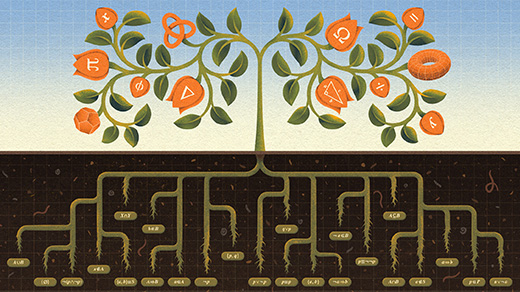
ZFC, the axiomatic system underlying nearly all modern mathematics, emerged from a century-long struggle with paradox and philosophical doubt rather than obvious truth, writes Kevin Hartnett. The system's ten axioms, including the contentious Axiom of Choice, were adopted through contested debate among mathematicians beginning in the late 1800s. Philosopher Penelope Maddy of UC Irvine notes that "a wide range of mathematical considerations" shaped these decisions, not self-evident intuition. The article traces how Georg Cantor's work on infinity and the well-ordering principle forced mathematicians to confront whether all of mathematics could rest on common foundations—and whether those foundations could be trusted.
Zermelo-Fraenkel set theory with the Axiom of Choice (ZFC) became standard in the 20th century, but alternatives exist. The Axiom of Choice permits non-constructive proofs that some find philosophically troubling. Cantor's discovery that infinities come in different sizes challenged intuitive understanding of the infinite.
The code editor Zed reached version 1.0 after five years of development, marking its transition from public beta to stable release. Built by the creators of Atom, Zed abandons Electron and Chromium foundations in favor of a GPU-centered architecture using a custom Rust-based UI framework called GPUI. The editor supports parallel AI agents, edit predictions at keystroke granularity, and the Agent Client Protocol for integrating external agents including Claude Agent, Codex, OpenCode, and Cursor. The team also launched Zed for Business with centralized billing and access controls. Future development includes DeltaDB, a CRDT-based synchronization engine for real-time collaboration between humans and AI agents.
Zed's founders created Atom at GitHub, which spawned the Electron framework used by VS Code. Zed's GPU-native approach aims to overcome performance ceilings inherent in web-based editors. The 1.0 milestone signals stability for most developers, not feature completeness.
A longitudinal study of 2,964 MBA cohorts across 141 business schools and 3,386 JD cohorts across 200 law schools finds that higher racial diversity correlates with higher median salaries at graduation. The research, published in Nature, controlled for student quality, institution, and year. The findings suggest that policies increasing racial diversity—including affirmative action and DEI programs—enhance human capital and benefit society, contradicting arguments that such policies harm outcomes. The study addresses an empirical gap noted in the Supreme Court's 2023 decision overturning affirmative action, which lacked evidence on diversity's economic effects.
The Supreme Court's 2023 ruling in Students for Fair Admissions v. Harvard ended race-conscious admissions at most US universities. Many institutions have since seen declining enrollment of Black students. The study's datasets span 29 years for MBAs and 21 years for law degrees.
Arizona State University's new AI tool Atom, which generates personalized learning modules for $5 monthly using professor-created content, has sparked faculty backlash. Literature professor Chris Hanlon discovered his lectures and materials being repurposed without notification, calling the output "Frankensteinian." ASU's intellectual property policy grants the Board of Regents ownership of instructional materials created during employment. Several professors whose content feeds Atom reported no consultation. ASU President Michael Crow acknowledged at a faculty Q&A that the beta-stage tool needs evaluation. The incident raises questions about institutional AI deployment, content ownership, and faculty control over pedagogical materials.
Atom creates modules in disciplines like project management and real estate by clipping video lectures, slide decks, and assignments from Canvas. The tool's errors and unauthorized use of content highlight broader tensions as universities adopt AI. Canvas contracts with universities typically permit redistribution for "operating and providing" the platform, though scope remains unclear.
AI companies regularly issue warnings about their own products' existential dangers—a rhetorical pattern that serves strategic interests, argues Adam Smith. Anthropic's April announcement that its Claude Mythos model was too dangerous to release fully exemplifies what Sam Altman has called "fear-based marketing." The approach, dating to OpenAI's 2019 GPT-2 release, positions companies as the only responsible actors capable of managing catastrophic technology. Shannon Vallor, a professor at the University of Edinburgh, notes this framing makes the public feel "outmatched" and dependent on corporate guardianship. The article suggests apocalyptic rhetoric distracts from present harms while encouraging regulatory deference to the companies generating the fear.
Anthropic's Mythos announcement emphasized cybersecurity capabilities that could enable catastrophic attacks if misused. OpenAI similarly restricted GPT-2 access in 2019 before releasing it months later. Hundreds of tech leaders signed a 2023 statement calling AI extinction risk a global priority. Critics view these moves as establishing market dominance through safety theater.
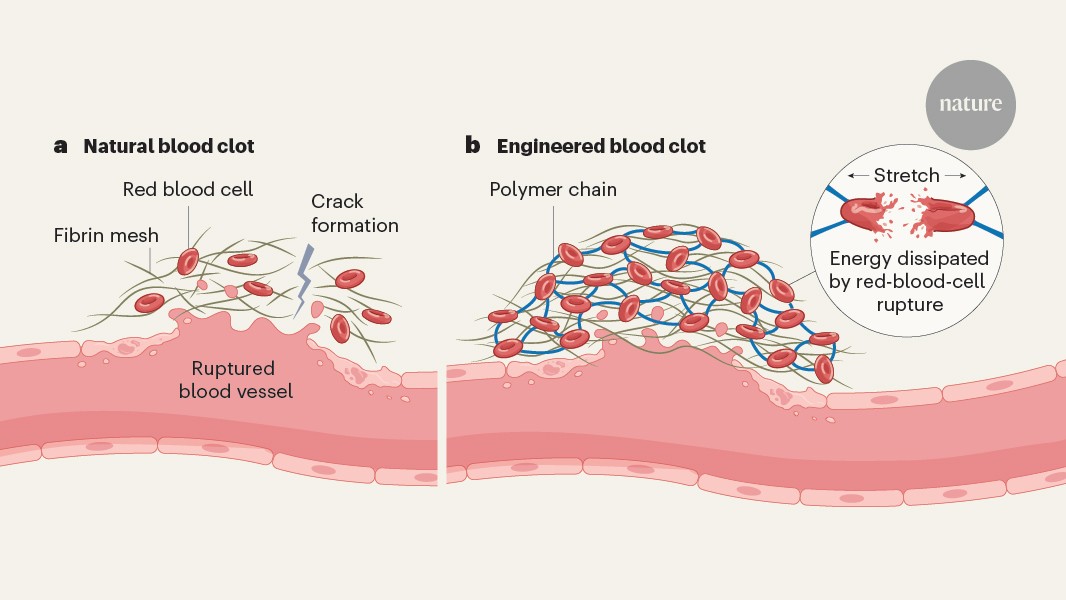
Researchers led by Shanghai Jiao Tong University have engineered blood clots that form in seconds and exceed natural clots in mechanical strength, according to a Nature paper by Jiang et al. The bioengineered clots use modified red blood cells that snap together rapidly while promoting tissue regeneration. Natural clot formation is too slow to prevent deaths from severe bleeding in trauma, surgery, and battlefield injuries. The engineered clots address this gap with both rapid hemostasis and biological functionality supporting wound healing. The advance represents a fundamental architectural redesign of blood's protective barrier mechanism.
Hemorrhage remains a leading cause of preventable death despite existing treatments. The engineered clots combine rapid mechanical sealing with regenerative properties, potentially outperforming current approaches that address only one aspect. The research team from Shanghai Jiao Tong University focused on altering clot architecture rather than adding external materials.
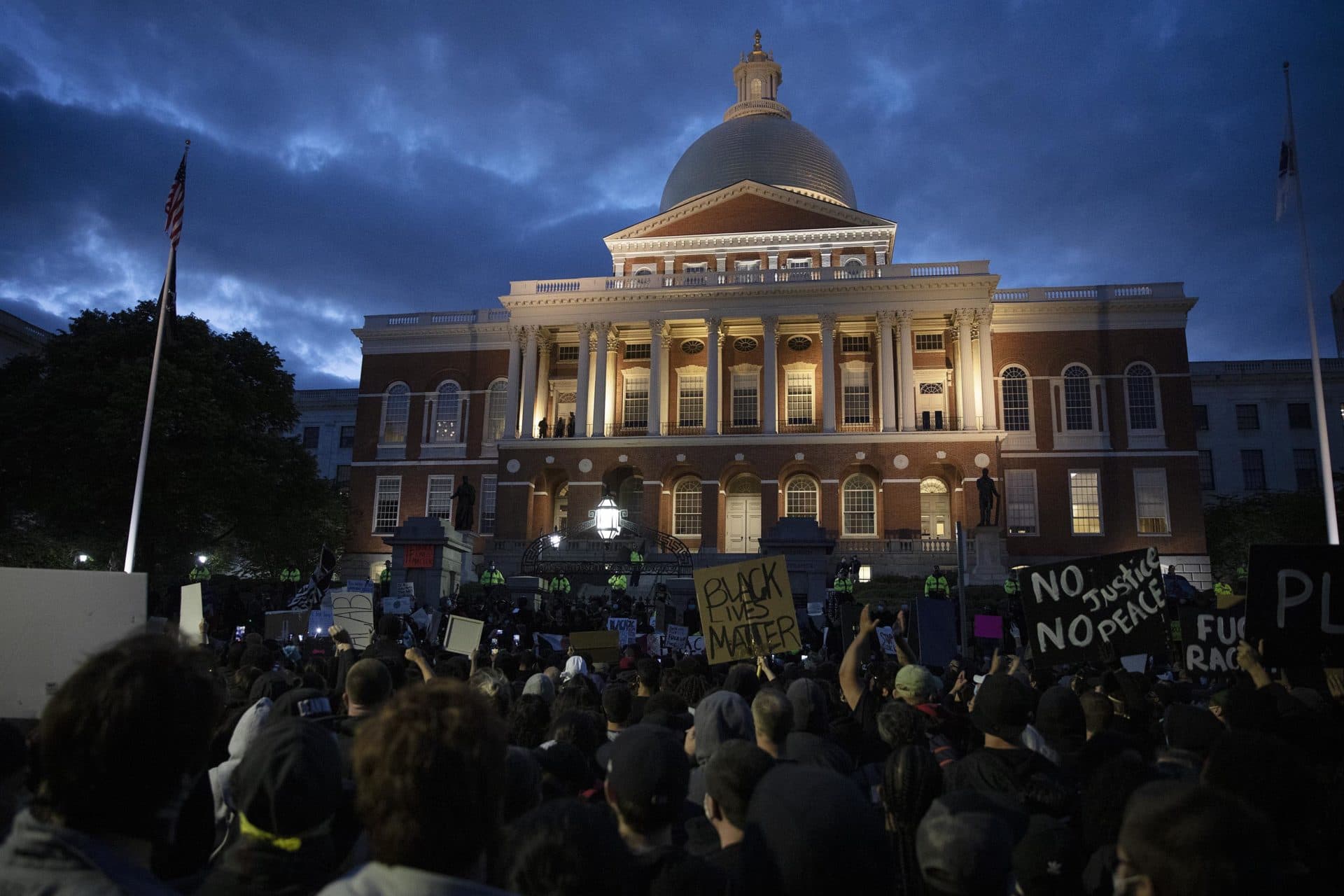
Boston agreed to pay $850,000 to four plaintiffs who alleged city police officers beat them with wooden batons and pepper-sprayed them during the May 31, 2020 Black Lives Matter protest following George Floyd's murder. The settlement, reached Monday, includes no admission of wrongdoing by the city. Plaintiffs Jasmine Huffman, Justin Ackers, Caitlyn Hall, and Benjamin Chambers-Maher submitted video evidence of officers driving protesters from the State House and Theater District areas. None of the named officers faced criminal charges. The lawsuit was among several across the country alleging excessive force against protesters demanding an end to police violence.
The May 2020 protest was one of numerous demonstrations nationwide after Minneapolis officer Derek Chauvin murdered George Floyd. The settlement comes six years later, reflecting prolonged timelines for police accountability litigation. Boston has faced multiple brutality claims from the 2020 protests.