The United States celebrated its 250th birthday on July 4, 2026, with a national spectacle at the National Mall in Washington, D.C., though record heat and a thunderstorm turned the day into a logistical ordeal. Temperatures reached 102°F in D.C., breaking the city's July Fourth record set in 1919, and roughly 150 million Americans fell under heat alerts. A storm forced National Mall crowds to shelter in federal buildings and subway stations before President Trump took the stage shortly after 11 p.m. His speech blended patriotic tributes (Medal of Honor recipients, historic flags) with partisan messaging promoting his SAVE America Act and attacking communism, drawing criticism for injecting politics into the national celebration. The fireworks finale, billed as the world's largest with 850,000 shells, concluded past midnight. About 400 members of the white nationalist group Patriot Front marched through Washington streets during the day. Power outages hit roughly 750,000 homes across seven northeastern states.
Every 50 years, the US marks a major founding milestone with national celebrations. The bipartisan America 250 commission, established by Congress, spent years organizing the semiquincentennial. Trump created a rival "Freedom 250" committee ahead of the event, drawing accusations that he was privatizing the anniversary. A time capsule buried during the celebrations will be opened in 200 years.
Ezra Jin Mingri, founder of the Zion Church, one of China's largest unregistered Christian congregations, was released from detention in China and flew to Los Angeles to rejoin his family, less than two months after President Trump raised his case with Xi Jinping during a meeting in Beijing. Jin and 17 other Zion Church leaders were arrested in October 2025 in what advocates called China's largest single-church crackdown in decades. The Communist Party requires Christians to worship in state-registered congregations; Zion operated openly outside that system for years, defying Beijing's restrictions on unregistered religious groups. Jin's family credited Trump's advocacy and Xi's personal intervention for securing the release. At least eight other Zion Church members remain detained, according to Human Rights Watch. The release comes as Trump and Xi have maintained regular diplomatic contact in 2026, with trade and technology disputes still unresolved.
China's government permits religious practice in five officially registered faiths, each controlled by state-linked bodies. Unregistered "house churches" and underground congregations, predominantly Protestant, have tens of millions of members and operate in a legal gray zone subject to periodic crackdowns. Beijing's constitution nominally guarantees religious freedom, while Communist Party rules prohibit it for Party members.
Ukrainian drones struck the St. Petersburg Oil Terminal early on July 4, hitting one of Russia's largest fuel storage and export facilities. The terminal, on the Gulf of Finland in Russia's second-largest city, handles up to 12.5 million tons of petroleum products per year. President Zelensky confirmed the attack on Telegram, calling the target "port oil infrastructure that is funding the Russian war." Russian officials said the city faced a "large-scale" drone assault; the Leningrad region reported 72 drones intercepted, though the terminal was hit and black smoke rose from the port area. Ukrainian forces also struck Kronstadt, a naval base near St. Petersburg. The attack extends Ukraine's long-range strike campaign several hundred kilometers into Russia's northwest, far from the active front lines in eastern and southern Ukraine. Earlier strikes in this campaign have hit oil depots in Krasnodar and fuel facilities in Crimea.
Ukraine has targeted Russian oil refineries and fuel depots throughout the war, aiming to strain the Kremlin's war revenue and create fuel shortages. St. Petersburg, Russia's second city and a major Baltic port, sits far from the Donbas and Zaporizhzhia front lines. Kronstadt, on an island near the city, hosts Russia's Baltic Fleet headquarters.
On July 7, a Paris appeals court will issue its ruling in Marine Le Pen's embezzlement case, a decision that will determine whether France's most prominent far-right politician can run in the 2027 presidential election. A lower court convicted Le Pen and 27 National Rally party members in March 2025 for misusing European Parliament funds between 2004 and 2016, paying party staff with money designated for EU parliamentary assistants. The sentence included four years in prison (two suspended), a 100,000 euro fine, and a five-year ban from public office enforced immediately, which bars her from the 2027 race. If the appeals court upholds the conviction, she is locked out of what her allies consider her best chance at the presidency. If it overturns or narrows the ban, the race reopens. Le Pen has indicated that 30-year-old National Rally leader Jordan Bardella could stand as her substitute candidate if she remains ineligible.
Marine Le Pen has run for French president three times, losing each time to the centrist candidate, most recently to Emmanuel Macron in 2022. Her National Rally party has grown from a fringe far-right movement into France's largest opposition force in the National Assembly. The 2027 election is widely seen as her strongest chance yet.
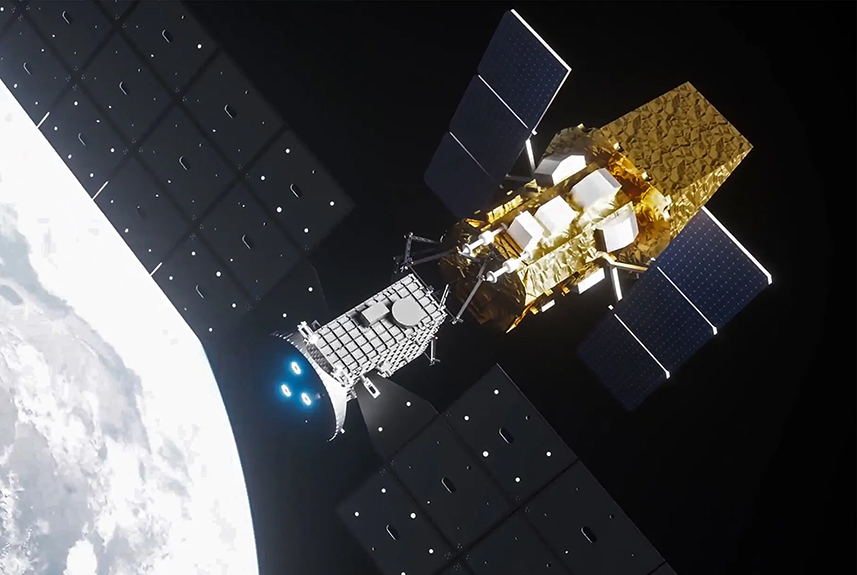
A startup called Katalyst Space Technologies launched a robotic spacecraft on July 3 to intercept the Neil Gehrels Swift Observatory before it burns up in Earth's atmosphere. Solar activity around the 2024 solar maximum expanded Earth's upper atmosphere, accelerating the telescope's orbital decay from its original altitude of 600 kilometers down to roughly 400 kilometers; uncontrolled reentry was projected by late 2026. NASA awarded Katalyst a $30 million contract in September 2025 and gave the company nine months to design, build, and launch a rescue spacecraft. The result is LINK, an 880-pound robot with three arms and ion thrusters, launched via a Pegasus XL rocket dropped from a modified L-1011 aircraft over the Marshall Islands. LINK will spend about a week maneuvering to rendezvous with Swift, then fire its thrusters over two to three months to tow the telescope back toward its original orbit. This would be the first time a commercial spacecraft has docked with a government satellite not designed for servicing.
The Neil Gehrels Swift Observatory has detected and tracked gamma-ray bursts, the most energetic explosions in the universe, since its launch in 2004. It can rotate to point at a new target within 75 seconds of a detection. On-orbit satellite servicing is rare; most aging spacecraft are left to decay or disposed of in graveyard orbits.
A growing body of research is challenging one of reproductive biology's most entrenched assumptions: that female mammals are born with a fixed egg supply and generate no more throughout their lives. A 2004 paper by Jonathan Tilly's team at Northeastern University identified stem cells in adult mouse ovaries apparently capable of generating new eggs, and subsequent work with human ovarian tissue, done in collaboration with researchers at Shanghai's Jiao Tong University and the University of Edinburgh, found what appeared to be egg-like structures growing from those cells. A 2017 study in mice tagged newly forming egg cells and showed them integrating into the ovarian reserve; some mice produced viable offspring. The findings remain contested: many reproductive biologists question whether the isolated cells are genuine egg precursors, and independent replication has been difficult. If confirmed, the implications extend to infertility treatment, preserving ovarian function after cancer therapy, and possibly delaying the onset of menopause.
Since a 1951 paper by Solly Zuckerman, reproductive medicine held that female mammals are born with all the eggs they will ever have, and that the supply depletes over time until menopause. This assumption underpinned decades of fertility medicine, including the growth of egg-freezing. Tilly's 2004 Nature paper was the first serious modern challenge to it.
Scientists studying samples from NASA's Curiosity rover have found that known non-biological processes cannot fully account for the concentration of carbon-rich organic molecules in a Martian rock from Gale Crater. In March 2025, researchers identified decane, undecane, and dodecane inside a mudstone sample analyzed by Curiosity's onboard chemistry lab, the largest organic compounds found on Mars. A follow-up study published in February 2026 evaluated all known non-biological sources of such molecules, including meteorite delivery, ultraviolet chemistry, and volcanism, and found they fall far short. The team worked backward roughly 80 million years, accounting for how much organic material cosmic radiation would have destroyed since the rock reached the Martian surface, and estimated the original concentration was higher still. Researchers say an unknown non-biological process could still be responsible. Definitive answers will require sample return: the Perseverance rover has been collecting rock cores for eventual analysis in Earth laboratories.
Gale Crater is an ancient lake bed that Curiosity has explored since 2012, making it a prime target for biosignature research. Organic molecules are carbon-based compounds that form through both biological and non-biological processes; their presence on Mars is necessary but not sufficient evidence for ancient life. Perseverance's cached samples may reach Earth laboratories in the mid-2030s.
Researchers at the Barcelona Institute of Science and Technology have built a device that keeps donor eyes functional outside the body long enough to make full eye transplantation plausible. The device, called ECaBox (Eye-in-a-Care-Box), works by pumping oxygen-rich fluid through the artery that normally supplies blood to the eye while maintaining precise temperature and pressure in a sealed chamber. In tests on 12 human eyes from deceased donors, treated eyes retained structural viability for 24 hours and, within 15 minutes, regained the ability to respond to light, indicating that retinal photoreceptor cells remained intact. A previous whole-eye transplant attempt at NYU Langone in 2023 produced no visual recovery because the transplanted eye deteriorated before and during surgery. The Barcelona team now plans a portable surgical version of ECaBox. The research has not yet been peer-reviewed. Optic nerve regeneration, the other major barrier to functional eye transplants, remains an unsolved problem.
Cornea transplants are routine, but whole-eye transplants have never succeeded in restoring vision because the optic nerve, which carries visual signals to the brain, cannot regenerate after being cut and reconnected in humans. ECaBox addresses the viability problem of keeping a donor eye alive, not the nerve regeneration problem. Solid organ transplants for kidneys, livers, and hearts are routine.
A security researcher discovered that YouTube Studio's AI assistant could be manipulated into revealing private video titles by injecting hidden instructions into a video comment. An attacker first posts a comment on a creator's video, then edits it to embed a hidden AI directive. Because YouTube does not re-notify creators when comments are edited, the injected instruction persists undetected. When a creator clicks a suggested AI prompt in Studio, the assistant reads the comment, executes the attacker's instruction, and generates a link. When the creator clicks that link, their private video metadata, including titles of unreleased or unpublished content, is transmitted to the attacker's server. The method exploits prompt injection: a technique where untrusted data fed to an AI system contains hidden commands the model treats as legitimate instructions. Google rejected the researcher's bug report, classifying the issue as requiring "social engineering" rather than as a direct security vulnerability. The full writeup is at javoriuski.com.
YouTube Studio is Google's management dashboard for video creators, with an AI assistant that reads comments, analyzes performance, and suggests responses. Prompt injection attacks are a growing concern for AI systems with access to user data: the model trusts instructions in untrusted inputs. Similar attacks have been demonstrated against other AI assistants including ChatGPT and Microsoft Copilot.
Newer Claude models are getting better at reasoning but worse at following external tool schemas, argues Armin Ronacher, creator of the Flask web framework, in an essay that drew wide attention from developers. Ronacher found that Claude Opus 4.8 and Sonnet 5 began inventing fields that don't exist in tool schemas when calling his own code-editing tools, adding phantom keys like requireUnique or oldText2 alongside otherwise correct payloads, causing tool calls to fail validation. His hypothesis is that the models were trained with reinforcement learning against Anthropic's closed-source Claude Code harness, sharpening their priors for that specific tool ecosystem at the cost of generalizing to other implementations. The failure rate reached 20% in some user sessions. Enabling strict grammar-constrained sampling fixed the problem, suggesting a tractable solution exists but isn't yet deployed. For teams building agentic workflows on top of Claude's API with their own tool schemas, this is a real and growing compatibility cost.
Tool calling lets language models interact with external functions by sending structured JSON calls matching a declared schema. Anthropic's Claude Code is the company's primary agentic coding assistant, with a large proprietary tool ecosystem. Reinforcement learning from human feedback shapes model behavior; when that feedback concentrates on one tool environment, models can overfit to its conventions at the expense of other implementations.