Russia struck Kyiv overnight on July 2 with 74 missiles and 496 drones, killing at least 30 people and injuring more than 85. The attack deployed a record 28 ballistic missiles in a single assault on the capital, including hypersonic Zircon missiles, in what Ukrainian officials called the most massive aerial bombardment of the city since the war began. Ukrainian air defenses intercepted 48 missiles and 476 drones, but those that broke through hit more than 30 locations across all of Kyiv's districts: apartment buildings, hotels, and administrative facilities. One nine-story residential building in the Darnytskyi district lost six floors to the blast. Ukraine's state emergency service said rescue operations remained ongoing at multiple sites. President Volodymyr Zelensky cut short a visit to Dublin after receiving intelligence warning of the attack. Poland scrambled fighter jets in response to debris nearing its airspace. Russia's defense ministry said the strike targeted military-industrial plants and logistics infrastructure.
Russia has waged a large-scale war against Ukraine since February 2022. Kyiv has faced repeated aerial attacks throughout the conflict; Ukraine relies on Western-supplied air defense systems to intercept incoming missiles and drones, but the sheer volume of this assault overwhelmed a significant portion of those defenses.
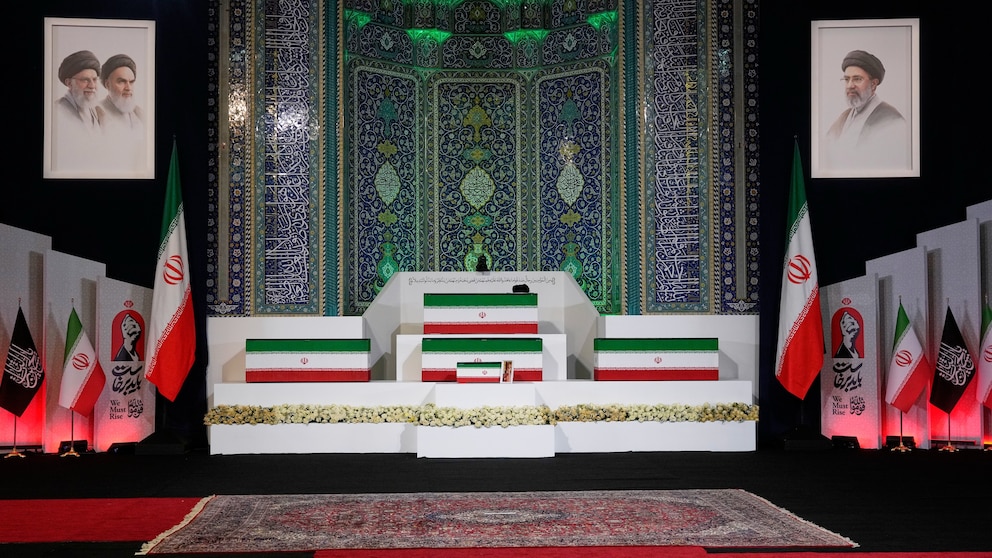
Iran began the state funeral of Supreme Leader Ali Khamenei on Thursday, four months after Israeli airstrikes killed him at the start of the US-Israel war in February. His coffin arrived at Tehran's Grand Mosalla mosque under a red Shia flag symbolizing martyrdom and vengeance, as authorities prepared for up to 20 million mourners in the capital alone. The ceremony runs July 3 through 9, spanning Tehran, Qom, Mashhad, and Karbala in Iraq. Iran's military commander Ali Abdollahi warned the US and Israel against any strike during the proceedings, threatening harsh retaliation. The warning followed an Israeli defense minister's public statement that Mojtaba Khamenei, the late leader's son and his successor as Supreme Leader, was marked for death. Six thousand water sprinklers line the funeral square to cool the crowds under July heat. Iranian officials describe the event as a defiant message to the Trump administration.
Khamenei was Iran's Supreme Leader for 34 years. Israeli airstrikes killed him on February 28, 2026, the first day of the joint US-Israel campaign against Iran. His son Mojtaba became Supreme Leader after his death. The two sides agreed to a ceasefire in June, though tensions have flared repeatedly since.
Instagram accepted paid advertisements in India directing users to child sexual abuse material, a BBC Eye investigation published Thursday found. The ads used terms including "rape video" and "child video" and linked to Telegram channels where buyers could purchase the material for about $1. Some showed children as young as 12 in explicit images alongside adults. BBC investigators created an alias account; within days, Instagram served ads depicting children in sexually suggestive situations. The investigators flagged one ad through Instagram's standard reporting system; Meta's review returned 24 hours later saying the post did not violate community guidelines. BBC then contacted Meta's press team directly, which responded by disabling several ads, suspending the offending accounts, and blocking related URLs, contradicting the initial moderation outcome. Telegram said it removed more than 274,000 groups and channels related to child sexual abuse in 2026. Meta has not explained how the ads cleared its review system.
Tech platforms have legal reporting obligations for child sexual abuse material in multiple countries. Meta has faced repeated criticism over content moderation failures across its products. India is one of Instagram's largest markets, with several hundred million active users.
The James Webb Space Telescope has uncovered hundreds of objects in the early universe that standard cosmological models cannot explain, and three years of attempting to explain them away has not resolved the problem. JWST found galaxies shining just 280 million years after the Big Bang, brighter than models predicted for that era. It found black holes with masses billions of times the sun's existing only 650 to 750 million years after the Big Bang, when existing theory says they would need much longer to grow that large. It also found hundreds of mysterious compact reddish objects, dubbed Little Red Dots, that no prior model predicted. Astrophysicists have proposed a range of fixes: gas may convert to stars more efficiently in the early universe, early stars may have been unusually massive, or black holes may have grown through super-Eddington accretion, a process that breaks the usual size limit. No leading theory has emerged. The telescope continues delivering data that rewrites the expected timeline of cosmic history.
The Big Bang occurred 13.8 billion years ago. The standard cosmological model, called Lambda-CDM, predicts how quickly the first stars and galaxies formed and how fast black holes grew. JWST began science operations in 2022 and has produced results that consistently outpace those predictions.
Europe's highest court ruled Thursday that Google must pay a €4.1 billion ($4.7 billion) fine for abusing Android's market power, ending an eight-year legal fight and making the penalty legally final. The European Commission levied the original fine in 2018 after finding that Google required phone manufacturers to pre-install Google Search and Chrome as a condition of licensing Android, giving its own apps an unfair distribution advantage over rivals. A lower EU tribunal trimmed the fine from €4.34 billion to €4.1 billion in 2022, but upheld the core finding. Google appealed to the Court of Justice of the European Union, Europe's top court, which sided with regulators Thursday. The ruling cements one of the largest antitrust penalties in tech history. Google changed its Android app-bundling practices in Europe following the initial ruling, but the fine remains due in full. The company said it was disappointed with the decision.
The EU's competition regulator has fined Google billions across several antitrust cases over the past decade, targeting its search, advertising, and Android practices. This case centered on how Google used its control of the dominant mobile operating system to lock in its own apps at the expense of competing search engines and browsers.
OpenAI is in active talks with the Trump administration about offering the US government a 5% equity stake in the company, the Financial Times reported Wednesday, citing people familiar with the matter. At OpenAI's current $852 billion valuation, that stake would be worth about $42.6 billion. CEO Sam Altman has pitched the concept to President Trump, Commerce Secretary Howard Lutnick, and Treasury Secretary Scott Bessent, framing it as sharing AI's upside with the American public. The proposal envisions similar stakes from Anthropic, Google, and Meta, funneled through a sovereign wealth fund. The pitch comes as OpenAI completes its conversion from a nonprofit to a capped-profit company, a transition that drew scrutiny from Congress and state attorneys general concerned the company was evading its charitable obligations. Senator Bernie Sanders had pushed for a much larger government stake. The deal would require Congressional approval and remains in early conceptual stages.
OpenAI, founded as a nonprofit in 2015, began restructuring as a for-profit entity in 2024. The conversion required dissolving the nonprofit's control, drawing lawsuits and regulatory scrutiny. The company argues it needs uncapped capital access to compete with China in AI development.
Astronomers have traced a high-energy subatomic particle, a neutrino, back to a specific source in space, and the culprit is a dust-shrouded galaxy hidden 11 billion light-years away. The IceCube Neutrino Observatory, buried in Antarctic ice at the South Pole, detected the particle in 2021 at an energy of 750 teraelectronvolts, among the highest ever recorded. A team led by astrophysicist Yuji Urata then used gravitational lensing, a technique in which a nearer galaxy bends light like a magnifying glass to reveal objects behind it, to identify the source. They found a compact starburst galaxy, a type of system that churns out stars at extreme rates. The galaxy, now nicknamed Shadow Blaster, matches the particle's arrival direction with high statistical confidence. The results, published in Nature Astronomy this week, suggest that dusty starburst galaxies like Shadow Blaster may account for up to 20% of the diffuse neutrino background that IceCube has long detected without knowing where it comes from.
Neutrinos are subatomic particles with almost no mass that pass through ordinary matter without interacting. Tracing high-energy neutrinos back to their sources reveals what cosmic environments produce them. IceCube, a cubic kilometer of ice instrumented with sensors, has been detecting neutrinos since 2010 but has struggled to identify individual sources.
Amazon, Adobe, Atlassian, Citi, and other major companies have begun restricting employee access to AI tools after costs spiraled out of control, according to internal sources and documents obtained by 404 Media. In at least one case, a company's AI spending tripled to more than $15 million per month. The shift follows AI providers moving from flat-rate subscription pricing to usage-based billing, which charges companies per token generated, making heavy use far more expensive than initial contracts suggested. Companies are responding by directing employees toward cheaper, less capable AI models, imposing token limits and spending caps, and in some cases eliminating unlimited access. Adobe ended its unlimited Claude access program. The reports reveal a gap between the promise companies made when deploying AI, framed as a productivity revolution, and the financial reality once employees began using these tools throughout their workdays. A company that triples its AI spending in months faces a question its initial business case did not answer: does that spending produce proportional gains?
Enterprise AI tools, including Microsoft Copilot and various Claude and GPT deployments, are sold on per-seat or per-token pricing. Early enterprise deals often included flat-rate or trial pricing that made heavy use cost-efficient; those terms have since been renegotiated as providers shifted to usage-based billing.
America's broadband speeds lag Switzerland's by a factor of hundreds because of regulatory policy, not terrain. Stefan Schüller, a software engineer in Switzerland with 25-gigabit symmetric fiber at home, made the case in a blog post that reached the front page of Hacker News this week with 455 upvotes. Switzerland mandated in 2008 that each home receive four dedicated fiber strands in a point-to-point architecture, then required competing internet providers to share access to that neutral infrastructure at regulated prices. When Swisscom, the dominant carrier, tried to shift to cheaper shared architecture in 2024, the Swiss competition regulator fined it 18 million francs and ordered it to stop. American providers, by contrast, operate as territorial monopolies with no obligation to share physical infrastructure with competitors. Germany tried building parallel competing networks instead and spent billions on redundant cables before seeing slower results than Switzerland. Schüller's argument: the free market label Americans apply to their broadband describes a territorial monopoly, not competition.
The US consistently ranks below many European and Asian countries in both internet speeds and cost per megabit. Regulators have debated for decades whether broadband is a utility requiring regulated infrastructure access or a private market product. The FCC's net neutrality rules, which governed how ISPs could treat internet traffic, were repealed in 2024.
The Vatican excommunicated all bishops, priests, and formally adhering members of the Society of Saint Pius X, a traditionalist Catholic group with around 600,000 followers worldwide, after the group defied Pope Leo XIV and consecrated four new bishops without papal approval on July 1. The ceremony, attended by 15,500 people in Écône, Switzerland, prompted the Vatican's Dicastery for the Doctrine of the Faith to declare the society in schism the following day. For the group's followers, the consequences are immediate: the Vatican declared that confessions and marriages administered by SSPX priests are now invalid sacraments. Members who continue attending SSPX Masses face excommunication. The society had maintained an irregular relationship with Rome for decades, with Pope Francis granting partial reconciliation that allowed its priests to perform certain sacraments. That reconciliation is now reversed. SSPX leaders said they acted from a state of necessity to ensure their faithful could receive ordained clergy.
The Society of Saint Pius X was founded in 1970 by French Archbishop Marcel Lefebvre in opposition to the reforms of the Second Vatican Council, the 1960s modernization of Catholic doctrine and liturgy. Its bishops were originally excommunicated in 1988 after Lefebvre consecrated bishops without papal approval; negotiations over the following three decades produced partial reconciliation.