Venezuela absorbed two major earthquakes on Wednesday that killed at least 164 people and injured nearly a thousand more. The two strikes hit within 39 seconds of each other, with the first measuring 7.2 magnitude and the second 7.5, making the pair the most powerful to hit the country since 1900. Both epicenters were near Morón, a coastal city about 100 miles west of Caracas. The coastal port city of La Guaira suffered the worst damage, with buildings flattened and rescue workers reporting voices calling from rubble. Tremors knocked out power across the capital and triggered a tsunami advisory for nearby Caribbean islands. Acting President Delcy Rodríguez, who has governed Venezuela since Nicolás Maduro was seized by US forces six months ago, declared a national emergency. The disaster strikes at one of Venezuela's most fragile moments, with its institutions still adjusting to a new political order and its infrastructure depleted by years of economic collapse.
Venezuela has been in political and economic crisis for years. Nicolás Maduro was seized by US forces in early 2026, leaving Delcy Rodríguez, his former vice president, as acting head of state. La Guaira is Venezuela's main port city, handling most of the country's maritime imports.
The Supreme Court ruled 6-3 on Thursday that the Trump administration can strip Temporary Protected Status from about 350,000 Haitians and 6,000 Syrians living and working in the United States. Temporary Protected Status, known as TPS, is a humanitarian program that allows nationals from countries hit by conflict, disaster, or other extraordinary conditions to stay in the US legally without facing deportation. The Trump administration moved to terminate protections for both groups last year, citing its authority over immigration policy. Justice Samuel Alito, writing for the conservative majority, held that federal judges had overstepped when they blocked the termination, finding that courts cannot review many of the underlying challenges. Justice Elena Kagan's three-justice dissent argued that ending TPS would cause immigrants irreparable harm. The court acknowledged that neither Haiti nor Syria was determined safe for return. With the ruling, deportation proceedings can now move forward.
TPS lets people from countries in crisis stay in the US without deportation, even without permanent residency. Haiti is still recovering from its 2021 earthquake and ongoing gang violence. Syria remains under a fragile post-Assad transition after years of civil war.
via MIT Technology Review, BBC World, Ars Technica
IBM announced on Thursday a prototype chip that packs around 100 billion transistors into an area the size of a fingernail, twice the density of the company's previous record from 2021. The design, which IBM markets as a sub-1-nanometer process, uses a new transistor architecture called CFET, short for complementary field-effect transistor. Standard chips arrange transistors side by side; IBM stacks them vertically and then staggers the upper layer relative to the lower one, simplifying the wiring and allowing far more transistors in the same space. Manufacturing steps stay below 400 degrees Celsius to preserve the delicate structures. Compared to the previous generation, IBM estimates 50 percent more computing work in the same timeframe, or 70 percent better energy efficiency at equal performance. The technology is years from commercial production, but IBM says semiconductor partners plan to incorporate it into data center processors and consumer chips before the end of the decade.
Moore's Law, the observation that transistors on a chip double roughly every two years, has been slowing as miniaturization hits physical limits. The 1-nanometer barrier matters because at that scale, further shrinking requires new architectures rather than finer lithography. IBM's CFET design is one of several approaches the industry is exploring to continue progress.
Both chambers of Congress voted this week to formally direct President Trump to halt military hostilities against Iran, invoking the 1973 War Powers Resolution in what could become a defining constitutional confrontation. The joint action takes the form of a concurrent resolution, which under the War Powers Act carries legal force to compel the withdrawal of troops and cannot be vetoed by the president. Trump is expected to ignore the directive, arguing the resolution's enforcement mechanism is unconstitutional, a position backed by a 1983 Supreme Court ruling that left the war powers question unresolved. That unresolved gap is what legal scholars now expect to reach federal court for the first time. The confrontation is one of the sharpest tests in decades of whether Congress can rein in a president who commits forces to combat without a formal declaration of war.
The War Powers Resolution was passed in 1973 to limit the president's power to deploy military forces without congressional authorization. Presidents of both parties have disputed its constitutionality since its passage, and courts have largely declined to rule on the core dispute. The US military became engaged against Iran earlier in 2026.
Brent crude fell to $72.75 a barrel on Thursday, dropping nearly $3 in a single day as tanker traffic through the Strait of Hormuz, the narrow waterway connecting the Persian Gulf to the open ocean, continued to recover. Oil peaked near $118 a barrel after Iran threatened the strait and crossings collapsed during the conflict, and prices have now fallen nearly 40 percent from that high. Data from the analytics firm Kpler counted 70 confirmed crossings on Thursday, roughly double the previous day's total. Tankers are using an alternative route along Oman's coastline, promoted by a United Nations maritime agency, to reduce exposure to Iranian shore batteries. Traffic remains around 25 percent of the pre-conflict baseline. Iran has warned it may renew attacks if terms of the US-Iran agreement are not met, but tanker operators have so far judged the route safe enough to resume.
The Strait of Hormuz, a roughly 21-mile-wide chokepoint between Iran and Oman, carries about 20 percent of the world's oil supply. During the Iran conflict earlier this year, Iranian threats and attacks sharply reduced tanker crossings, spiking global energy prices. Japan, South Korea, and India were among the most exposed importers.
Harvard mathematician Lauren Williams explains in this week's Quanta Magazine podcast why a structure from algebraic combinatorics called the positive Grassmannian keeps reappearing across physics, biology, and traffic theory. The Grassmannian is a geometric space that catalogues all possible subspaces of a higher-dimensional space. Restricting it to configurations where certain coordinates stay non-negative, the so-called positive version, turns out to match the mathematical signature of systems where particles or agents repel one another. That repulsion pattern appears in quantum scattering, protein molecule synthesis, and how cars spread out on a congested highway. Williams's work connects to the amplituhedron, a geometric object introduced by physicist Nima Arkani-Hamed that encodes particle-collision probabilities as a volume, replacing enormously complex Feynman diagram calculations. The same geometric constraint serves as the hidden skeleton of many apparently unrelated physical and biological processes.
The Grassmannian is a generalization of the concept of a line or plane through the origin. Algebraic combinatorics studies the discrete structures, such as lattices and polytopes, that appear inside these spaces. The amplituhedron is a shape whose volume directly encodes probabilities of particle scattering in quantum field theory, discovered around 2013.
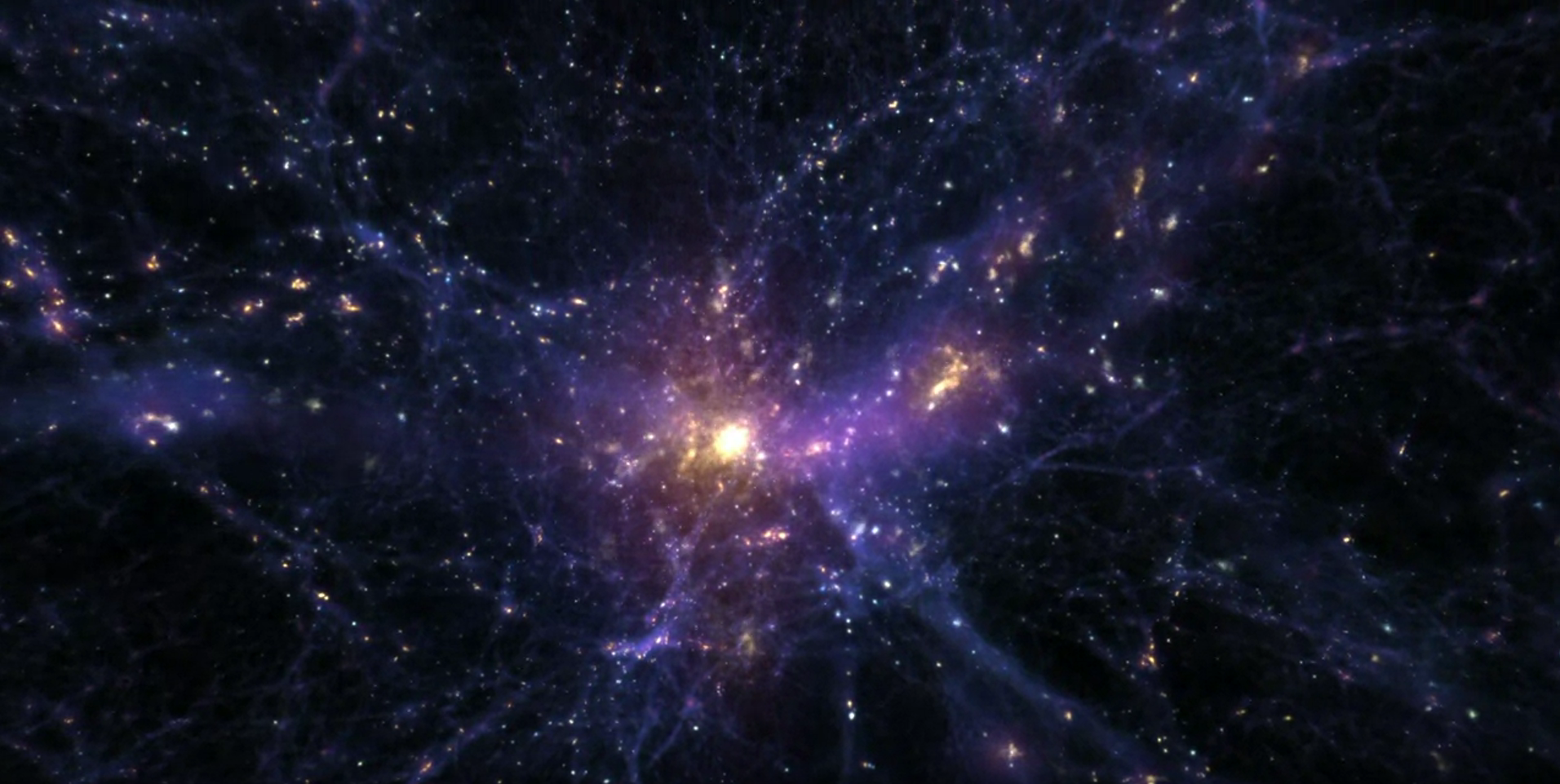
A study published last week in Nature by Italian physicists Francesco Sylos Labini and Marco Galoppo challenges the cosmological principle, the foundational assumption that the universe looks statistically the same in every direction. Using data from the Dark Energy Spectroscopic Instrument, an Arizona telescope array mapping the three-dimensional positions of millions of galaxies, the researchers found enormous structures with preferred orientations, some extending billions of light-years. The standard cosmological model predicts that on scales larger than about a billion light-years, any directional variation should vanish. The DESI data, the researchers argue, contradicts that prediction. Independent physicists have raised a competing objection: the findings conflict with measurements of the cosmic microwave background, the oldest light in the universe, which would need to show far larger temperature variations if the new results held. The scientific community is awaiting independent analysis of the full DESI dataset.
The cosmological principle holds that the universe is homogeneous and isotropic at large enough scales. It underpins virtually every standard cosmological model, including Lambda-CDM, which describes dark matter and dark energy. DESI is the most detailed three-dimensional map of the universe yet constructed, spanning billions of light-years.
Ford has rehired around 350 veteran quality-control engineers over the past three years after discovering that AI systems could not replicate the tacit knowledge those workers carried. The company had replaced experienced quality inspectors with automated and AI-driven tools, expecting the software to catch manufacturing defects more reliably than humans. Instead, the AI systems flagged problems they could not explain or fix, left no mechanism for training junior engineers, and failed to handle edge cases that the veterans recognized on sight. The returned workers now do two jobs: inspecting vehicles and reprogramming the AI tools to recognize what they know. Ford's quality ratings have since recovered. The automaker ranked as the top mainstream brand in this year's JD Power Initial Quality Study, a survey measuring defects reported by new-car buyers in the first 90 days of ownership. The episode offers a concrete account of what happens when manufacturers treat accumulated craft knowledge as replaceable overhead.
JD Power's Initial Quality Study has been the automotive industry's quality benchmark for decades. Ford had lost ground to South Korean brands like Hyundai and Kia for much of the past decade. Tacit knowledge in manufacturing is know-how that workers carry but cannot easily write down, typically built by inspecting thousands of defects over many years.
Qualcomm agreed to buy Modular, an AI software startup, for around $3.9 billion in an all-stock deal that positions the chip company to challenge Nvidia's control over the AI software ecosystem. Modular built two products with a following in the machine-learning community: MAX, an inference platform that lets AI models run on chips from multiple manufacturers, and Mojo, a programming language that extends Python with performance features suited to AI workloads. The products are designed to break the lock that Nvidia's CUDA software platform holds over AI development. Because CUDA runs only on Nvidia hardware, researchers who adopt it are tethered to Nvidia chips. Qualcomm's bet is that a hardware-agnostic alternative, combined with its own silicon business, can pull workloads away from Nvidia in data centers and on-device AI applications. Modular's founders include Chris Lattner, who created the LLVM compiler infrastructure and Apple's Swift programming language.
CUDA is Nvidia's proprietary platform for programming its graphics chips for general-purpose computing. Launched in 2006, it became the default environment for AI research and gave Nvidia a structural advantage: researchers who learned CUDA were, in practice, committed to Nvidia hardware. Multiple companies have tried to build CUDA alternatives; none has achieved comparable adoption.
A federal judge in Boston permanently blocked the Trump administration on Tuesday from requiring documentary proof of citizenship to register to vote, along with several other election rules the president sought to impose by executive order. The ruling by U.S. District Court Judge Denise Casper converts a preliminary injunction she issued last year into a permanent ban. It covers three major provisions: requiring documentary proof of citizenship for voter registration, discarding mail ballots that arrive after Election Day even when postmarked on time, and withholding federal funds from states that refuse to comply with either requirement. Judge Casper held that the Constitution places authority over federal elections with Congress and with the states, not with the executive branch, and that the executive order exceeded presidential power under any reasonable interpretation of that authority. The administration is expected to appeal.
Trump signed an executive order early in his second term directing federal agencies to enforce his election rules, arguing noncitizen voting was widespread. Multiple federal courts blocked major provisions. Civil rights groups challenged the order, arguing documentary proof requirements would disproportionately burden citizens who lack passports or other formal documents.





.png)