A three-member UN Commission of Inquiry released a report on June 23 concluding that Israel has committed and continues to commit genocide against Palestinians in Gaza, with the deliberate targeting of children cited as the conduct establishing genocidal intent. The commission found that Israel carried out four of the five prohibited acts defined as genocide under the 1948 Genocide Convention: deliberate killings, inflicting serious bodily and mental harm, imposing conditions designed to destroy the group, and measures to prevent births. At least 20,179 Palestinian children were killed by October 2025, representing roughly 30% of total deaths since the war began in October 2023. The report builds on a September 2025 finding in which the commission said there were reasonable grounds to conclude genocide was occurring, but the new report goes further, emphasizing the deliberate targeting of children as a distinct element establishing intent. Israel rejected the findings as a libellous sham, calling the commission biased.
The UN Commission of Inquiry into the occupied Palestinian territory was established in 2021 to investigate alleged violations of international law. It has no enforcement authority; findings generate political pressure but not binding legal obligations. A parallel case at the International Court of Justice, filed by South Africa in 2024, is the legal forum where a genocide ruling could carry binding weight.
Anthropic built an AI coding model called Mythos 5 in April 2026 and judged it too effective at writing software exploits to release publicly, sharing it only with a small group of vetted cybersecurity researchers. On June 9 the company released a safer variant, Fable 5, to the general public. Three days later the Trump administration declared both models national security threats under export control rules and ordered Anthropic to block global access, citing a tip from Amazon CEO Andy Jassy that Fable posed a cybersecurity danger. Amazon is both a major Anthropic investor and a direct competitor in cloud AI through its own Bedrock platform, a conflict of interest Anthropic publicly noted. Anthropic revoked global access to both models within hours of the order and has since filed suit against the administration. Senior Anthropic representatives met with administration officials on June 23 but reached no resolution. A secondary effect of the ban is that the security researchers using Anthropic models to find and patch vulnerabilities in US infrastructure no longer have access to those tools.
Anthropic is the San Francisco AI company that makes the Claude series of models. The Fable and Mythos names replace the earlier Claude 4 product line. Export controls restrict US companies from sharing certain technologies with foreign users; the Trump administration applied them here to block international access to Fable and Mythos. Anthropic's lawsuit argues the controls exceed the administration's statutory authority.
OpenAI on June 22 released GPT-5.5-Cyber, a fine-tuned variant of its latest model built for defensive cybersecurity work, through a program called Daybreak. The model can trace reachability paths through large codebases, validate vulnerabilities in controlled environments, write and test patches, and produce evidence summaries for human analysts. On CyberGym, a standardized vulnerability-detection benchmark, it scored 85.6% against 81.8% for standard GPT-5.5 and 73.1% for Claude Opus 4.7. It scored 39.5% on ExploitGym, a benchmark testing exploit generation, compared to 25.95% for the standard model. OpenAI restricts access to verified defenders through a vetting program called Trusted Access for Cyber; launch partners include Cisco, CrowdStrike, IBM, and Palo Alto Networks. Alongside the model, OpenAI announced Patch the Planet, an initiative to use AI to find and fix known vulnerabilities in critical open-source infrastructure. The release came as Anthropic's models were simultaneously frozen by export controls, leaving security teams in the field suddenly short of tools.
OpenAI's Daybreak program launched in early 2026 with the argument that security defenders need access to the same AI capabilities that attackers already have. GPT-5.5-Cyber runs at lower refusal thresholds than the standard model. ExploitGym is a controlled test environment where the model attempts to generate working exploits; a 39.5% success rate reflects real capability but inside a sandboxed, vetted context.
New York City voters are casting ballots Tuesday in a Democratic primary for the 12th congressional district covering upper and midtown Manhattan, a safely Democratic seat left open by Rep. Jerry Nadler's retirement. The race has drawn more than $30 million in outside spending because AI policy became its organizing theme. Alex Bores, a state assemblyman and former Palantir software engineer, is the AI safety candidate: he wants to tax AI companies' compute use, impose child-protection standards, and require transparency in safety testing. AI safety advocacy groups funded partly by Anthropic investors spent roughly $10 million to boost him. A Silicon Valley super PAC called Leading the Future spent about $8 million opposing him and backing Micah Lasher, a former state assemblyman who opposes new regulation. Polls show the race approximately even between Bores and Lasher, with the rest of the field including Kennedy grandson Jack Schlossberg and former Republican operative George Conway trailing. The seat is guaranteed to go Democratic in November.
The NY-12 district stretches across Manhattan's Upper West Side, Upper East Side, and Hell's Kitchen. Jerry Nadler held the seat for over 30 years and chaired the House Judiciary Committee. AI policy has few natural electoral tests; this race became one because Bores explicitly campaigned on regulating AI and drew organized funding on both sides of that position.
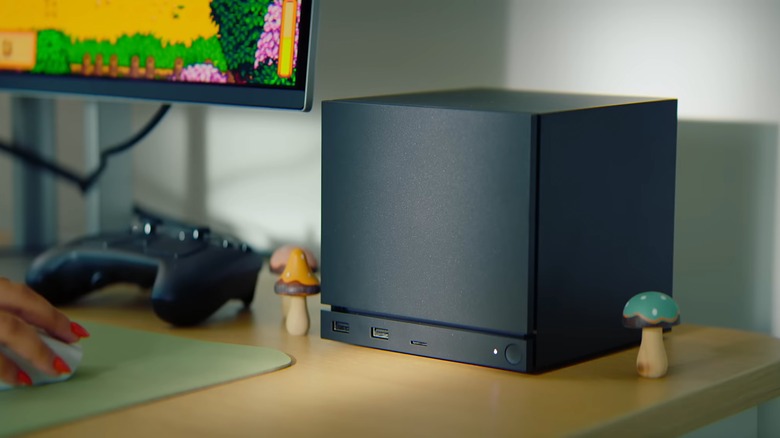
Valve opened reservations on June 23 for the Steam Machine, a compact desktop PC designed for living room gaming, priced at $1,049 for the base 512GB model and $1,349 for the 2TB version. The device uses a custom AMD Zen 4 processor and a semi-custom RDNA 3 GPU, delivering roughly 70% better CPU performance and six times the graphics output of the Steam Deck. The form factor is a 6-inch cube with interchangeable faceplates and mounting options for sitting beside a television. The machine supports 1440p and 4K gaming with DDR5 RAM and an NVMe storage slot that users can upgrade after purchase. Valve is limiting the first batch to 20,000 units, one per customer, with initial purchases shipping June 25. The launch settles years of speculation about whether Valve would re-enter the living room hardware market. The original Steam Machine lineup in 2015 relied on third-party manufacturers and sold poorly; this version is Valve's own hardware built to a single spec.
Valve's Steam Deck portable PC, released in 2022, validated running Windows games on Linux through a compatibility layer called Proton. The Steam Machine extends that bet to the living room with desktop-class performance. Unlike most gaming PCs, it runs SteamOS and can boot into a console-style interface, though users can also install Windows.
ASML, the Dutch company that makes machines for printing circuits onto silicon chips, has begun deploying its most advanced system: a High-NA extreme ultraviolet lithography machine that costs $400 million, weighs more than 150 tons, and stands roughly as tall as a double-decker bus. The machine generates ultraviolet light by firing high-powered lasers at molten tin droplets tens of thousands of times per second, producing light with a wavelength short enough to print features as small as 8 nanometers, down from 13 nanometers on the previous generation. The higher numerical aperture of 0.55, up from 0.33, lets chip designers cut transistor size by roughly half and nearly triple component density without stacking multiple exposure passes. Intel purchased the first unit; deployment to production lines is expected around 2027. ASML controls roughly 90% of global chip-lithography tool sales and posted nearly $40 billion in revenue in 2025. The company plans to produce 60 of these machines in 2026, rising to 80 in 2027.
Lithography etches circuit patterns onto silicon using light, scaled down to atomic dimensions. ASML holds a near-monopoly because the underlying EUV technology required decades of investment no other company matched. US export controls prevent ASML from selling its most advanced machines to Chinese chipmakers, including this High-NA generation, a source of ongoing friction between Washington and the Hague.
Dozens of US public libraries removed Pride Month displays and declined to host LGBT-themed events this June, according to public records obtained by 404 Media. Library administrators cited fear of backlash rather than any formal policy, with several telling reporters they did not want to be judged for their choices. The self-censorship follows a documented surge in organized pressure campaigns: 90% of 2025 book challenges were linked to coordinated advocacy groups, including CatholicVote's Hide the Pride initiative, which asks supporters to contact libraries and demand removal of LGBT materials. The pattern has a documented cost for staff who resist. Rachel Rodman, a Missouri librarian, was fired in June 2025 after refusing to take down a Pride display. Staff at libraries hosting Rainbow Storytime events received death threats. Administrators at libraries that have gone quiet told 404 Media they are choosing not to draw attention rather than face the cost of defending their programming, a calculation that has spread into communities with no prior history of challenges.
The American Library Association reported a record 1,247 book challenges in 2023, the highest number since it began tracking in 1990. The target of pressure campaigns has shifted: early campaigns named specific titles for removal; recent ones treat any visible acknowledgment of LGBT existence during Pride Month as grounds for challenge. Libraries draw most of their funding from city and county governments subject to the same political pressure.
Commercial shipping through the Strait of Hormuz has resumed at near-normal volumes, with 42 ships transiting the waterway on Saturday, June 21, as shipping companies return to standard Gulf routing. Iran sealed the strait on March 4, 2026, nine days after a US and Israeli strike killed Iranian Supreme Leader Ali Khamenei on February 28. The June 14 deal between the US and Iran allows commercial vessels to transit without charge for 60 days while the two sides negotiate a permanent arrangement. US forces have begun mine-removal operations in the strait and opened an alternate shipping lane off Oman's coast to handle traffic while Iranian-controlled waters remain partially cleared. Energy traders report Brent crude has fallen 14% since the deal was signed as Gulf oil exports resume. The terms after the 60-day window remain unresolved: Iran has confirmed no new commitments were made on the strait's long-term status during the Vance talks in Switzerland, and shipping companies say they are planning around the uncertainty.
The Strait of Hormuz, between Iran and Oman at the mouth of the Persian Gulf, is the world's most important oil chokepoint: about 20% of global petroleum supply passes through it daily. Iran threatened to close the strait in multiple previous crises but never acted until 2026. The closure drove oil prices to near-record levels and forced insurers to suspend war-risk coverage on Gulf cargoes.
Madison Square Garden compiled a surveillance dossier on three civil liberties activists who publicly criticized its facial recognition system, according to documents obtained by 404 Media. The file included background information, contact details, social media handles, and screenshots of the activists' tweets, and was stored in a SharePoint folder accessible to multiple MSG staff. The three targets were Evan Greer of Fight for the Future, Albert Fox Cahn of the Surveillance Technology Oversight Project, and Adam Schwartz of the Electronic Frontier Foundation, each of whom had organized opposition to MSG's facial recognition program. Their criticism intensified after a 2025 data breach exposed 45 gigabytes of files from MSG's security contractor. MSG Entertainment had previously used its facial recognition system to bar attorneys whose firms had active litigation against the company from entering its venues, a practice New York regulators ordered halted in 2023. The company has not commented on the dossier.
MSG Entertainment operates Madison Square Garden and a cluster of other New York entertainment venues. It deployed facial recognition scanning of all visitors starting around 2022, positioning it as a security measure. The 2023 regulatory order on attorney exclusions came after media coverage showed the company systematically identifying and turning away lawyers at the door based on their employer's case files.
The National Highway Traffic Safety Administration opened a Special Crash Investigation into a June 20 Tesla accident in Katy, Texas, in which a Model 3 struck a home and killed Martha Avila Mantilla, 76, who was standing in the front room. Driver Michael Butler, 44, told sheriff's deputies the vehicle was operating on Tesla's Autopilot driver-assistance system when it failed to make a right turn and accelerated to an estimated 60 to 70 miles per hour before hitting the brick wall. Butler showed no signs of impairment and was cooperating with investigators. NHTSA's Special Crash Investigation program examines accidents that may involve automated driving systems; opening the inquiry does not automatically trigger a recall. Investigators will retrieve the vehicle's event data recorder to confirm whether Autopilot was actually engaged at the time of the crash. Tesla's Autopilot has been under federal scrutiny since 2021, and a 2023 recall required software changes to how the system handles intersections, the same class of scenario involved here.
Tesla markets Autopilot as a driver-assistance system that still requires driver attention, but its naming and promotional framing have led many drivers to treat it as fully self-driving. NHTSA has investigated dozens of Autopilot-involved crashes since 2021. The 2023 recall covered over 2 million vehicles and required software changes to add more warnings, but did not redesign the underlying system.