France placed 35 of its 96 departments on red heat alert Sunday, the highest warning level, as one of the country's most intense June heatwaves built toward a dangerous peak. A further 45 departments carry orange warnings, putting roughly 53 million people under some form of advisory. Forecasters at Météo-France say temperatures in southwestern regions, the Paris area, and Burgundy will reach 39 to 43°C Monday through Thursday, which could match the highest national daily average ever recorded in France for any season. Authorities canceled 71 intercity train routes and closed 845 schools on Monday. The government banned alcohol sales across all red-alert zones during Sunday's annual Fête de la Musique, the nationwide street music festival. Officials described the event as "exceptional intensity," comparable to the lethal August 2003 and July 2019 heatwaves. Hospitals in affected regions are on emergency standby.
France's deadliest peacetime disaster in recent memory was the 2003 European heat wave, which killed an estimated 15,000 people in France and roughly 70,000 across Europe over two August weeks. A second major event struck in summer 2019. Both spurred investments in early-warning systems, hospital capacity plans, and public cooling centers.
Ukrainian forces struck an oil depot in Crimea's port city of Kerch and fuel transport facilities in Russia's Krasnodar region overnight Saturday, killing at least four people and wounding 28. President Volodymyr Zelenskyy described the strikes as "long-range sanctions" targeting Russia's military fuel supply chain. Russia-occupied Crimea suspended all civilian gasoline sales in response, leaving fuel available only to government agencies for an undefined period. The Kerch Bridge linking Crimea to mainland Russia closed to traffic. Russia's appointed Crimean authorities reported power outages across several areas of the peninsula. Ukrainian forces have targeted Crimea's fuel infrastructure repeatedly over recent weeks, producing the worst energy crisis on the peninsula since Russia's 2014 annexation. Russia's defense ministry claimed its air defenses intercepted 239 Ukrainian drones overnight, though strikes continued to cause damage.
Russia annexed Crimea from Ukraine in 2014 and uses the peninsula as a key logistics hub for forces fighting in southern Ukraine. Ukraine struck the Kerch Bridge, Crimea's only land link to Russia, in 2022. Russia now relies on ferries and sea-based fuel delivery, and Ukrainian strikes have made those supply routes increasingly difficult to defend.
Bolivian President Rodrigo Paz declared a state of emergency Friday after 50 days of nationwide road blockades that have choked food and fuel supplies to major cities. The 90-day decree authorizes the military to clear roads and restore order. Protesters demand that Paz reinstate fuel subsidies cut under austerity measures and increase education funding. At least 17 people have died since demonstrations began, most from medical emergencies made fatal by blocked ambulance routes. Clashes with riot police left 37 people injured and resulted in 365 arrests. By Saturday, authorities reported no active blockades, an immediate effect of the military deployment. Former President Evo Morales, who governed Bolivia for more than 13 years before leaving in 2019, has supported the protests from hiding and called for new elections. The US Trump administration has backed Paz and pledged emergency assistance.
Bolivia's fuel subsidies, among the most generous in South America, were funded for years by natural gas export revenues under Morales's government. As gas production declined and export income fell, Paz's administration reduced subsidies to stabilize finances, a decision deeply unpopular among workers, truckers, and rural communities who depended on cheap fuel.
Abiy Ahmed's Prosperity Party swept Ethiopia's general elections on June 1, winning a commanding parliamentary majority in a vote that excluded large swaths of the country. Election authorities suspended or canceled voting in dozens of constituencies due to violence and "unfavorable conditions." The Tigray region, still recovering from a civil war that ended in a 2022 ceasefire, held no elections at all. In Oromia, Ethiopia's largest region, government forces continue fighting the separatist Oromo Liberation Army. Gunmen from the Fano militia have controlled territory in the neighboring Amhara region since 2023. Regional analysts warn that Abiy's consolidated power could deepen these conflicts and increase the risk of confrontation with Eritrea, whose relationship with Ethiopia has deteriorated sharply since the Tigray war. Results gave Abiy a strong domestic mandate while armed conflicts in three of Ethiopia's major regions remain active and unresolved.
Abiy Ahmed received the 2019 Nobel Peace Prize for ending Ethiopia's 20-year border conflict with Eritrea. Two years later, he sent federal troops into Tigray, triggering a civil war that killed an estimated 300,000 to 500,000 people. A ceasefire in late 2022 halted the fighting but left Tigray in ruins and Ethiopia-Eritrea relations in collapse.
Two physicists at Germany's Institute for Theoretical Physics have published a model proposing that what we call black holes might instead be "gravastars," compact objects that form without producing a singularity or an event horizon. Daniel Jampolski and Luciano Rezzolla published their paper in Physical Review D. Their model describes how a collapsing cloud of matter could stop short of a singularity when infalling material encounters a region dominated by dark energy, which then expands outward to create a stable equilibrium. To any observer outside the object, it looks identical to a black hole: nothing escapes, and gravity bends light the same way. The interior, however, contains no infinite-density point. The model is the first to trace how a gravastar could form dynamically from stellar collapse rather than assuming it into existence. The authors speculate the dark energy region inside could act as a seed for a self-contained mini-universe.
Black holes are among general relativity's most robust predictions. When a massive star exhausts its fuel, gravity can crush its core to a singularity, a point of infinite density where the laws of physics break down. Physicists have proposed alternatives for decades, including gravastars and "fuzzballs," but prior models could not explain how these objects would actually form from the collapse of a real star.
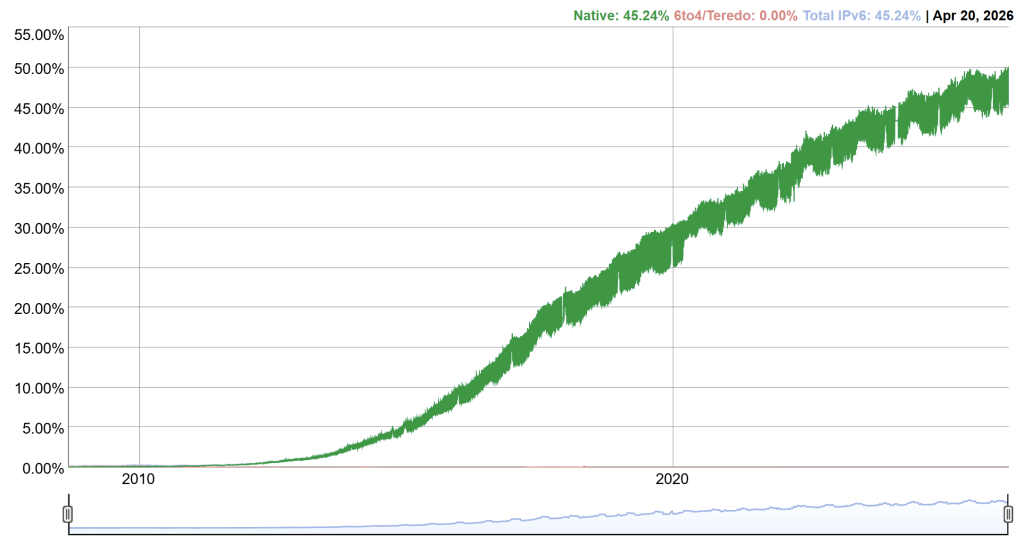
On March 28, 2026, Google's traffic statistics showed IPv6 carrying 50.1% of requests from users reaching its services, the first time the internet's next-generation addressing protocol crossed that threshold for a major platform. The number is a single-day measurement, and other trackers report lower figures: Cloudflare measured 40% of HTTP requests over IPv6 and APNIC, a regional internet registry, puts global capability at 43%. The gap reflects different methodologies. All three figures represent a steep climb from roughly 20% in 2018. Adoption has been uneven: Asia-Pacific crossed 50% in 2025, North America a few years earlier, while many markets lag. IPv4, the dominant protocol designed in the 1980s, has exhausted its address space, while IPv6 provides a practically unlimited supply. The milestone signals that IPv6 has moved from experimental infrastructure to production-grade deployment at global scale.
IPv4 uses 32-bit addresses, providing about 4.3 billion unique addresses, a pool that ran dry around 2011. IPv6 uses 128-bit addresses, providing enough to assign trillions to every atom on Earth's surface. A workaround called NAT, which lets multiple devices share one IPv4 address, reduced pressure to migrate for years and delayed the transition by roughly a decade.
Brazil's lower house of Congress approved a constitutional amendment in late May that would end the country's six-day workweek, passing 461 to 19. The measure, introduced by federal deputy Erika Hilton of the Socialism and Liberty Party, would cut the constitutional cap on weekly working hours from 44 to 40 and require two paid rest days per week, with employers prohibited from reducing monthly salaries to compensate. About one-third of Brazil's formal workers currently follow a "6x1" schedule, working six days and resting one, particularly in retail, hospitality, healthcare, and aviation. A poll found 63% of Brazilians support the change. The amendment now moves to the Senate for ratification. Critics warn the restriction could push workers toward Brazil's informal sector, where 40% of the workforce already operates outside labor protections, and prompt employers to automate or reduce hiring rather than absorb the cost.
Brazil's 44-hour work cap dates to the 1988 constitution, enacted at the return of democracy. The informal labor market, at roughly 40% of all workers, reflects decades of high payroll taxes and complex regulations that make formal hiring expensive. Workers in the informal sector receive no paid rest days, no overtime protections, and no employer contributions to social insurance.
A case study published on Martin Fowler's engineering blog describes how a pharmaceutical research firm built a multi-agent AI system that holds up under production conditions. The system, called PRINCE, routes drug research data through a sequence of specialized AI agents, each handling a distinct step of preclinical analysis. Thoughtworks consultant Sarang Kulkarni, who led the project, argues that agentic AI reliability requires two disciplines: context engineering, meaning routing only relevant information to each agent at each stage rather than flooding all agents with all available data; and harness engineering, meaning building control structures for orchestration, error recovery, and monitoring around the models rather than relying on the models alone. Every reasoning step in PRINCE is logged with citations, letting auditors in a regulated environment trace each conclusion back to its source. The article challenges the tendency to treat multi-agent reliability as a model capability problem.
Agentic AI refers to systems where a language model takes sequences of actions, calling tools or other models, rather than producing a single response. When one model's output becomes another model's input across a long workflow, failures compound and outputs become difficult to inspect. Most AI research focuses on model capability; this piece focuses on the surrounding engineering infrastructure.
Bluesky's decentralized social network runs on ATProto, a protocol designed so users own their identities independently of any single company. A technical analysis posted this week identifies a gap in that promise. Every ATProto account is anchored to a Personal Data Server that holds two types of cryptographic keys: signing keys, used to authenticate every post, like, and follow across the network; and rotation keys, which can replace signing keys and reassign accounts to different servers. The PDS operator holds both. A hostile or negligent operator can post as you, like content as you, or lock you out of your account across every ATProto application, not just Bluesky, and the network treats those actions as authentic. The analysis recommends mandatory backup rotation key enrollment at account creation, client-side key management, and tools for users to audit what their PDS has signed on their behalf.
Bluesky launched in 2023 as a decentralized alternative to Twitter, built on ATProto, a protocol developed partly by Jack Dorsey after he left Twitter. The goal was portability: your posts and identity should be yours to move elsewhere, with no single company holding them hostage. The key-custody gap described in this analysis means that portability currently depends on your hosting provider acting in good faith.
James Burrows, who co-created Cheers and directed more than 1,000 television episodes across four decades, died Friday at 85. He directed 243 of Cheers' 273 episodes and all 246 episodes of Will and Grace, figures that mark him as one of the most productive sitcom directors in television history. Burrows defined the rhythms of the multicamera comedy format, where ensemble casts perform before a live studio audience and timing and reaction carry more weight than camera movement. He directed the Friends pilot in 1994, setting the show's early look and energy, and later piloted The Big Bang Theory and Two and a Half Men. An 11-time Emmy winner, he began directing at 35 and came from a theatrical family: his father Abe Burrows co-created the musical Guys and Dolls. He is survived by his wife, Debbie, and four daughters. No cause of death was disclosed.
Cheers ran on NBC from 1982 to 1993, winning 111 Emmy Awards across eleven seasons. Set in a Boston bar, the show made Ted Danson, Kelsey Grammer, and Rhea Perlman into major stars. Its finale in May 1993 drew 80 million viewers, the most-watched scripted series finale in US television history at the time.