A US Apache helicopter patrolling the Strait of Hormuz, the narrow oil-shipping passage between Iran and the Arabian Peninsula, went down on Tuesday after an Iranian drone hit it; both pilots survived without injury. President Trump blamed Iran for the shootdown and ordered retaliatory strikes on Iranian air defenses, radar sites, and coastal targets near the strait, including a telecommunications tower and water tanks on Qeshm Island. Iran's Revolutionary Guard answered within hours, hitting US military positions in three allied countries: drone attacks on the US Fifth Fleet base in Bahrain and the Ali Al Salem airbase in Kuwait, plus a long-range missile strike on Jordan's Azraq airbase that the Guard says destroyed an F-35 hangar. Jordan said it intercepted five of the incoming missiles with no casualties. Iran also shot down a separate US surveillance drone near its coast. The Guard says it remains ready for a 'crushing and decisive response' to further US action, though reporters in the region say both Washington and Tehran still prefer negotiation to a wider war.
This war began in February when US and Israeli strikes killed Iran's Supreme Leader Ali Khamenei and other top officials, drawing missile barrages on Israel and Gulf states. An April ceasefire never fully held: Iran kept the Strait of Hormuz partly closed, and the US and Iran already traded strikes in the Gulf earlier this month.
Anthropic released Claude Fable 5 on Tuesday, the first publicly available version of its most capable model family, called Mythos. The underlying Mythos 5 has been restricted to vetted cybersecurity researchers since April, after an earlier preview version found thousands of serious security flaws across every major operating system and browser. Fable 5 keeps the same core abilities but reroutes any question touching cybersecurity, biology, chemistry, or copying other AI models to a weaker, safer model instead, a switch that triggers in under 5% of conversations. Fable 5 scores 80% on a standard coding benchmark versus 69% for Anthropic's previous best model, and Stripe says it compressed a two-month, 50-million-line code migration into a single day. In science, it sped up drug-candidate design tenfold and ran genomics research that outperformed larger published models. AI researcher Ethan Mollick says working with it feels less like directing a tool and more like commissioning an artist: you describe what you want, pay for it, and judge the result, while a swarm of sub-models you can't fully see does the work.
Mythos is Anthropic's internal name for its most advanced model tier; 'Fable' is the public-facing brand. The April-only Mythos preview ran under 'Project Glasswing,' a controlled rollout to cybersecurity firms because of its hacking ability. The release lands as Anthropic, like OpenAI, moves toward a public stock listing.
Shipping insurers have sharply raised the cost of sailing through the Strait of Hormuz, the waterway that carries about 20 million barrels of oil a day, mostly to Asia. Insurance on a single tanker transit has jumped from under 1% of the ship's value to as much as 10%, a cost that flows straight into oil prices worldwide. Writing in The Dispatch, Philip Rossetti argues this 'risk premium' is not a temporary side effect of the war with Iran but a permanent fixture of the oil market. His reasoning: Iran cannot defeat the US military, so its only real leverage is the threat to disrupt the strait, and it has every reason to keep that threat alive even after the war ends. Rossetti's fix is not government price controls or strategic reserves, which he says scare off investment by adding uncertainty. Instead, he wants Washington to encourage US oil producers to expand output, on the theory that more supply from more places is the most durable way to blunt Iran's hold on prices.
The Strait of Hormuz is the only sea route out of the Persian Gulf, used by Saudi Arabia, the UAE, Qatar, and Iran to export oil. Iran has periodically threatened to mine or close it during the conflict that began in February, and the US Navy has intervened repeatedly to keep it open.
Maine Democrats picked Graham Platner, an oyster farmer and Marine Corps veteran, as their nominee to challenge Republican Sen. Susan Collins in November, one of the most closely watched Senate races of the year. Platner beat Maine's sitting governor, Janet Mills, the candidate most national Democrats had expected to back, after Sen. Bernie Sanders endorsed him early and Platner ran as a critic of a Democratic establishment he says is too close to corporate donors. The win came despite a rough few months for his campaign: reporters found old social media posts using Nazi imagery, including a now-covered tattoo, plus allegations from former girlfriends of sexting and abusive behavior. None of it stopped Maine Democrats from nominating him, and recent polling shows him running close to or ahead of Collins already. Platner's win was one of several primary results on Tuesday, a night that also saw Nevada's Republican governor advance toward a rematch and a Trump-backed candidate win the GOP nod for a vacant Nevada House seat.
Susan Collins is a four-term Republican senator known for occasionally breaking with her party, making Maine one of the few realistic Senate pickup opportunities for Democrats in 2026. Sanders, an independent who caucuses with Democrats, has used early endorsements like Platner's to back populist outsiders over establishment picks in several races this cycle.
Taiwan Semiconductor Manufacturing Company, the world's biggest contract chipmaker and the company that manufactures the most advanced processors for Nvidia, Apple, and nearly everyone else in AI hardware, signaled this week that it may raise prices again. In a rare interview with the BBC, chairman C.C. Wei said he'd 'like' to raise prices, noting that rivals already have, while finance chief Wendell Huang ruled out any dramatic 'fourfold, fivefold' jump and said any increase would 'reflect our value' from the company's manufacturing lead. Industry analysts at TrendForce reported separately that TSMC is weighing a roughly 15% increase on its advanced 3-nanometer chips in the second half of this year, with further increases mapped out through 2029. Wei also said the global shortage of AI chips will persist for years because TSMC's factories are already running at full capacity and still can't meet demand, while Huang pushed back on the idea that AI spending is a bubble. The comments come days after a sharp sell-off in chip stocks across Asian and US markets.
TSMC makes the chips that power most modern AI systems but doesn't sell its own products; it manufactures designs from companies like Nvidia and Apple in advanced 'fabs' that took decades and hundreds of billions of dollars to build, leaving few rivals able to match its most cutting-edge production.
A startup called Ferveret, founded by two MIT nuclear engineers, has built a data center cooling system based on technology originally developed to cool nuclear reactors. Reza Azizian and Matteo Bucci spent years studying how bubbles form and detach from hot surfaces inside reactors, a process called subcooled boiling, and adapted it to cool computer chips instead. Their system submerges servers in a liquid, free of the toxic PFAS chemicals used in some competing coolants, engineered so that bubbles on the chip surface stay small, detach quickly, and recondense fast, speeding up heat removal. Data centers currently spend roughly a third of their electricity on cooling alone, using air-cooling methods that have barely changed in 50 years, and many sit in places where water for cooling is scarce. Ferveret says its system improves computing efficiency by 15% over the best liquid cooling available today, squeezes 35% more AI output from the same power budget, and uses no water at all, which the company says could let data centers expand into drier regions powered by renewable energy.
AI data centers' power and water demands have become a flashpoint as new facilities strain local electric grids and aquifers, especially in drought-prone areas of the US Southwest. Most data centers still use air conditioning or basic liquid cooling adapted from older computing eras, not technology built for the heat density of AI chips.
Ukraine has spent months hitting Russian oil refineries and depots with long-range drones, and the strategy is now causing real shortages inside Russia and the Ukrainian territory it occupies. In May alone, Ukrainian forces struck oil facilities more than 30 times, hitting eight of Russia's ten largest oil companies, and a fresh strike on June 8 set fire to a major depot in Russia's Krasnodar region. The clearest impact is in occupied Crimea, where the Kremlin-installed governor admitted this month that the peninsula 'cannot fully satisfy demand' for fuel; gasoline there has been rationed by coupon since the end of May, and hundreds of buses have been unable to leave their depots. Shortages have also spread to Moscow and St. Petersburg, along with regions near the front line. Ukraine has separately used naval drones to destroy the railway ferries that supply Crimea and has made the highway connecting Russia to Crimea through occupied Mariupol too dangerous for routine transport, cutting off two of the peninsula's main supply routes at once.
Russia annexed Crimea from Ukraine in 2014, and the peninsula depends on supply routes from mainland Russia for fuel and goods. Ukraine has increasingly targeted Russia's oil industry, its largest source of export revenue, both to weaken the war economy and to disrupt logistics for Russian forces in occupied southern Ukraine.
Health insurers make an easy villain: they deny claims, raise premiums, and post billion-dollar profits while patients fight for coverage. The numbers tell a different story, argues economist Noah Smith on his Noahpinion blog. UnitedHealth Group, the largest US insurer, made $23.1 billion in profit last year, a real number, but tiny next to the $241.9 billion it paid out in medical costs, and most insurers run profit margins of just 1 to 6%, far below the 12% average for S&P 500 companies. Even if every insurer in the country operated at zero profit, Smith calculates, that would free up enough money to fund only about 9% more healthcare. Administrative overhead, often blamed alongside insurers, accounts for roughly 23% of spending, and isn't the main driver either. Smith points instead to providers: hospitals, drug makers, device manufacturers, and doctors who charge far more in the US than in other wealthy countries, while insurers absorb the public's anger as the visible face of a pricing system they don't control.
Noah Smith is an economist whose Substack, Noahpinion, covers economics and policy. Public anger at insurers intensified after a UnitedHealthcare executive was murdered in late 2024, an incident that made insurance companies a lightning rod for broader frustration over US healthcare costs, even though, Smith argues, they aren't where most of the money goes.
via Higher Ed Dive, Chronicle of Higher Education, +1 more
The University of Florida is again at the center of a fight over diversity policy, this time over its choice for university president. The Board of Trustees named Stuart Bell, who spent ten years as president of the University of Alabama and led the Southeastern Conference, as the sole finalist for the job. Conservative activists and Florida politicians attacked Bell over his record at Alabama, where he created a diversity office and oversaw a sharp rise in Black and Latino enrollment, calling him an 'ideologue.' The criticism echoes last year's rejection of Santa Ono, the former University of Michigan president, whom Florida's Board of Governors blocked from the same job over similar concerns. Bell has responded by publicly disavowing his old approach, telling students at a campus forum, 'I have not come to Florida to bring DEI or any form of woke back,' and pledging to focus on merit and 'hard work' instead. The episode follows a December 2025 move by UF trustees to ban spending any university money, public or private, on diversity programs in the next president's contract.
Florida has led a national push by Republican-controlled states to eliminate diversity, equity, and inclusion (DEI) programs at public universities, including a 2023 law banning DEI spending. Santa Ono's brief, contested presidency at Michigan and his rejection by Florida last year made him a symbol of the fight over whether university leaders can credibly renounce past DEI work.
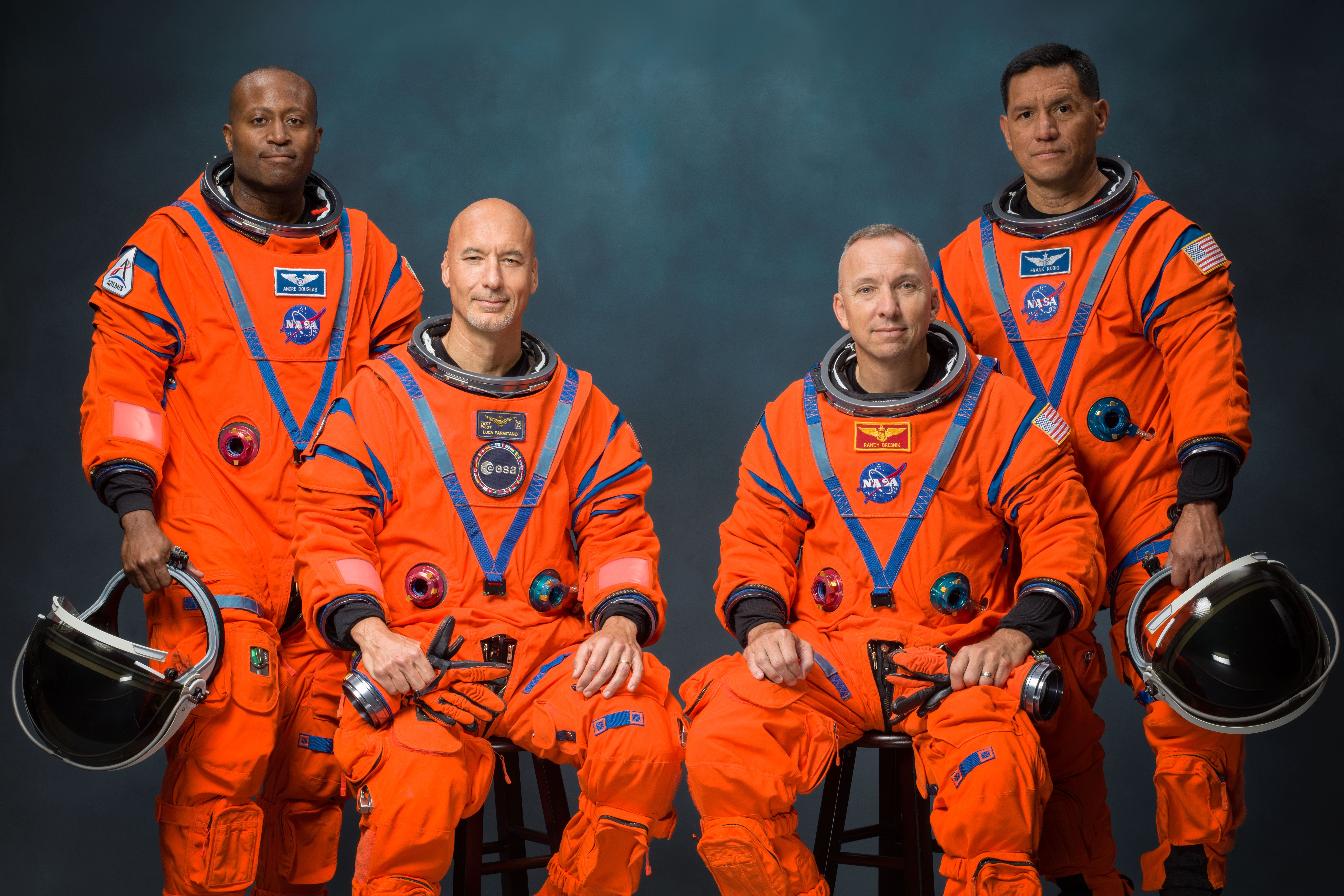
NASA introduced the four astronauts who will fly its next major test mission toward returning humans to the Moon, though none of them will get anywhere near the lunar surface. Randy Bresnik will command the flight, with Italian astronaut Luca Parmitano of the European Space Agency as pilot, and Frank Rubio and Andre Douglas serving as mission specialists; backup astronaut Bob Hines will train alongside them. Their mission, planned for next year, will stay in low Earth orbit for about two weeks, where the crew will practice docking the Orion capsule with two competing commercial lunar landers built by SpaceX and Blue Origin. Getting that docking right is the main remaining technical hurdle before NASA attempts an actual crewed Moon landing, currently targeted for the Artemis IV mission in 2028. The announcement follows April's successful Artemis II flight, which sent astronauts around the Moon and back without landing, the first crewed mission to leave low Earth orbit since Apollo 17 in 1972.
NASA has hired both SpaceX (a modified Starship) and Blue Origin (its Blue Moon lander) to build human landing systems, hedging against delays or failures from either company. Artemis III was originally meant to be the landing mission itself; NASA restructured the program to add this orbital test flight after the landers fell behind schedule.