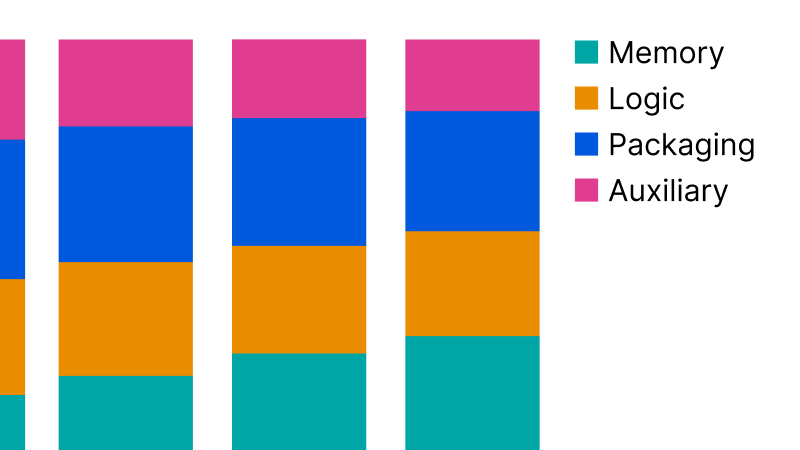
High-bandwidth memory (HBM) now accounts for 63% of AI chip component costs, up from 52% in early 2024, according to an Epoch AI analysis covering chips from Nvidia, AMD, Google, and Amazon. Total component spending on AI chips roughly doubled from $22 billion in 2024 to $52 billion in 2025, with HBM alone driving $20 billion of that increase. Logic die costs stayed near 13%, while packaging and auxiliary components fell as a share. The shift reflects tight HBM supply and rising prices. Hyperscalers are already factoring the trend into capital expenditure plans: Microsoft's $190 billion FY2026 capex includes $25 billion from higher component prices, and Meta raised its 2026 capex range by $10 billion for the same reason. Memory, not logic, is becoming the dominant cost driver in AI hardware.
HBM stacks are specialized memory chips placed vertically and close to the processor to reduce latency and power, critical for training large AI models. The main suppliers are SK Hynix, Samsung, and Micron.
Researchers at Tohoku University have shown that adding distributed micro-roughness (DMR) — surface irregularities too fine to see — can cut aerodynamic drag by up to 43.6%. The finding upends an 80-year-old assumption that smooth surfaces minimize drag. The team, led by associate professor Aiko Yakino, used a magnetic levitation wind tunnel that suspends models without support struts, eliminating airflow interference that masked the effect in earlier experiments. The DMR technique delays the transition from smooth laminar flow to chaotic turbulent flow, unlike shark-skin-inspired riblets that manage turbulence after it forms. The researchers measured drag coefficients across Reynolds numbers from 0.35 million to 3.6 million. If the results translate to real aircraft, the energy savings could be substantial.
The boundary layer is the thin layer of air next to a surface; laminar flow has low friction, turbulent flow has high friction. Delaying transition reduces drag. A 1940 study by Japanese scientist Ichiro Tani had linked surface roughness to early transition.
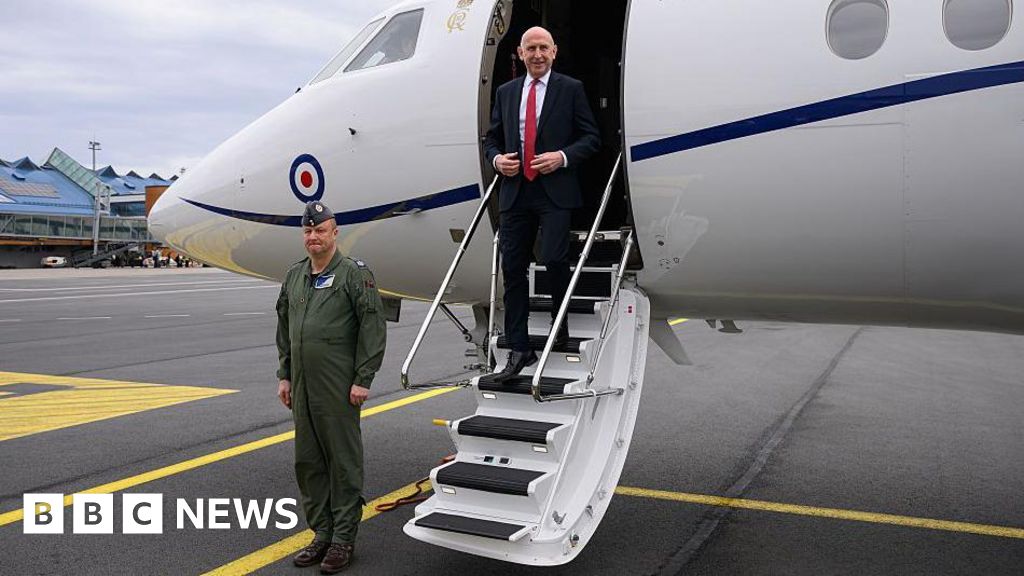
An RAF jet transporting UK Defence Secretary John Healey had its GPS signal jammed for the duration of a three-hour flight near the Russian border on Thursday. Pilots switched to an alternative navigation system. Russia is believed responsible. The incident occurred as Healey returned from visiting British troops in Estonia, and a day after it emerged that two Russian warplanes had dangerously intercepted an RAF spy plane over the Black Sea last month, with one Su-35 disabling the Rivet Joint's autopilot and a Su-27 passing within six metres. It is unclear whether Healey was specifically targeted, but the flight path was visible on tracking websites. A similar GPS jamming affected then-Defence Secretary Grant Shapps's plane in 2024.
GPS jamming involves broadcasting radio noise to overpower satellite signals, a tactic Russia has used near its borders and in conflict zones. The RAF Rivet Joint is a signals-intelligence aircraft based on the Boeing RC-135.
Riot police forced their way into the Ankara headquarters of Turkey's main opposition Republican People's Party (CHP) on Sunday, days after an appeals court nullified the election of party leader Özgür Özel and reinstated 77-year-old Kemal Kilicdaroğlu. Party members had barricaded the entrance; tear gas was deployed. Özel, who called the court ruling a move to eliminate rivals, later led hundreds of supporters toward parliament. The court's decision also replaces the entire party executive. The governor's office said police acted to enforce the court order after Kilicdaroğlu's representatives requested the handover. Human Rights Watch had warned the day before that President Recep Tayyip Erdoğan's government was using 'abusive tactics' to undermine democracy. The CHP's popular Istanbul mayor, Ekrem Imamoğlu, has been jailed for over a year on corruption charges.
Erdoğan has led Turkey since 2003, first as prime minister then president. He can only run again if early elections are called before 2028 or the constitution is changed. The CHP is the main secular opposition party.
George Hotz argues that adopting AI agents for software development will be a costly mistake. After six months of using agents to write parts of tinygrad and reverse-engineer hardware, he concludes they frontload progress but never deliver polish, leaving a slot-machine dynamic where you keep pulling the lever hoping for a finished result. The output is broken in ways that become harder to detect as models improve, because they are statistical mimics of programming, not engineers. Hotz sees large organizations as most vulnerable: bottom performers will produce 10x the slop without the self-check that high performers apply. The result, he predicts, will be more code and more features than ever, but a dark age for quality. He expects macOS to get worse as Apple pushes AI on its engineers.
George Hotz is known for jailbreaking the iPhone and founding comma.ai. tinygrad is his open-source deep learning framework. The piece responds to claims that AI agents can replace software engineers.
Virginia's new law, effective July 1, bans the transfer or purchase of semiautomatic firearms defined as 'assault firearms' and magazines holding over 15 rounds, making violations a misdemeanor punishable by up to a year in jail. Stephen P. Halbrook, a constitutional lawyer, argues the ban defies the Supreme Court's Heller precedent protecting arms 'in common use.' He notes that Justice Kavanaugh recently predicted the Court would soon address AR-15 bans, and that Justice Kagan acknowledged the AR-15 as the most popular rifle in the country. Halbrook also points out that the Virginia Constitution explicitly protects the right to keep and bear arms, and that a 1964 legislative declaration affirmed that right for personal defense and sport. Governor Spanberger signed the bill while conceding it may need clarifying language for hunting firearms.
The Supreme Court's 2008 Heller decision recognized an individual right to possess firearms for self-defense. The Court has not yet ruled on assault weapons bans, but several justices have signaled interest. Virginia's law follows similar bans in California and Maryland.
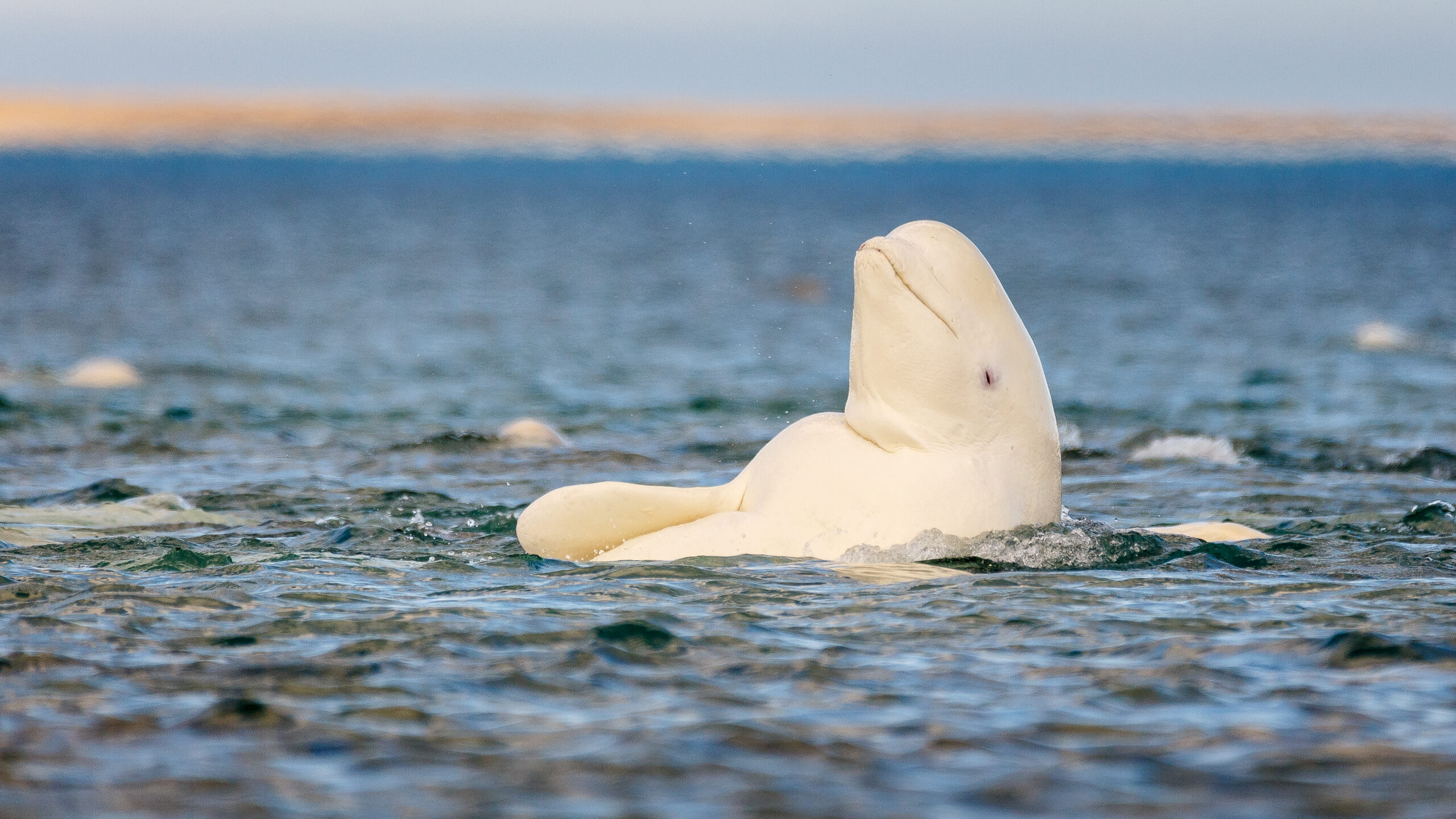
Two beluga whales at a New York aquarium, Natasha and her daughter Maris, showed behaviors consistent with mirror self-recognition in a study published in PLOS One. Researchers marked the whales with waterproof lipstick during feeding and observed them orienting marked body parts toward a mirror, while sham marks without pigment produced no such response. The footage is over two decades old; the team digitized and reanalyzed it after original tapes degraded. The mirror test, invented in 1970, is passed by only a handful of species: humans, great apes, elephants, dolphins, magpies, and possibly orcas and cleaner wrasse. The beluga results sit at the edge of what counts, with some behaviors overlapping with known solo play, but the authors argue the progression of stages matches other species that show self-recognition.
The mirror self-recognition test places a mark on an animal where it can only be seen in a reflection; touching the mark while looking in the mirror suggests the animal understands the reflection is itself. The test's inventor, Gordon Gallup, has disputed many positive results.
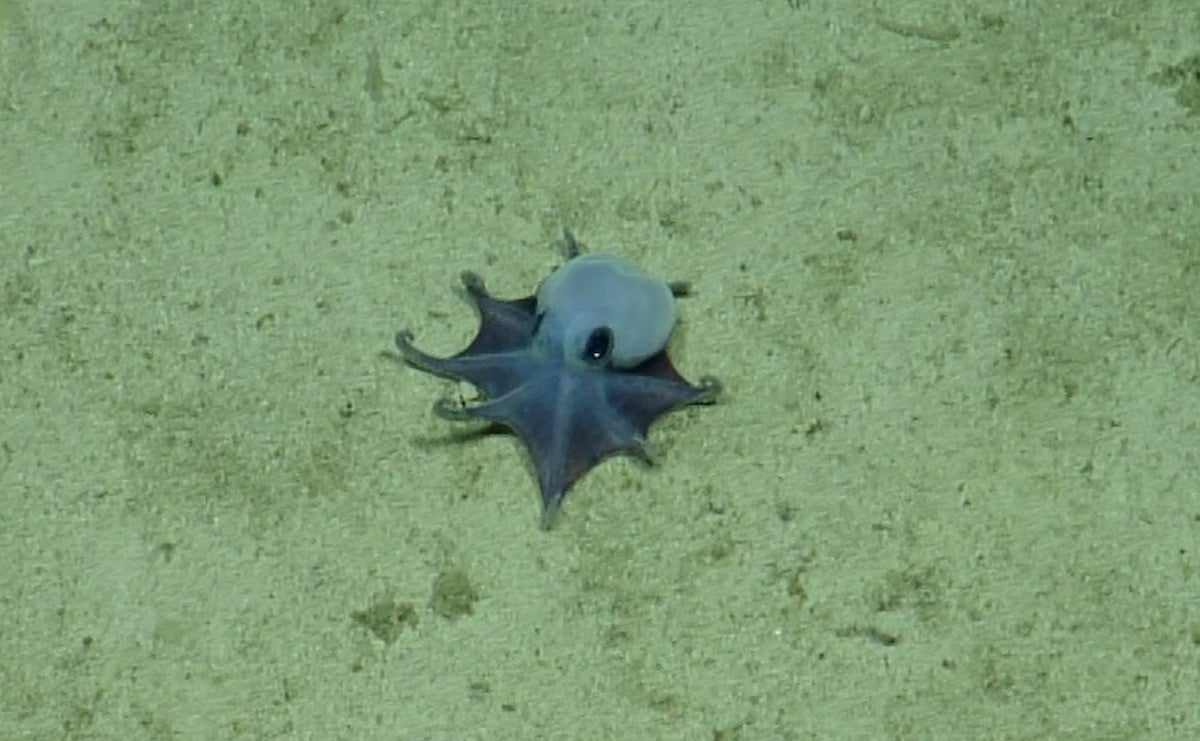
Scientists have described a new species of deep-sea octopus, Microeledone galapagensis, discovered in 2015 off Darwin Island in the Galápagos at a depth of 1,773 meters. The golf-ball-sized blue cephalopod was collected by the robotic sub Hercules during an E/V Nautilus expedition. Octopus expert Janet Voight of the Field Museum recognized it as something she had never seen. Micro-CT scans revealed distinctive features: relatively few arm suckers, smooth skin, and unique beak and organ coloring. The specimen carried 13 eggs. The find underscores how much of the deep ocean around the Galápagos remains unexplored. The archipelago, famous for Darwin's finches, continues to yield new species.
The Galápagos Islands, about 600 miles off Ecuador, are a biodiversity hotspot and UNESCO World Heritage site. The E/V Nautilus is a research vessel operated by the Ocean Exploration Trust, founded by Robert Ballard.
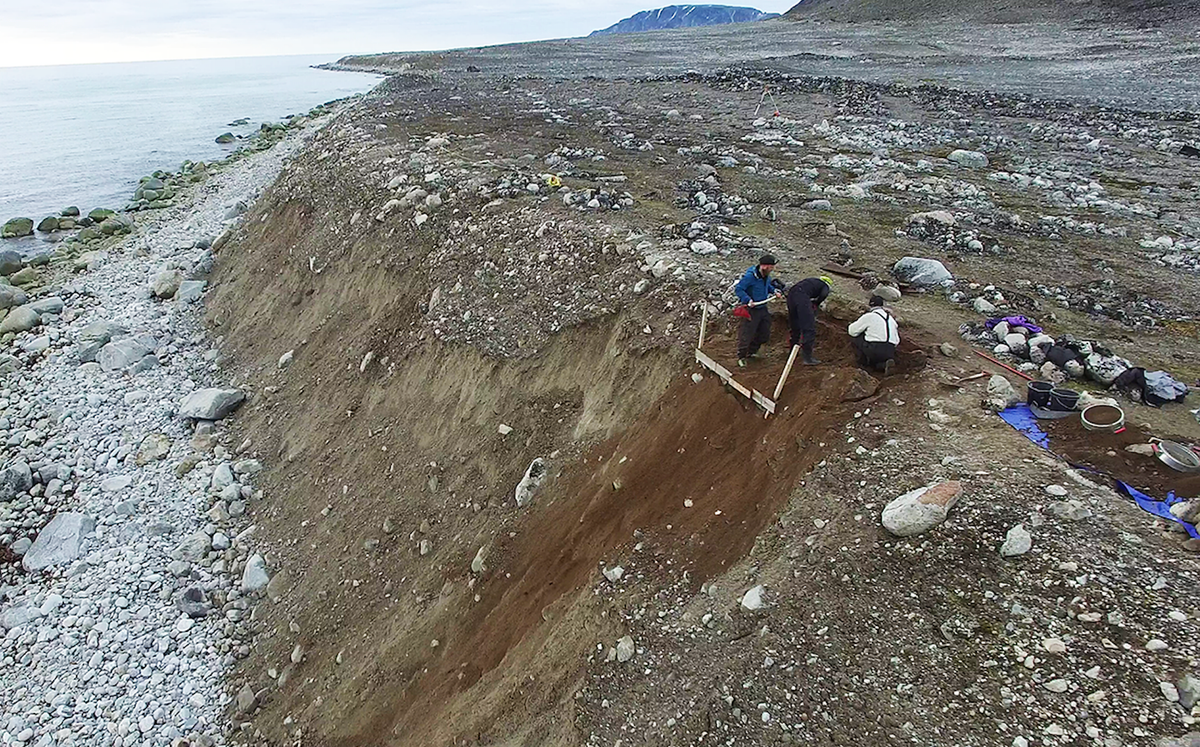
Permafrost thaw at Likneset, a 17th- and 18th-century whaling burial site on Norway's Svalbard archipelago known as Corpse Point, is exposing and destroying graves, according to a PLOS One study. Researchers re-examined remains first documented in the 1970s and found coffin lids collapsed, sideboards displaced, and one grave completely destroyed, its contents scattered downslope. The bones tell of hard lives: 18 of 19 studied sailors had scurvy, and most died in their 20s or early 30s, with healed injuries suggesting cumulative stress rather than acute trauma. The authors warn that in situ preservation is no longer viable under warming permafrost and call for urgent documentation before more is lost. The Arctic is warming nearly four times faster than the global average.
Svalbard is a Norwegian archipelago in the Arctic Ocean. Likneset served as a burial ground for European whalers who operated in the region during the early modern period. Permafrost is ground that remains frozen for at least two years; its thaw releases greenhouse gases and destabilizes structures.
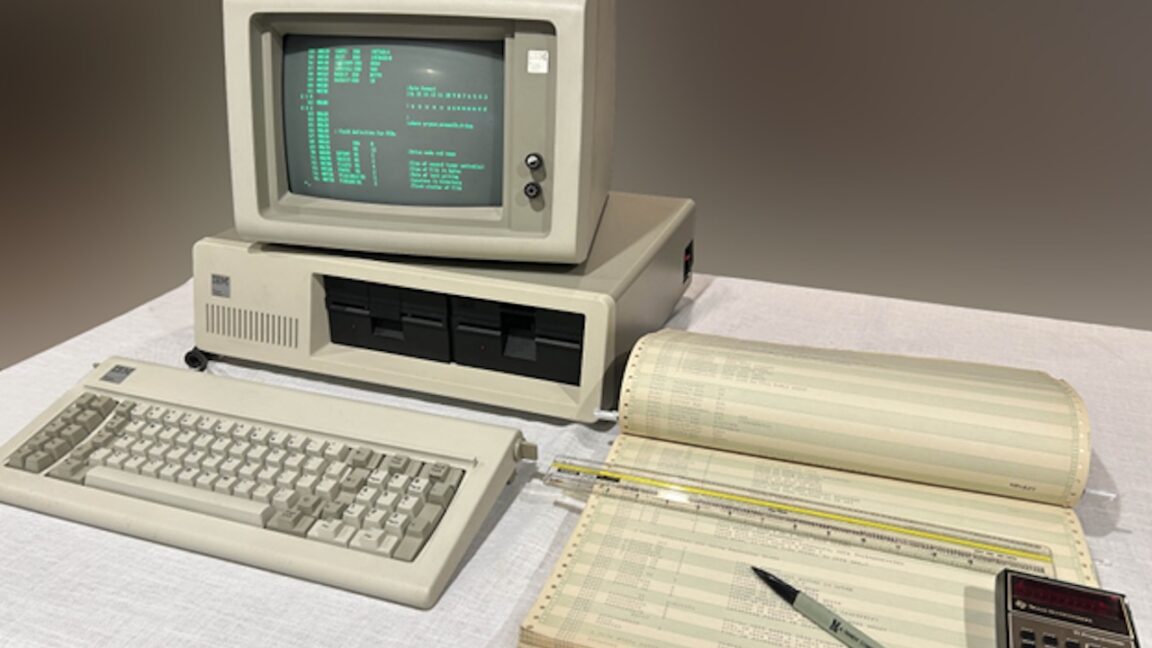
Microsoft has released the source code for 86-DOS 1.00, the predecessor to MS-DOS, along with development snapshots of PC-DOS 1.00 and utilities like CHKDSK. The code predates the MS-DOS branding and was recovered from paper printouts provided by original developer Tim Paterson. A volunteer group, the DOS Disassembly Group, transcribed the decades-old printouts after optical character recognition failed. Paterson created 86-DOS for an Intel 8086 computer kit; Microsoft licensed it, hired Paterson, and later bought the rights to supply an operating system for the IBM PC. The release joins earlier open-sourcing of MS-DOS 1.25, 2.0, and 4.0.
MS-DOS became the dominant operating system for IBM PC clones in the 1980s and 1990s. Microsoft previously open-sourced later versions in 2014 and 2018. The 86-DOS source offers a glimpse of the software that launched the PC revolution.