OpenAI’s latest large language model has solved the 80-year-old unit distance conjecture, a geometry problem that asks for the maximum number of pairs of points that can be placed at exactly one unit apart. The AI constructed a higher-dimensional lattice with special symmetries, then mapped it down to two dimensions to produce a configuration that beats the long-standing record set by Paul Erdős in 1946. Mathematicians Timothy Gowers and Daniel Litt, who reviewed the proof, say it is the first AI-generated result that would merit publication in a top journal if produced by humans. The model did not prove that its construction is optimal, but the breakthrough demonstrates that AI can now contribute genuinely novel mathematical insights, not just verify existing ones. OpenAI researchers Mehtaab Sawhney and Mark Sellke described the output as resembling their own working style.
The unit distance problem asks: for n points in the plane, what is the maximum number of pairs separated by exactly one unit? Erdős conjectured that a carefully spaced grid is nearly optimal, but proving it remained open for 80 years.
Cleve Moler, the mathematician and computer scientist who created MATLAB, has died. Moler developed the original MATLAB in the late 1970s as a simple interactive interface to the LINPACK and EISPACK numerical libraries, aiming to give his students at the University of New Mexico easier access to matrix computation. The software grew into a dominant platform for scientific computing, engineering simulation, and algorithm development, used by millions of researchers and engineers worldwide. Moler also co-founded MathWorks in 1984 with Jack Little, turning MATLAB into a commercial product while maintaining its deep roots in numerical linear algebra. His work shaped how generations of scientists and engineers approach computation, making matrix manipulation and visualization a standard part of the technical workflow.
MATLAB (Matrix Laboratory) began as a teaching tool and evolved into a comprehensive environment for numerical computing, control systems, signal processing, and more. Moler’s contributions to numerical methods, including the LINPACK project, are foundational.
The global memory supply is being diverted from smartphones to AI servers, driving up costs and killing the cheap smartphone market that brought internet access to hundreds of millions of people in the developing world. Memory production is highly inelastic—fabs take years to build—so when AI companies bid up prices for high-bandwidth memory, manufacturers reallocate capacity away from the low-margin chips used in budget phones. The International Data Corporation forecasts a 13% drop in worldwide smartphone shipments this year, with declines exceeding 20% in Africa and the Middle East. The author argues this is not a temporary blip but a structural reset: if AI consumption continues to grow, even rich-world consumers will soon face sharply higher prices for phones, laptops, and other electronics that depend on the same memory supply chain.
Smartphones use DRAM and NAND flash memory. The same fabrication plants produce memory for both consumer devices and data-center GPUs. AI training and inference require massive amounts of high-bandwidth memory, creating competition that squeezes out lower-margin applications.
Harvard College’s faculty voted overwhelmingly to cap A-range grades at 20% of grades in each course, a move to curb grade inflation that has seen the median grade rise to an A-minus. The policy, which passed with nearly 70% support, will apply to all undergraduate courses. Students expressed concern that the cap could disadvantage them when applying to graduate schools and jobs where peers from other elite institutions still benefit from inflated transcripts. The vote follows years of debate about grading standards at Harvard, where critics argue that compressed grade scales make it hard to distinguish exceptional work. Similar caps exist at a handful of other universities, but Harvard’s size and influence make this one of the most significant faculty-led efforts to rein in grade inflation.
Grade inflation at elite US universities accelerated in the 1960s and again in the 2000s. At Harvard, the most common grade is an A, and the average GPA has risen above 3.7. Faculty have periodically debated reforms, but this is the first binding cap to pass.
Using the James Webb Space Telescope, astronomers have mapped the weather on a tidally locked gas giant 700 light-years away, revealing cloudy mornings and clear evenings on WASP-94A b. The team used limb-resolved spectroscopy to separate the light filtering through the planet’s morning and evening edges during transit. The morning limb showed high-altitude aerosols blocking deeper atmospheric signals, while the evening limb revealed clear skies with gaseous water vapor. This challenges the standard assumption that exoplanet atmospheres are uniform, which could mean that chemical compositions inferred from traditional transmission spectroscopy are systematically off. The planet’s extreme day-night temperature contrast drives equatorial super-rotation winds that sweep clouds around the globe, creating the asymmetric weather pattern.
Transmission spectroscopy measures starlight filtered through an exoplanet’s atmosphere during transit. For tidally locked planets, one side always faces the star, creating large temperature differences. Limb-resolved spectroscopy splits the signal from the leading and trailing edges to capture spatial variation.
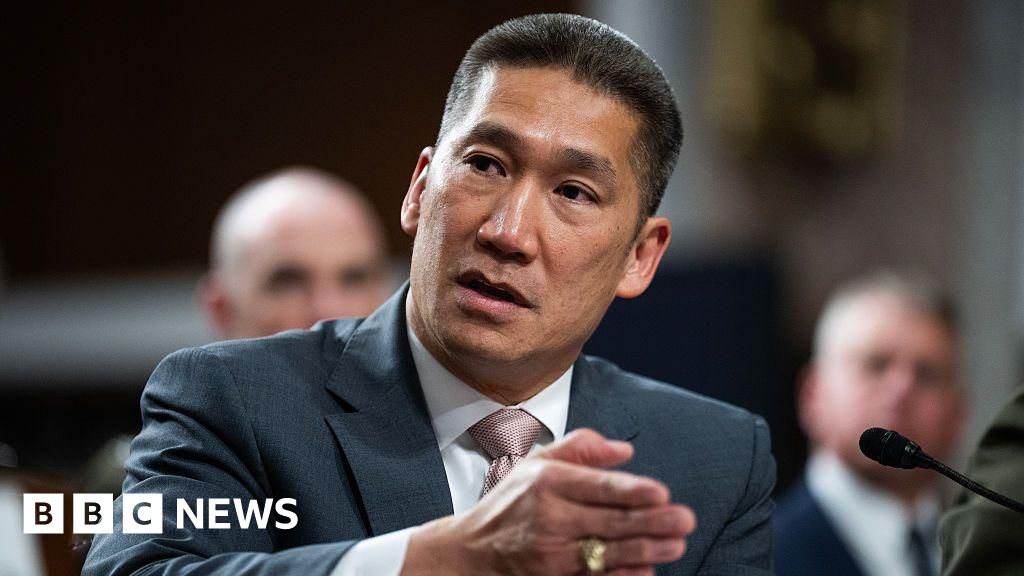
The United States is pausing a $14 billion arms sale to Taiwan to ensure it has enough munitions for the ongoing military operation against Iran, acting Navy Secretary Hung Cao told a Senate hearing. President Trump had previously called the sale a ‘negotiating chip’ with China and said he would discuss it directly with Taiwan’s president—a break from decades of diplomatic protocol. Taiwan’s presidential office said it has not received any official notice of a pause. The move comes weeks after Trump met with Xi Jinping in Beijing, where the Chinese leader emphasized Taiwan as the most important issue in US-China relations. Beijing claims Taiwan as its territory and has not ruled out using force to bring it under control.
The US has sold defensive weapons to Taiwan since 1979 under the Taiwan Relations Act, but each sale angers Beijing. The $14 billion package, approved last December, was one of the largest ever. The Iran conflict, code-named Epic Fury, is straining US munitions stockpiles.
A new paper on arXiv proposes Multi-Stream LLMs, an architecture that decouples the prompt processing, internal reasoning, and output generation into parallel streams. Current language models process tokens sequentially, which creates a bottleneck: the model cannot begin generating a response until it has fully processed the input and completed its chain-of-thought. The proposed approach allows these stages to overlap, potentially reducing latency and improving throughput. The paper demonstrates that the parallel streams can be trained end-to-end without sacrificing quality. If adopted, this could make large models more responsive in interactive applications and more efficient in serving multiple users. The work has drawn attention on Hacker News, where commenters note its potential to change how LLM inference is architected.
Most LLMs today use autoregressive decoding: each token is generated one at a time, conditioned on all previous tokens. This sequential dependency limits parallelism. Multi-stream architectures aim to break that dependency by separating concerns into independent streams that can run concurrently.
The Coalition for Independent Technology Research is suing the Trump administration over a State Department visa restriction policy that targets foreign officials and researchers involved in content moderation and disinformation research. The policy, announced by Secretary of State Marco Rubio, is so vague that it chills speech and due process, the plaintiffs argue. The lawsuit, filed in Washington, DC, asks the court to strike down the policy as unconstitutional. Government lawyers counter that the policy targets conduct—assisting foreign censorship—not speech. The case could determine whether the US can use immigration law to punish online safety work, with implications for researchers worldwide who study hate speech, propaganda, and platform accountability.
Since returning to office, the Trump administration has pursued what it calls the ‘censorship-industrial complex,’ alleging that tech platforms, academics, and civil society groups colluded to suppress conservative voices. The visa policy is part of that broader effort.
A survey of US HR leaders by learning platform D2L finds that generative AI is raising productivity expectations for entry-level roles even as headcount stays flat. Thirty percent of companies are hiring fewer junior employees and using AI to handle tasks previously assigned to new graduates. The report warns that this shift eliminates the foundational on-the-job learning that builds future senior leaders: 58% of HR professionals worry about a leadership shortage within five years, yet 74% have no programs to replace the lost training. Respondents also report declines in problem-solving, communication, and interpersonal skills among recent hires compared to cohorts from three to five years ago. The findings suggest that short-term efficiency gains from AI may come at the cost of long-term talent development.
Entry-level roles have traditionally served as a training ground where new graduates develop professional skills through routine tasks. AI automation of those tasks—data entry, basic analysis, drafting—removes the learning opportunities that prepare workers for more complex responsibilities.
More than 30 US states are asking a federal judge to break up Live Nation-Ticketmaster, following a jury verdict that found the company illegally monopolized the live events market. The proposed remedies go beyond the Department of Justice’s settlement, demanding that the company sell its ticketing business and a ‘sufficient number’ of large amphitheaters, and barring it from tying venue access to the use of its promotion services. The states also seek monetary relief for consumers who paid inflated ticketing fees. Live Nation has vowed to fight the verdict. The case represents one of the most significant antitrust actions against a tech-enabled platform since the Microsoft case, with potential ripple effects for other dominant digital marketplaces.
The DOJ sued Live Nation-Ticketmaster in 2024, alleging it used exclusive contracts and threats to maintain a monopoly over concert promotion and ticketing. A jury agreed in April 2026. The states’ proposed remedies are now before Judge Arun Subramanian.