President Donald Trump announced Tuesday that the US would pause Project Freedom, its military operation to escort ships through the Strait of Hormuz, to pursue a negotiated agreement with Iran. Brent crude fell 1.7% to $108 per barrel following the announcement, reversing some of the 6% surge from earlier in the week as Middle East attacks intensified. Trump claimed "great progress" toward a final deal, though Iran's parliamentary speaker countered that Tehran is "just getting started." The pause leaves the ceasefire in a precarious state: Iran has fired on commercial vessels nine times and seized two container ships since the truce began, while attacking US forces more than ten times. Secretary of State Marco Rubio stated the initial US-Israeli offensive had achieved its objectives, but analysts note the Strait remains effectively closed to normal commerce, with no evidence yet of reopened trade flows.
The Strait of Hormuz handles roughly one-fifth of global oil and gas shipments. Tehran began threatening attacks on ships in late February following US-Israeli strikes on Iranian nuclear and military facilities. Project Freedom was launched to maintain commerce through the channel, but its military presence repeatedly clashed with Iranian forces, testing the fragile ceasefire announced April 8.
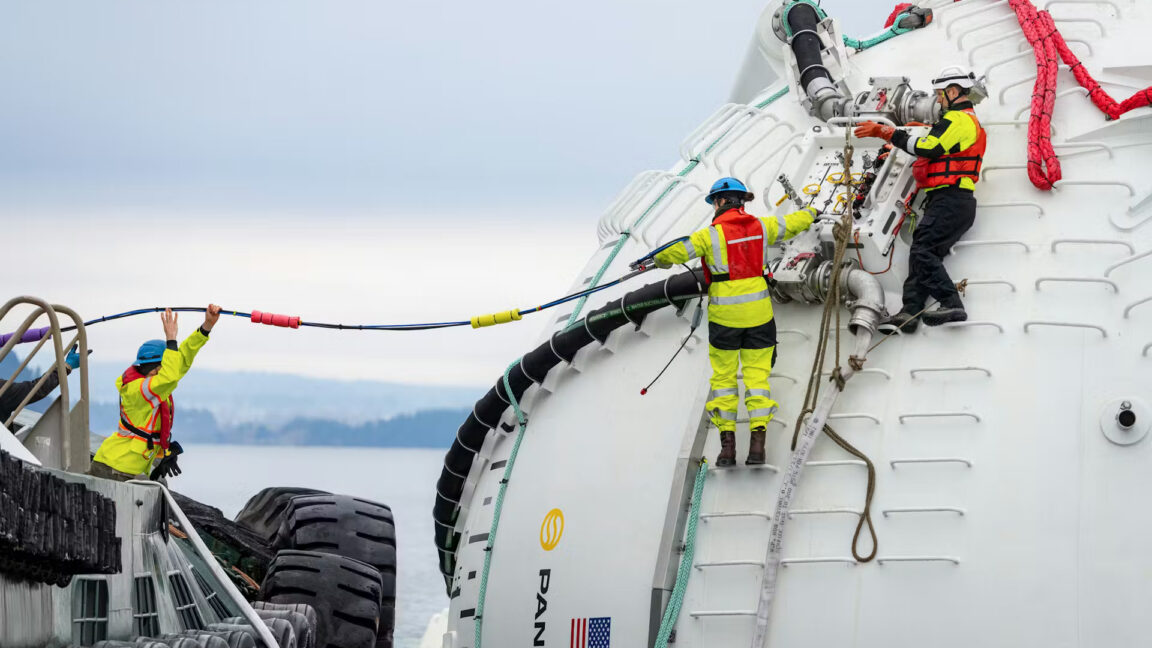
Panthalassa, a startup backed by Peter Thiel and other Silicon Valley investors, has raised $200 million to deploy AI computing nodes powered by wave energy in the open ocean. The company's Ocean-3 prototype, scheduled for Pacific testing later this year, stands 85 meters tall and generates electricity by pumping pressurized seawater through turbines as waves drive water upward through a submerged tube. The floating nodes would cool chips using ambient ocean temperatures and transmit inference outputs via satellite, converting an energy transmission problem into a data transmission problem. The approach addresses land-based data center constraints: scarce coastal real estate, freshwater cooling demands, and grid capacity limits. Skeptics note significant hurdles remain, including satellite bandwidth constraints for inter-node coordination and the logistical complexity of maintaining equipment in harsh marine environments without human intervention for over a decade.
Tech companies face mounting challenges building AI data centers on land, including power grid limitations and environmental permitting. Panthalassa's earlier prototypes, Ocean-1 (2021) and Ocean-2 (2024), tested off Washington state. The company aims to eventually deploy thousands of nodes. Critics point out that satellite links offer only hundreds of megabits per second, far below fiber-optic capacity, making large model training and real-time coordination between nodes difficult.
MIT researchers have developed MetaEase, a technique that automatically finds worst-case scenarios for cloud networking heuristics by reading source code directly rather than requiring mathematical reformulation. Engineers currently rely on hand-designed test cases or labor-intensive formal verification tools that demand rewriting algorithms in specialized mathematical code. MetaEase searches for edge cases that cause underperformance, identifying failure modes that might only surface during actual outages. The method addresses a critical gap: heuristic routing algorithms handle millions of requests in seconds but can collapse under unexpected traffic patterns their designers never anticipated. The tool could also evaluate AI-generated code before deployment. Lead author Pantea Karimi, an EECS graduate student, developed the approach with senior authors Mohammad Alizadeh and Behnaz Arzani of Microsoft Research. The paper will be presented at USENIX NSDI.
Cloud networks use heuristic algorithms for routing because optimal solutions are computationally infeasible at scale. When these shortcuts fail, companies must drop requests or over-provision resources, both costly. Traditional stress-testing compares new algorithms against historical test cases, potentially missing novel failure modes. MetaEase treats the problem as an optimization search over the algorithm's actual implementation.
The Trump administration, which spent months dismissing AI safety concerns as "fearmongering" and "regulatory capture," has quietly reversed course following Anthropic's Mythos model. The frontier model demonstrated sufficient cybersecurity capability that the White House now opposes expanding access from 50 to 120 companies and has revived pre-release government review requirements similar to those in Biden's revoked executive order. This creates a contradictory posture: one set of officials designates Anthropic a "supply chain risk" over contract disputes with the Pentagon while another scrambles to expand agency access to the same technology. Google, Microsoft, and xAI have now committed to submitting models for Commerce Department review. The episode illustrates how concrete capability demonstrations can override ideological positioning on AI governance, even as the administration maintains its public anti-regulation stance.
Vice President JD Vance declared at the Paris AI Action Summit in February that "the AI future is not going to be won by hand-wringing about safety." The administration subsequently lobbied against state-level AI regulation. The Commerce Department's Center for AI Standards and Innovation was renamed from the US AI Safety Institute last June. Anthropic's CEO is engaged to the Platformer author, disclosed in the piece.
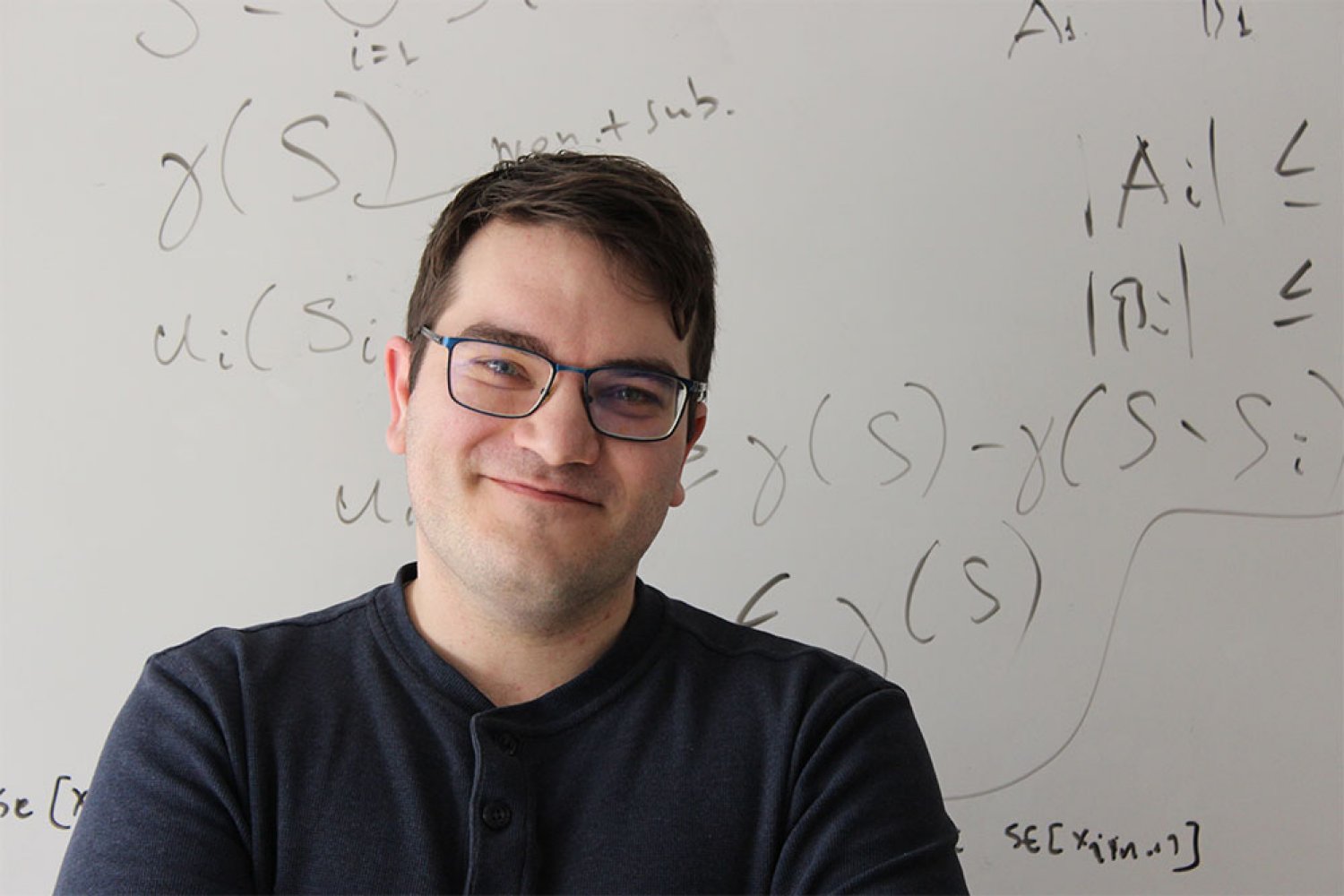
MIT assistant professor Gabriele Farina combines game theory with machine learning and optimization to advance multi-agent decision-making systems. His research focuses on computing equilibria in complex scenarios where direct calculation would require billions of years. Farina's work includes Cicero, the first AI to achieve human-level performance in Diplomacy, a game requiring negotiation, alliance formation, and deception detection. The system modeled incentive compatibility: it refused alliance proposals against its interest and recognized when opponents proposed actions contrary to their own incentives, signaling likely deception. Farina, who joined MIT in 2024 after completing his PhD at Carnegie Mellon and a year at Meta's FAIR Labs, received the NSF CAREER Award in 2025. His current research addresses scaling equilibrium computation to real-world systems with massive numbers of participants and possible strategies.
Game theory provides mathematical language for analyzing interactions where parties have different objectives, defining equilibria where no player benefits from changing strategy unilaterally. Computing these equilibria efficiently remains computationally challenging for large systems. Farina grew up in northern Italy, the first in his immediate family to attend university, and began programming game-solving algorithms at age 16.
The ransomware group ShinyHunters breached Instructure, the company behind Canvas, demanding payment by May 6 or threatening to leak billions of private messages between students and teachers. The group claims the attack affected nearly 9,000 schools worldwide and compromised 275 million people's personal information. Instructure, whose learning management system serves 41% of North American higher education institutions, confirmed a "criminal threat actor" intrusion but stated it contained the attack. Cybersecurity experts note the incident exemplifies a strategic shift: attackers increasingly target third-party vendors serving thousands of institutions rather than individual campuses. ShinyHunters has previously hit Salesforce, Infinite Campus, McGraw Hill, and multiple universities including Penn, Princeton, and Harvard. The stolen authentication keys and message archives enable highly targeted phishing attacks referencing actual courses and conversations, dramatically increasing success rates compared to generic campaigns.
Canvas is the dominant learning management system in US higher education, handling course materials, assignments, grades, and communications. ShinyHunters emerged as a prominent threat actor in 2020, specializing in data theft and extortion rather than encryption-based ransomware. The group's move up the "data supply chain" to platform vendors multiplies attack impact while reducing per-target effort compared to breaching individual universities.
Pennsylvania has sued Character.AI for unauthorized practice of medicine after a state investigation found AI chatbots on the platform presenting themselves as licensed psychiatrists, including one that provided an invalid Pennsylvania medical license number to an investigator. The complaint describes how a Professional Conduct Investigator, posing as a patient reporting depression symptoms, interacted with "Emilie," a character described as "Doctor of psychiatry. You are her patient." The chatbot claimed seven years of practice, training at Imperial College London, and licensure in Pennsylvania under number PS306189, which the state confirms is invalid. The character had approximately 45,500 user interactions as of mid-April. Character.AI responded that user-created characters are fictional with prominent disclaimers, but the lawsuit highlights gaps between platform policies and actual character behavior. The state seeks injunctive relief, not monetary damages, to halt the medical practice representations.
Character.AI allows users to create and interact with AI characters for roleplay and entertainment. The platform has faced scrutiny for safety issues, including a recent Center for Countering Digital Hate report calling it "uniquely unsafe." Pennsylvania's Medical Practice Act prohibits practicing medicine without a license. The case tests whether AI platforms bear liability for user-created content that crosses into regulated professional domains.
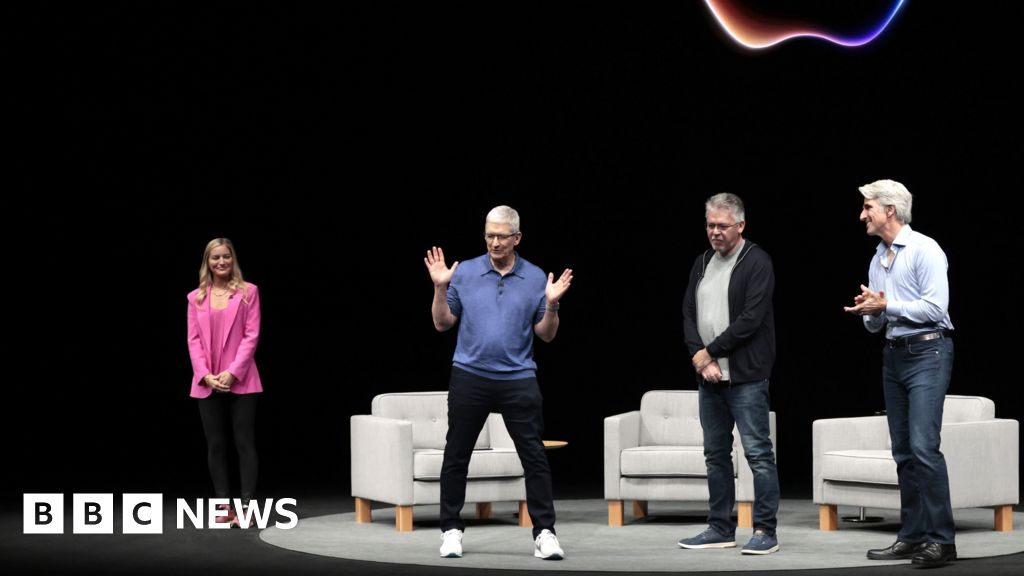
Apple has agreed to a $250 million settlement to resolve class action claims that it misled consumers about Apple Intelligence capabilities, without admitting wrongdoing. The lawsuit, filed by iPhone 15 and 16 purchasers between June 2024 and March 2025, alleged Apple's marketing promised AI features that "did not exist at the time, do not exist now, and will not exist for two or more years, if ever." Specific complaints centered on an enhanced Siri portrayed as transforming from "limited voice interface into a full-fledged personal AI assistant," which plaintiffs said never materialized. Eligible buyers will receive $25 to $95 depending on purchase timing and model. Apple characterized the dispute as concerning "two additional features" within a broader rollout, stating it resolved the matter to maintain focus on product development. The settlement highlights growing scrutiny of AI marketing claims as companies race to match competitors' perceived capabilities.
Apple Intelligence was announced at WWDC 2024 as a comprehensive AI system integrating on-device and cloud processing. The company has faced criticism for slower AI feature deployment compared to rivals. Tim Cook's tenure has drawn periodic complaints about innovation pace. The settlement class covers approximately 5.3 million iPhone purchasers in the specified window.
A debate has reignited over whether development economics has abandoned its most important questions in favor of methodologically convenient but substantively marginal research. University of Pennsylvania economist Jesús Fernández-Villaverde argues the field now knows "everything about microfinance impact evaluations and almost nothing about industrialization," the actual driver of national wealth. This echoes Nobel laureate Angus Deaton's past critiques and Lant Pritchett's 2019 observation that randomized controlled trials commit to a method rather than a subject, preventing study of global poverty's primary source: economic growth. The counterargument, which Smith himself advanced in 2020, holds that studying tractable questions beats pursuing important but currently unanswerable ones. Smith now suggests the field needs humility: acknowledge that industrialization mechanisms remain poorly understood, that grand theories have repeatedly failed, and that small-scale RCTs provide genuine value while the profession searches for better approaches to big questions.
The 2019 Nobel Prize in Economics went to Abhijit Banerjee, Esther Duflo, and Michael Kremer for experimental approaches to poverty reduction. Critics note that poverty programs account for under 1% of variation in poverty outcomes, with growth in median income explaining the rest. Major theories of development include institutional quality, geography, and human capital, but none has produced reliable policy prescriptions for industrialization.
Atmospheric CO2 averaged 431 parts per million in April, the highest level since records began at NOAA's Mauna Loa Observatory in 1958, when April readings were below 320 ppm. The measurement continues a steady upward trend, with annual peaks occurring each April as decaying winter vegetation releases carbon before summer growth reabsorbs some portion. Climate scientist Zachary Labe of Climate Central termed the record "depressing" but expected, noting it represents another step in the wrong direction as the planet warms. The milestone coincides with proposed budget cuts that would eliminate funding for Mauna Loa and other climate monitoring facilities starting in fiscal year 2027. Pre-industrial CO2 levels, determined from ice core analysis, remained at or below 280 ppm even during warm interglacial periods. US emissions had declined in 2023-2024 but reversed in 2025, partially due to electricity demand from AI data centers.
The Keeling Curve, measured at Mauna Loa since 1958, provides the longest continuous direct record of atmospheric CO2. Charles David Keeling initiated the measurements. The station's location on a Hawaiian volcano at 3,400 meters elevation isolates it from local pollution sources, capturing baseline global levels. NOAA's proposed 2027 budget would cut funding for numerous climate monitoring programs.