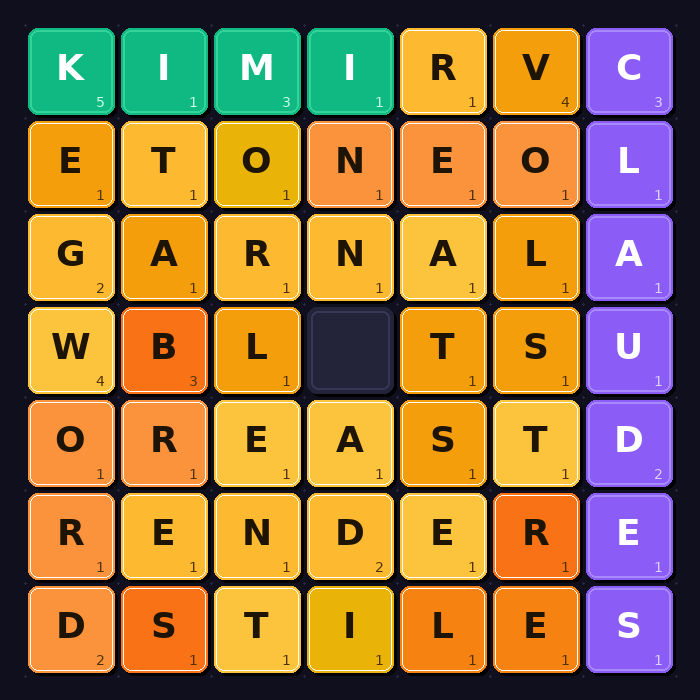
Moonshot AI's open-weights model Kimi K2.6 won a live programming tournament against Western frontier labs, finishing first in the Word Gem Puzzle challenge with 22 match points and a 7-1-0 record. The competition pitted ten models against each other in real-time sliding-tile word puzzles on grids from 10×10 to 30×30, with scoring that rewarded longer words and penalized short ones. Kimi won through aggressive sliding: a greedy algorithm that scored each move by what positive-value words it unlocked, falling back to alphabetical direction when no progress was available. This caused inefficient oscillation on smaller grids where seed words survived intact, but paid off on larger grids where reconstruction was the only path to points. Xiaomi's MiMo V2-Pro placed second with a brittle scan-only strategy. GPT-5.5 took third; Claude Opus 4.7 finished fifth. The result marks a notable moment for Chinese open-weights models in head-to-head coding competition.
The AI Coding Contest is an ongoing tournament where language models compete in real-time programming tasks with objective scoring. The Word Gem Puzzle involves sliding tiles to form valid English words in straight horizontal or vertical lines, with longer words scoring more points. Moonshot AI is a Chinese startup founded in 2023; Kimi K2.6 is available as open weights. Xiaomi's MiMo V2-Pro is currently API-only, though the company has announced weights for V2.5 Pro are coming soon.
New Mexico Attorney General Raúl Torrez won a $375 million jury verdict against Meta in March for misleading users about child safety. Starting Monday, a three-week public nuisance trial will determine what business changes the court will order. The state seeks age verification for New Mexico users, a ban on end-to-end encryption for minors, a 90-hour monthly usage cap, limits on infinite scroll and autoplay, and a 99% detection rate for new child sexual abuse material. Torrez aims to change how Meta operates, not just extract payment: "Even at $375 million... it's not enough in and of itself to change the way they're doing business." The remedies would apply only to New Mexico, though Meta could extend them nationally or exit the state entirely. The outcome will shape negotiations in thousands of pending cases against tech companies and signal whether courts will order structural changes to platform business models.
Meta faced a jury trial in New Mexico over allegations it misled users about the safety of Facebook, Instagram, and WhatsApp for children. The March verdict found Meta liable for $375 million. The current phase is a bench trial before Judge Bryan Biedscheid to determine remedies under public nuisance law. Meta has threatened to shut down services in New Mexico if ordered to make changes it deems infeasible.
California's proposed one-time 5% wealth tax on billionaires fails on three counts, argues Noah Smith. First, one-time levies cannot fund ongoing programs; the money runs out, forcing future political battles over renewal or cuts. Second, state-level taxes on the ultra-rich invite exit: billionaires can simply move. Third, the proposal exemplifies "slopulism"—the Democratic fantasy that government can run solely on super-rich taxes while the merely-rich get cuts. Smith, who supports progressive taxation, notes that capital availability is not scarce in America and that billionaires will not flee to Singapore over moderate rate hikes. But a confiscatory one-time state tax combines the worst features of both approaches: volatility for government, uncertainty for taxpayers, and revenue loss through migration. The structure guarantees a future crisis when the five-year spending window closes.
California Democrats have proposed a one-time 5% tax on net worth over $1 billion, with proceeds directed to health care, education, and food assistance over five years. The state faces persistent budget shortfalls. Billionaire migration has become a visible phenomenon, with high-profile departures to Texas and Florida. Smith is an economist and former Bloomberg columnist who writes on policy and markets.
President Volodymyr Zelensky has turned the Middle East conflict into an opportunity for Ukraine, signing defense technology deals with Saudi Arabia, the UAE, and Qatar after Iranian missile and drone strikes hit those countries. Ukraine offers hard-won expertise in intercepting low-cost drones: its systems cost around $10,000 to stop Shahed-136 drones that Russia fires at $80,000-$130,000 each. The Gulf partnerships tighten alliances with wealthy US-allied states and could yield defense contracts. Simultaneously, Ukraine secured an $8.6 billion deal with Norway and a $4.7 billion package with Germany in April. The diplomacy addresses a strategic vulnerability: US military hardware is increasingly committed to the Middle East, leaving less available for Europe. Trump claims a Ukraine "solution" is near after a "very good" call with Vladimir Putin, though previous optimistic predictions have not materialized.
The US-Israel war with Iran began February 28, 2026. Russia has benefited from higher oil prices as Middle East supply disruptions redirect demand to sanctioned Russian crude. Ukraine has fought Russian invasion since February 2022, developing extensive drone warfare and air defense experience. The Shahed-136 is an Iranian-designed loitering munition used extensively by Russia.
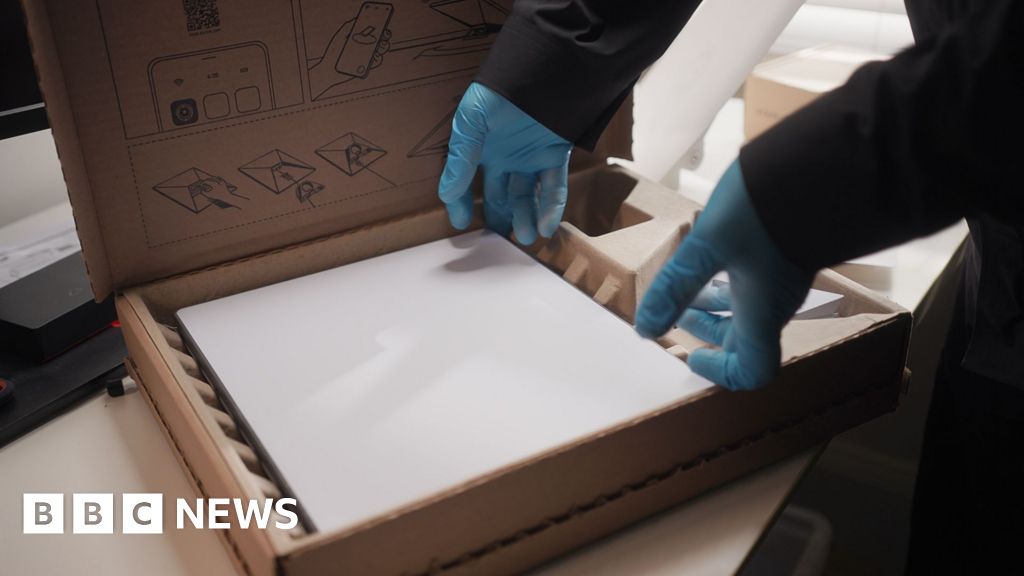
A network of Iranians outside the country is smuggling Starlink satellite internet terminals across borders to bypass Iran's two-month national internet shutdown, one of the longest ever recorded. The blackout began after US and Israeli airstrikes on February 28 and follows a January shutdown during protests that killed over 6,500 people. Sahand, a network member using a pseudonym, has sent a dozen terminals since January; volunteers estimate 50,000+ Starlinks are now in Iran. The regime criminalized Starlink use last year with penalties up to two years for possession and ten years for distribution. State media report arrests of sellers and buyers, often combined with charges of espionage. A Persian-language Telegram channel, NasNet, has sold approximately 5,000 terminals over two and a half years. The terminals connect directly to SpaceX satellites, bypassing Iran's controlled domestic network entirely.
Iran maintains a "tiered" internet system: a state-controlled domestic network for all citizens, with limited access to the global internet. The government has repeatedly shut down internet access during unrest, including nationwide protests in 2019 and 2022. Starlink, operated by SpaceX, provides broadband via low-earth orbit satellites and has been used in Ukraine and other conflict zones.
MIT alumnus Peter Godart has expanded Found Industries to address critical metal supply chain vulnerabilities. The company originally developed technology to transform aluminum into high-density fuel; when Godart discovered the process required gallium—a metal 99% controlled by China with export restrictions—he built electrochemical extraction technology rather than accept dependency. That internal tool is now Found Metals, a division aiming to become a major Western gallium supplier with Department of Energy support. Gallium is essential for semiconductors, defense systems, and energy applications. Found Energy continues separately, with a 100-kilowatt demonstration plant running and industrial pilots planned for 2027. Godart developed the aluminum fuel concept at NASA JPL for planetary exploration, then adapted it for terrestrial use with MIT professor Douglas Hart. The dual-structure company attempts to solve energy storage and critical mineral independence simultaneously.
Peter Godart earned MIT degrees in mechanical and electrical engineering (2015, 2019, 2021). He worked at NASA's Jet Propulsion Laboratory on in-situ resource utilization for space missions. China has used export controls on gallium and other critical minerals as economic leverage. The US government has prioritized domestic supply chain resilience for defense and energy security.
Microsoft changed a default setting in VS Code to automatically add "Co-authored-by: Copilot" trailers to Git commits when AI-generated contributions are detected, even for users who have disabled AI features entirely. The change merged in April 2026 altered the git.addAICoAuthor configuration default from "off" to "all". Users report the trailer appearing in commits where no Copilot interaction occurred, including with chat.disableAIFeatures set to true. The GitHub pull request shows 1,104 upvotes and 523 comments, with top-voted reactions calling the change "vandalism" and demanding reversion. A code review comment noted the runtime fallback still calls config.get with 'off', creating inconsistency with the schema default. Microsoft has not publicly responded to the criticism at time of writing.
VS Code is Microsoft's widely-used open-source code editor. GitHub Copilot is an AI coding assistant owned by Microsoft. The co-authored-by trailer is a Git convention for attributing multiple contributors to a commit. The change was made in pull request 310226 to the VS Code repository.
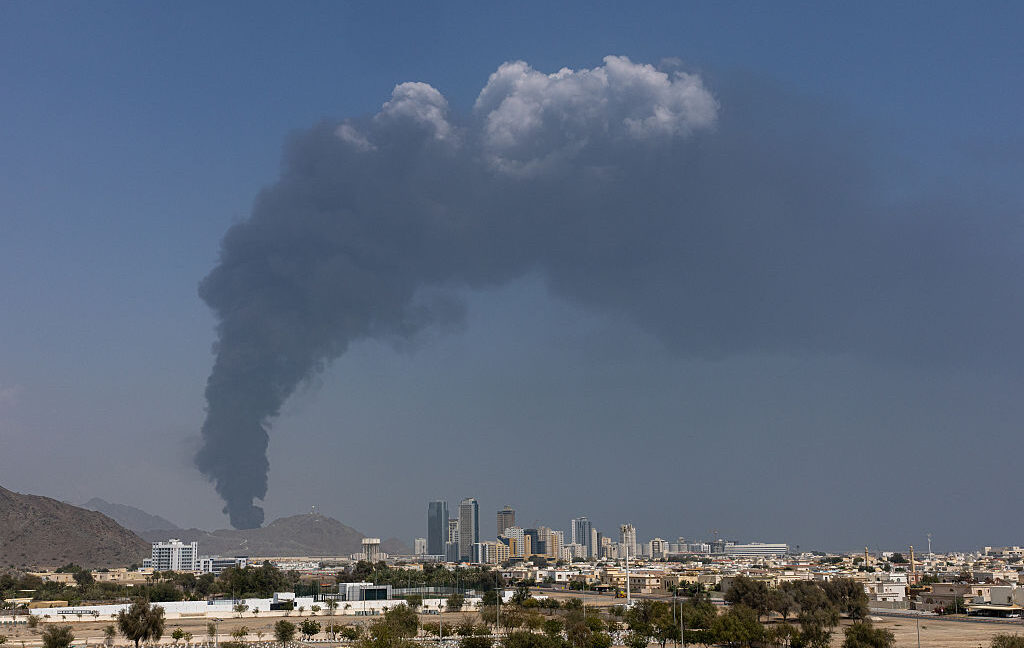
Amazon Web Services expects several more months to repair war-damaged data centers in the UAE and Bahrain, meaning total recovery from February's Iranian drone strikes could approach half a year. The April 30 status update said the ME-CENTRAL-1 and ME-SOUTH-1 regions cannot support customer applications; billing remains suspended after an initial $150 million waiver for March. AWS recommended customers migrate to other regions and restore from remote backups. Some, like Dubai-based Careem, completed overnight migrations. Internal documents previously described 14 EC2 server racks knocked offline at one facility, plus flooding from fire suppression activation and cooling system failures. The announcement follows Pure Data Centre Group's decision to pause Middle East investments until the conflict subsides. The war began February 28 with US-Israeli strikes on Iran; an uneasy ceasefire now holds with dueling naval blockades of the Strait of Hormuz.
Iranian drone strikes on February 28, 2026 targeted three Amazon data centers in the UAE and Bahrain. AWS initially waived March 2026 billing for affected customers. EC2 (Elastic Compute Cloud) is AWS's core virtual server service. Careem is a Dubai-based super app offering ride-hailing, delivery, and household services. Pure Data Centre Group is a London-based data center developer.
The War Powers Act's 60-day limit on unauthorized presidential hostilities has become a legal fiction that both parties exploit, writes Nick Catoggio. Senator Susan Collins cited the deadline to justify her first vote to end the Iran war, but the White House claims the clock reset when the ceasefire began April 7—leaving 23 days or perhaps a full reset. Catoggio argues the entire framework is preposterous: the 1973 law was designed to prevent secret wars like Nixon's Cambodia bombing, not to grant 60-day bombing licenses. The common interpretation that presidents may attack freely for two months before seeking authorization inverts the constitutional design. The practical result is that even symbolic congressional constraints on warmaking are disappearing. Catoggio suggests that soon even empty gestures like the current resolutions will be unheard of, with the 60-day provision becoming a permanent enabling device rather than a limit.
The War Powers Resolution of 1973 requires presidents to notify Congress within 48 hours of committing armed forces to military action and forbids forces from remaining for more than 60 days without congressional authorization. Presidents of both parties have contested its constitutionality. The US-Israel war with Iran began February 28, 2026; a ceasefire took hold April 7. Nick Catoggio writes the Boiling Frogs newsletter at The Dispatch, a center-right publication.
Sonic Fire Tech demonstrated infrasound fire suppression in California, using AI-activated emitters to vibrate oxygen molecules away from flames and extinguish a kitchen grease fire in seconds without water. The company aims to replace sprinklers in homes and commercial spaces, and develop a backpack system for wildland firefighters. Infrasound suppression has been documented in scientific literature but never commercialized. Sonic Fire Tech claims millisecond deployment, no water damage, and no chemicals. Fire protection engineers are skeptical: Nate Wittasek notes that sound does not cool surfaces or wet fuel, raising re-ignition risks, while water sprinklers slow flashover and protect escape routes. The company has presented to CAL FIRE and Contra Costa County firefighters. California requires sprinklers in new homes built since 2011. Sonic Fire Tech's press materials explicitly target this residential sprinkler market.
Infrasound refers to sound waves below 20 Hz, inaudible to humans. The physics of acoustic fire suppression involves disrupting combustion by displacing oxygen from the fuel source. CAL FIRE is California's state firefighting agency. California's residential sprinkler mandate applies to all new construction since 2011.