The US military struck Iranian missile and drone storage facilities and coastal radar positions along the Strait of Hormuz on Friday in retaliation for Iran's drone attack on a Singapore-flagged cargo vessel two days earlier. Iran's Islamic Revolutionary Guard Corps hit the "Ever Lovely" on June 24, damaging its bridge and upper deck in an attack that prompted the UN to suspend maritime escort operations through the waterway. US Central Command said its strikes targeted facilities on Sirik Island and IRGC coastal positions. Iran's government condemned the strikes as "blatant violations" of the memorandum of understanding that ended the broader Middle East conflict and vowed a "swift and decisive" response. The IRGC claimed it repelled the attack on Sirik Island. The tit-for-tat exchange strains a fragile ceasefire framework involving the US, Iran, Israel, and Lebanon — with Washington and Tehran still formally negotiating troop positioning and rules of engagement even as both militaries trade blows.
The Strait of Hormuz, a narrow channel between Iran and Oman, handles roughly 20 percent of the world's oil trade. Since a ceasefire ended the broader Middle East conflict earlier in 2026, the US and Iran have formally negotiated rules of engagement, but the IRGC has continued to contest commercial shipping in the strait.
Two earthquakes struck northwestern Venezuela in rapid succession on June 24 — a 7.2-magnitude foreshock followed 39 seconds later by a 7.5-magnitude mainshock, both centered near San Felipe in Yaracuy state. The 7.5-magnitude event is the strongest to hit Venezuela in over 125 years. The death toll reached at least 920 by Friday, with more than 4,500 injured and over 50,000 people reported missing. In La Guaira, the coastal city serving Caracas, more than 250 residential buildings collapsed; Simón Bolívar International Airport sustained heavy damage and lost telecommunications, hampering rescue coordination. International teams from Mexico, El Salvador, the Dominican Republic, and an 80-member US contingent including structural engineers and search dogs arrived by Friday. Venezuela's acting president declared a state of emergency. The country was already in economic crisis before the disaster, and the scale of destruction threatens to overwhelm infrastructure that has been deteriorating for years.
Venezuela's economy has contracted for most of the past decade due to mismanagement and sanctions, leaving hospitals, rescue services, and housing stock underfunded. The death toll rose from 235 on Thursday to 920 by Friday morning as rescue teams reached areas that had been cut off by damaged roads and telecommunications.
The US Commerce Department lifted its export ban on Claude Mythos 5 on Friday, allowing Anthropic to grant access to over 100 pre-approved organizations after nearly two weeks of restrictions. The ban was imposed on June 12 after the government discovered a method to jailbreak Fable 5, Anthropic's public-facing model, and froze both Fable 5 and Mythos 5 on national security grounds. Anthropic says it implemented safeguards addressing the identified risks. Under the new arrangement, Commerce Secretary Howard Lutnick approved a list of "trusted" US entities that can now use Mythos 5 — but Fable 5 remains unavailable, and the approved list can be revised at any time. The episode mirrors restrictions placed on OpenAI's GPT-5.6 Sol this week, where the government is vetting all customer access to frontier models before general release. Critics say the Trump administration has inserted itself as a gatekeeper for advanced AI with sweeping authority to suspend commercial AI services and no clear legal standards for doing so.
Claude Fable 5 and Mythos 5 are Anthropic's top two model tiers — Fable is the publicly accessible version, Mythos the more powerful closed-access version. The June 12 export ban cited a jailbreak vulnerability that could allow users to extract sensitive technical knowledge, triggering emergency restrictions under US export control law.
OpenAI on Thursday previewed GPT-5.6, a new model suite with three variants — Sol (flagship), Terra (balanced), and Luna (fast) — initially available to roughly 20 government-approved partner organizations. Sol represents OpenAI's strongest model to date, with particular improvements in coding, biology, and cybersecurity; it achieves top scores on Terminal-Bench 2.1, a benchmark for command-line workflows requiring planning and tool use. New capabilities include "max reasoning effort" mode for deeper processing and "ultra mode," which uses subagents to parallelize complex tasks. Pricing for the broader release is set at $5 per million input tokens and $30 per million output tokens for Sol. The restricted rollout reflects the same government review process now applied to Anthropic's Mythos 5: frontier AI models must clear an approval checkpoint before reaching users. OpenAI says general availability is coming in the weeks ahead.
GPT-5.6 Sol follows the earlier GPT-5 family and continues OpenAI's push toward agentic AI, where models orchestrate tools and subagents across long-horizon tasks. The three-tier naming mirrors product differentiation strategies used by other frontier labs, with Sol positioned as the high-compute research and enterprise option.
AI systems can now produce valid proofs in areas where human experts work for careers. That capability is reshaping how mathematicians understand their own discipline. An IEEE Spectrum report assembles some of the field's leading voices — including Fields medalists Terence Tao (UCLA) and Akshay Venkatesh (Princeton) alongside researchers at Carnegie Mellon and the London Institute — to sketch three possible futures: AI as a specialized tool, as a collaborative partner, or as an autonomous researcher making human intuition optional. Yang-Hui He at the London Institute framed it starkly: human mathematicians could become "priests to oracles," present but no longer essential to the work. The report does not resolve the debate, but it surfaces a genuine tension. Mathematics has derived prestige from the idea that proof-finding requires deep creativity. If AI can find proofs without understanding them, the field must decide whether the output or the process is what mathematics is actually for.
AI proof assistants like Lean and Coq have existed for decades but required step-by-step human guidance. The new generation of LLM-based systems searches for proof strategies with greater autonomy. In 2025, AlphaProof solved several International Mathematical Olympiad problems, making the question of AI's role in mathematics less hypothetical.
In 1947, Paul Erdős proved a fact about graphs and networks by showing that if you randomly select from all possible networks of a given size, the probability of finding one with certain desired properties is greater than zero — and therefore at least one such network must exist. The technique, called the probabilistic method, became foundational in combinatorics, number theory, and computer science, but its core machinery stayed largely unchanged for eight decades. A team of mathematicians has now extended the method, strengthening the bounds it can achieve and pushing it into problems where randomness alone was insufficient. Quanta Magazine reports the upgrade resolves a cluster of open problems in Ramsey theory, the branch of combinatorics that studies how order inevitably emerges in large structures. The advance carries practical weight beyond pure mathematics: the probabilistic method underlies algorithms for circuit design, data deduplication, and prime-number results that feed into modern cryptography.
Paul Erdős (1913-1996) was a Hungarian mathematician who published more papers than nearly anyone in history and introduced the probabilistic method to combinatorics. Ramsey theory, one area now extended by the upgrade, asks a simple question: in any sufficiently large structure, must some ordered pattern appear? The affirmative answer leads to results with coding and network-design applications.
Researchers at McMaster University have found a large cluster of genes in the common soil bacterium Streptomyces that simultaneously produces four distinct antibiotic compounds, all targeting the same metabolic pathway in bacteria — the synthesis of biotin, or vitamin B7. The four compounds attack the pathway from different angles: one inhibits an enzyme, one acts as a prodrug, one mimics a cofactor, and one sequesters biotin directly. Eric Brown's team published the findings in Nature. The significance is strategic rather than incremental: because all four compounds converge on the same essential pathway through separate mechanisms, a bacterium that evolves resistance to one still faces three lethal compounds. Bacteria would need to simultaneously evolve multiple counter-mutations to survive — a much higher evolutionary bar than single-antibiotic resistance. The team describes the megacluster as an evolved natural synergy. Antibiotic-resistant infections are projected to kill 39 million people between 2025 and 2050, and the pipeline for new drugs has been sparse for decades.
Antibiotic resistance develops when bacteria evolve ways to neutralize a drug. Most antibiotics target one pathway through one mechanism, making it feasible for bacteria to evolve a single counter-mutation. The megacluster approach borrows a strategy that some bacteria already use against natural competitors — multiple compounds coordinating against one target.
Hundreds of NIH grant proposals that passed scientific peer review are stuck in administrative limbo because new mandatory screening by senior HHS and NIH officials flags applications containing 235 politically disfavored terms. The list includes "gender," "equity," "diversity," "social determinants of health," and language classified as "lobbying activities" — a category that has ensnared proposals informing public health policy. Computational tools scan applications first; flagged ones then go to senior political appointees. Nature's investigation found the NIH is reviewing more than 3,200 proposals that were frozen, denied, or withdrawn under Trump administration directives. Health disparities research has been hit hardest, along with any study touching on community-level factors in disease. Scientists report that the screening has no transparent appeal process, and that chilling effects are spreading beyond flagged applications: researchers are pre-censoring grant language before submission to avoid triggering review.
NIH grants normally go through two stages: outside scientists score proposals for scientific merit, then program officers recommend funding up to a score cutoff. The new political layer sits on top of that process, allowing political appointees to block grants that already cleared peer review — a structure that critics say violates the independence of scientific funding.
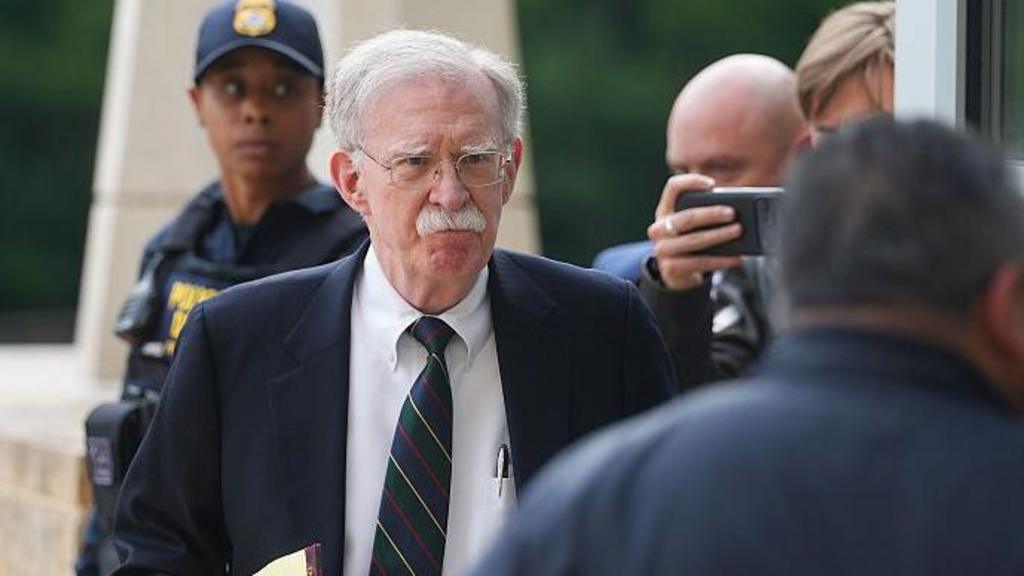
John Bolton — who served as Donald Trump's national security adviser from 2018 to 2019 — pleaded guilty on Friday to one count of mishandling classified information, reduced from 18 original charges. Prosecutors say Bolton regularly took handwritten notes from meetings with intelligence officials, military officers, and foreign leaders, then sent material containing national defense information to family members via text messages and an AOL email account. Under the plea agreement, he faces up to five years in federal prison and a $2.25 million fine, with half due within five days of sentencing. The sentencing date is set for October 28. Trump, who has maintained a hostile public relationship with Bolton since he published a critical memoir in 2020, said Bolton "will be dealt with harshly." Bolton is the third former Trump-era senior official in two years to face criminal charges for mishandling classified material.
Bolton left the Trump administration in 2019 and became a vocal critic. His 2020 memoir "The Room Where It Happened" alleged Trump proposed deals linking foreign policy to his personal political interests. Trump has repeatedly called for Bolton's prosecution. The classified-information charges are separate from the memoir and focus on Bolton's handling of notes during his time in office.
The Texas State Board of Education voted 9-5 on Thursday to add Bible passages and stories to the required reading curriculum for all public school students, affecting more than 5 million children. Elementary students will read picture-book versions of David and Goliath and Daniel in the Lion's Den; middle schoolers will study Sermon on the Mount passages from the New Testament; high schoolers will cover Adam and Eve and the parable of the prodigal son. The approved list contains roughly 200 texts in total, including essays alongside the scripture. Implementation is set for the 2030-2031 school year. Critics argue the mandate crosses the constitutional line separating church from state — the First Amendment bars government from promoting religion. Supporters argue the Bible holds historical and literary significance independent of faith. Legal challenges from civil liberties organizations are expected before the 2030 start date.
The US Supreme Court has held that public schools cannot sponsor religious instruction but may teach religion in an academic context. Texas's approach — mandating specific scripture passages rather than elective comparative religion — is designed to test that boundary in court. Texas's textbook market is large enough that its curriculum decisions influence what publishers offer nationwide.