Astronomers led by Kimihiko Nakajima at Kanazawa University have observed LAP1-B, the most chemically primitive galaxy ever detected, as it existed roughly 800 million years after the Big Bang. The James Webb Space Telescope spotted this ultra-faint object thanks to a 100-fold magnification from gravitational lensing by the massive galaxy cluster MACS J046. The galaxy contains just 0.4 percent of the oxygen-to-hydrogen ratio found in our Sun, indicating it formed from primordial gas lacking heavy elements. The stellar mass caps at roughly 3,300 solar masses, minuscule compared to the Milky Way's 100 billion. Emission lines from triply ionized carbon reveal radiation from extremely hot stars—theorized Population III stars, the first generation composed solely of hydrogen and helium from the Big Bang, burning furiously and dying young in supernovae that seeded the cosmos with heavier elements.
Population III stars are hypothesized to be hundreds of times more massive than our Sun, burning extremely hot due to the absence of heavy elements that help modern stars cool during formation. Their supernovae produced the first elements heavier than hydrogen and helium, enabling later stellar generations.
A team at MIT and Oak Ridge National Laboratory has developed a method to move tens of thousands of individual atoms within a three-dimensional crystal lattice in minutes at room temperature. The technique uses algorithms to steer an electron beam with sub-20-picometer precision, driving chromium atoms in the semiconductor CrSBr into selected interstitial sites to create vacancy-interstitial complexes. In their demonstration, researchers created more than 40,000 quantum defects across a 150-by-100-by-13 nanometer volume. Unlike prior methods limited to surfaces and requiring ultracold vacuums, this approach works beneath the surface and produces stable artificial states of matter that persist outside the microscope. The resulting impurity arrays form mesoscale crystals with tunable optical, magnetic, and quantum properties, opening paths toward scalable quantum computers, dense magnetic memory, and atomic-scale logic devices.
Since IBM's 1989 demonstration arranging 35 atoms to spell "IBM," atomic manipulation has advanced but remained slow and surface-bound. Existing techniques like optical tweezers and ion traps require high-vacuum, ultracold conditions. This new method achieves three-dimensional control at room temperature.
The economic separation between the United States and China is proceeding slowly but measurably, argues Noah Smith. Trump's tariffs, building on Biden's export controls, have driven China's share of U.S. imports down from roughly 21 percent in 2018 to about 13 percent in early 2026. The shift is not primarily to U.S. manufacturing—only 9 percent of Ohio manufacturers reported reshoring in 2025—but to Mexico, Vietnam, and other Asian nations. Electronics illustrate the pattern: two years ago most American PCs came from China; now most come from Vietnam. Investment flows tell a similar story. The transformation remains incomplete. Supply chains have rerouted rather than repatriated, and many products still contain Chinese components assembled elsewhere. Smith suggests this "messy divorce" reflects structural pressures both countries face: American concern about supply chain vulnerability and Chinese ambition to climb the value chain.
The mid-2010s economic arrangement had America doing R&D and design while China handled manufacturing. Both countries chafed at this. China used industrial policy to build national champions like BYD and Huawei. The U.S. responded with tariffs and technology restrictions.
MIT engineers have developed an mRNA-encoded adjuvant that substantially amplifies T-cell responses to vaccines, enabling complete tumor eradication in most mice tested. The approach packages mRNA for two immune signaling genes—IRF8 and NIK—into lipid nanoparticles, programming dendritic cells to shift toward the cDC1 phenotype most effective at activating T cells. When combined with tumor antigens, this adjuvant generated enough antigen-targeted T cells to eliminate cancers without the systemic toxicity of traditional cytokine adjuvants. The same boost improved T-cell responses to influenza and COVID-19 vaccines. Lead authors Akash Gupta, Kaelan Reed, and Riddha Das, working with senior authors Daniel Anderson and Christopher Garris, demonstrated that this immune-remodeling strategy avoids the overstimulation risks of direct cytokine delivery while achieving stronger protection against both cancer and infectious disease.
Most vaccines generate antibodies and some T-cell response by activating antigen-presenting cells. Existing cancer vaccines show promise but produce weak responses in many patients. Cytokines can strengthen immunity but often cause severe side effects through systemic overstimulation.
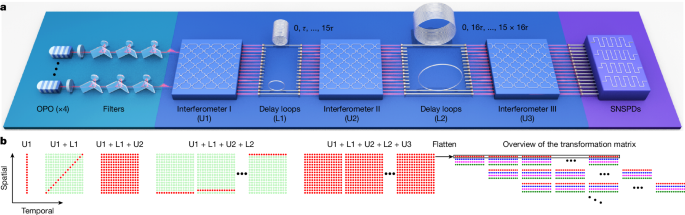
Chinese researchers have demonstrated Jiuzhang 4.0, a photonic quantum processor achieving an order-of-magnitude scale increase over prior Gaussian boson sampling experiments. The system incorporates 1,024 high-efficiency squeezed light sources into a hybrid spatial-temporal encoded circuit with 8,176 modes, achieving 92 percent source efficiency and 51 percent overall system efficiency. It produces samples with up to 3,050 detection events, operating in a Hilbert space of dimension approximately 10^2461—far beyond classical simulation capability. The cubic connectivity scaling enables pathways to trillion-qumode three-dimensional cluster states and fault-tolerant photonic quantum hardware. Experimental results withstood validation against all current classical methods, including matrix product state algorithms designed to exploit photon loss.
Gaussian boson sampling serves as a model for demonstrating quantum computational advantage and can generate bosonic error-correcting codes. Previous implementations faced scalability limits from photon loss in larger encoding circuits. This architecture overcomes those constraints.
Biologists and policy researchers are debating whether to restrict biological AI tools as capabilities advance toward potential bioweapon design. A 2024 Chinese study using open-source protein models to design conotoxins—small proteins from venomous cone snails, some lethal to humans—triggered concern among U.S. government officials. The researchers maintained their work aimed at drug discovery, not harm. Martin Pacesa at the University of Zurich warns that AI could now enable development of toxins as deadly as ricin yet virtually undetectable. Nobel laureate David Baker argues benefits outweigh risks but acknowledges this balance requires ongoing reassessment. Others, like Timothy Jenkins at Denmark's Technical University, contend that restricting software is futile and efforts should focus on detection and countermeasures instead.
Conotoxins are small proteins in cone snail venom that block nervous system ion channels. Some are medically useful—one derived pain treatment is FDA-approved—but others lack antivenom and are highly restricted. AI protein design tools like AlphaFold have made bespoke protein and virus design accessible at keystroke speed.
A study in Nature demonstrates that state control of media systematically alters large language model outputs by shaping the information environment that feeds training data. Researchers found that LLMs rate their own states more favorably when queried in the state's language if that state maintains tighter media control. The effect persists across models and suggests that training data biases—rather than explicit programming—transmit governmental information control into AI systems. This raises questions about whose perspectives global AI systems encode and whether multilingual models inadvertently replicate state propaganda architectures. The work by Waight, Yuan, Roberts, and Stewart builds on prior findings that LLMs produce biased outputs when prompted in African American English, pointing to structural patterns in how training data demographics shape model behavior.
The study connects to broader research on algorithmic bias, including findings that LLMs generate racist outputs when prompted in African American English. It suggests training data composition, not just model architecture, determines whose viewpoints AI systems amplify.
The U.S. Attorney's Office for the Northern District of Texas has issued a grand jury subpoena to NYU Langone Hospital seeking confidential information about patients under 18 who received gender-affirming care. This criminal escalation follows failed administrative subpoenas against other hospitals and marks the first known use of grand jury process to pursue medical records in this context. Providers or hospital officials could face arrest and prosecution. The subpoena arrives after NYU Langone cancelled its Transgender Youth Health Program in January 2025 following a Trump executive order, then fully closed it in early 2026 citing regulatory pressure. New York Attorney General Letitia James had ordered the hospital to resume care in March; Deputy Attorney General Todd Blanche demanded it not. Shannon Minter of the National Center for LGBTQ Rights called the subpoena "mafia-type behavior" and an egregious abuse of federal power to harass providers based on ideological opposition.
New York's Shield Law protects those seeking or providing gender-affirming care from out-of-state retaliation. At least eight prior Trump administration administrative subpoenas demanding trans youth medical records were thrown out; a separate DOJ subpoena slate against California hospitals was dropped in January 2026.
A team at Cactus has open-sourced Needle, a 26 million parameter model for function calling that runs at 6,000 tokens per second prefill and 1,200 tokens per second decode on consumer devices. The model was distilled from Gemini 3.1 using a Simple Attention Network architecture, pretrained on 200 billion tokens across 16 TPU v6e chips for 27 hours, then post-trained on 2 billion tokens of single-shot function call data. Needle outperforms FunctionGemma-270M, Qwen-0.6B, Granite-350M, and LFM2.5-350M on personal AI tool use benchmarks. The weights and dataset generation pipeline are fully open. The release includes a local web UI for testing and fine-tuning on custom tools. The team emphasizes that while small models can be finetuned locally, they remain finicky compared to larger conversational models.
Function calling enables AI agents to interact with external tools and APIs. Large models handle this capably but require substantial compute. The Cactus team investigated whether massive models are overkill for retrieval-and-assembly tasks fundamental to agentic systems.
Political scientist Eric Schickler and co-author Elina Maria Rodriguez have traced Republican criticism of higher education to the late 1980s, well before the current administration's attacks. Analyzing over 1,000 state and national party platforms from 1980 to 2025, they found GOP favorability scores declined steadily from mildly positive ratings around 1.0-1.3 to negative territory by 2024, while Democratic scores remained stable. Republican platform attention to higher ed dropped from 3 percent in the 1980s to 2 percent in the late 1990s, then surged to nearly 4 percent by 2024 as criticism intensified. The research, prompted by Schickler's memories of New College of Florida's bipartisan support in his undergraduate years and its recent political takeover by Ron DeSantis, suggests polarization on higher education followed the same trajectory as other issues but crystallized particularly sharply under the second Trump administration.
Schickler, now at UC Berkeley, attended New College of Florida in the late 1980s when Republican politicians viewed the liberal arts college as a community asset. DeSantis's 2023 takeover appointing conservative trustees including Christopher Rufo prompted Schickler to investigate whether higher education polarization was distinctive or followed standard partisan patterns.