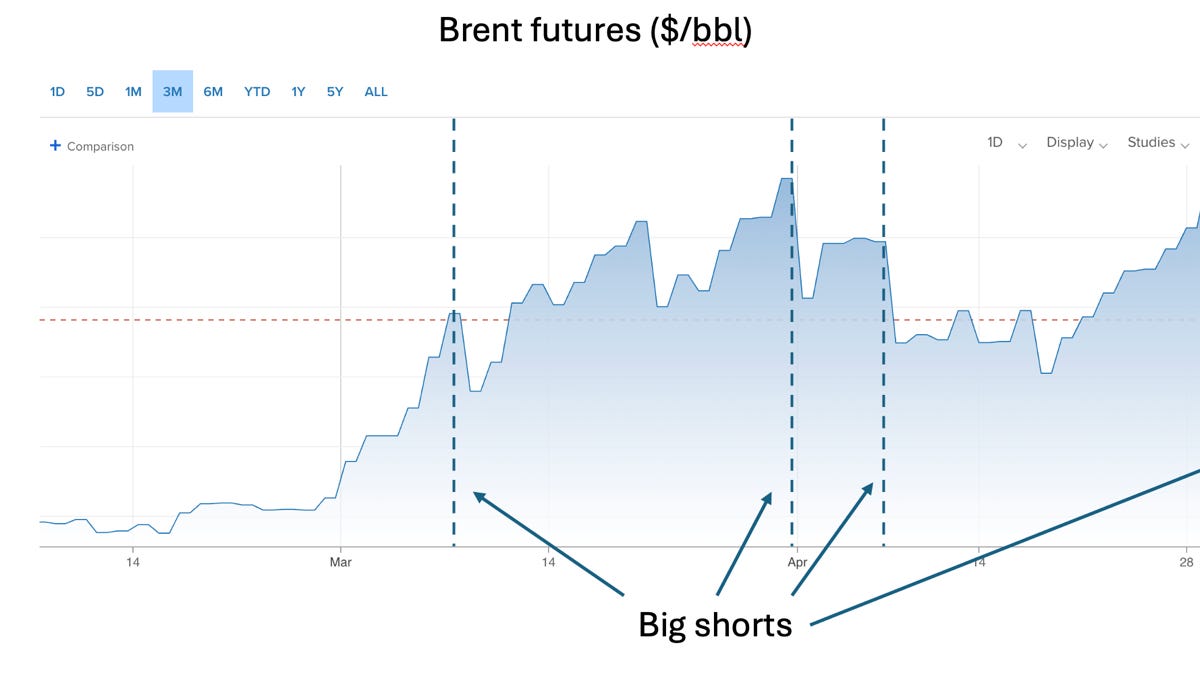
Someone with advance knowledge of Trump's Iran announcements keeps placing massive oil futures bets minutes before market-moving news breaks. On May 7, roughly $920 million in crude oil shorts appeared at 3:40 AM ET—seventy minutes before Axios reported a potential US-Iran deal. The shorts gained approximately $125 million when oil prices dropped over 12 percent. Krugman argues this pattern, repeated across multiple Trump announcements, reveals two failures: the administration makes no effort to stop the leaks, and the traders operate with complete impunity. The damage extends beyond raw corruption. Oil futures markets exist to let producers and consumers hedge price risk. When insiders with advance knowledge trade against you, hedging becomes a sucker's bet. Corporations trying to lock in fuel costs may pay excessive prices because their counterparty knows what Trump will tweet. The market's core function—reducing economic uncertainty—erodes when participants realize they're playing against marked cards.
Oil futures markets allow producers (who will sell oil later) and consumers (like airlines, who will buy later) to lock in prices today, reducing uncertainty for both sides. This hedging function assumes all parties have similar information. Insider trading violates that assumption.
A journalist tested Haotian AI, a Chinese realtime deepfake tool sold to scammers for approximately $4 million in revenue. The software morphs a user's face into anyone else's during live video calls on WhatsApp, Zoom, Teams, TikTok, Instagram, and YouTube. In a direct demonstration, the journalist watched his own face—five o'clock shadow, grin, under-eye bags—appear on another person's body in realtime. The deepfake pinched cheeks, covered noses, and stroked chins without breaking. Haotian AI offers fine-grained controls: adjustable nose size, jawline sharpening, lip thickness, even acne removal. Academic research found the Xception deepfake detection model struggled to identify Haotian AI outputs. The software likely builds on open-source face-swap tools; its true value is sophisticated technical support that lets nontechnical criminals deploy realtime impersonation. Romance scams, tax fraud, and virtual kidnappings stand to amplify as the barrier to convincing live deception drops.
Haotian AI (昊天AI) is marketed through Chinese-language Telegram channels to scammers operating in Southeast Asian scam compounds. The tool represents an evolution from static deepfakes to realtime morphing during live video calls.
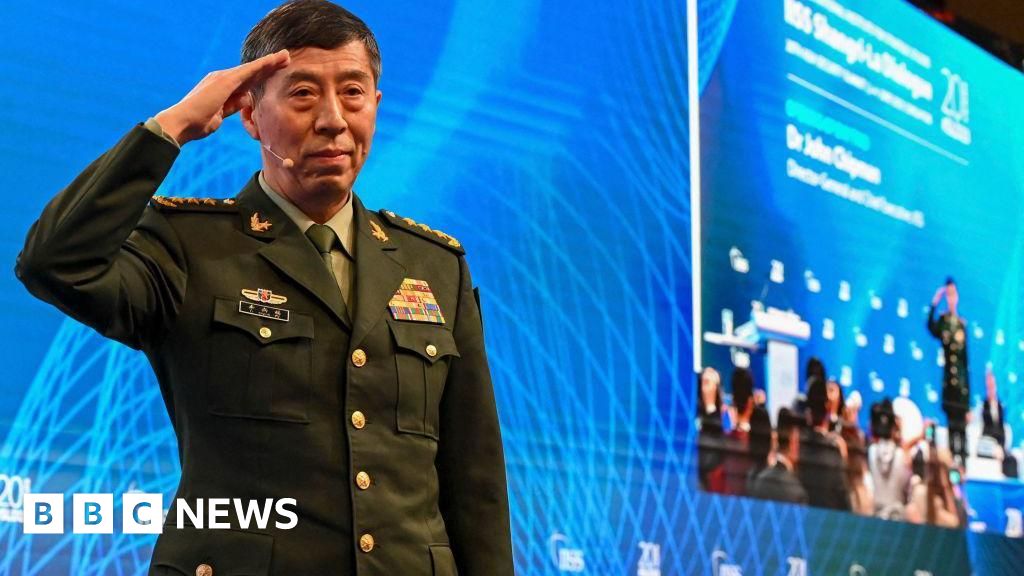
A Chinese military court sentenced two former defence ministers to death with two-year reprieve, meaning their sentences will convert to life imprisonment without possibility of reduction or parole after the reprieve period. Wei Fenghe, defence minister from 2018 to 2023, and his successor Li Shangfu, who served only months before disappearing from public view in October 2023, were found guilty of bribery. All personal assets were confiscated. The sentences follow a sweeping anti-corruption crackdown that has removed multiple top military figures. President Xi Jinping made a rare public reference to the campaign in February, stating the army had undergone revolutionary tempering in the fight against corruption. Critics note that Xi's anti-corruption drives have also functioned as tools to purge political rivals. The suspended death sentence format, common in high-profile Chinese corruption cases, allows the state to claim severe punishment while preserving the option to keep defendants alive.
Wei Fenghe (魏凤和) served as defence minister from 2018 to 2023. Li Shangfu (李尚福) replaced him in March 2023 and was dismissed in October 2023 after disappearing from public view. The suspended death sentence (死刑缓期执行) is a standard Chinese legal mechanism for high-profile corruption cases.
MIT neuroscientist Earl Miller and Northeastern psychologist Lisa Feldman Barrett challenge decades of cognitive dogma in a new Nature Reviews Neuroscience paper. The classical view holds that your brain soaks in sensory features, compares them to stored prototypes, and only then plans action. Miller and Barrett argue the reverse: your brain constructs categories from predicted action plans first, then shapes sensory processing to match. When you see a dog, your brain doesn't neutrally analyze fur and bark before deciding what to do. It predicts motor plans based on your needs—avoidance in an unfamiliar neighborhood, approach on your own block—and constructs a momentary category that compresses sensory signals to serve that plan. The brain is predictive, not reactive. Anatomical and electrophysiological evidence supports this: motor plans flow toward sensory surfaces, actively shaping what you perceive. The framework has implications for understanding how prediction errors drive learning and why mismatched expectations feel disruptive.
Earl K. Miller is Picower Professor of Neuroscience at MIT. Lisa Feldman Barrett is University Distinguished Professor at Northeastern. Their paper 'Categorization is Baked into the Brain' appears in Nature Reviews Neuroscience.
A large-scale educational program in northern Nigeria reduced child marriages by 80 percent, according to research published in Nature. The intervention, tested across 293 villages, combined four components: free schooling for girls, support for female teachers, community engagement with local religious leaders, and small group meetings for adolescent girls. The religious leader engagement proved critical in a region where early marriage has deep cultural roots. The program cost approximately $100 per girl annually. Researchers tracked outcomes for four years. The effect size surprised even the research team: marriage rates among girls aged 12 to 16 dropped from roughly 60 percent to under 15 percent in treated communities. The study demonstrates that bundled interventions can shift entrenched social norms when designed with local institutional knowledge. The researchers emphasize that single-component programs—scholarships alone, for example—typically fail to achieve comparable effects.
Northern Nigeria has among the highest child marriage rates globally. The study was led by researchers from the University of California, Berkeley and local Nigerian partners. The 'big push' intervention design emphasizes complementary components reinforcing each other.
Google DeepMind's AlphaEvolve, a Gemini-powered coding agent, has produced measurable improvements across genomics, hardware design, and mathematics. In genomics, AlphaEvolve enhanced DeepConsensus—a DNA sequencing error correction model developed by Google Research—achieving a 30 percent reduction in variant detection errors. PacBio, a sequencing instrument manufacturer, stated the improvement unlocks higher accuracy rates that may enable discovery of previously hidden disease-causing mutations. AlphaEvolve combines large language models with evolutionary search algorithms to explore program spaces. The system has also generated novel algorithms for matrix multiplication and contributed to hardware optimization for Google's Tensor Processing Units. Unlike demonstration projects, these deployments represent integration into production scientific and engineering workflows. The DeepConsensus improvement illustrates a pattern: AI coding agents moving from toy problems to systems where marginal accuracy gains translate directly into scientific or commercial value.
DeepConsensus corrects errors in Pacific Biosciences (PacBio) sequencing data. Variant detection errors occur when sequencing mistakes are misinterpreted as genuine genetic variations. AlphaEvolve uses an evolutionary algorithm to mutate and select code improvements over multiple generations.
University of Amsterdam researcher Petter Törnberg's recent work suggests social media's toxic dynamics may be structurally inevitable—and that proposed fixes often backfire. Using agent-based models with large language model personas, Törnberg found that echo chambers emerge naturally from basic platform architecture even without algorithmic filter bubbles. Users with low disagreement tolerance amplify small conflicts until communities polarize or homogenize. Surprisingly, filter bubbles can stabilize diversity: when users see even 10 percent content matching their views, they tolerate more disagreement without leaving. Törnberg validated this in r/MensRights, finding users departed when their posts diverged linguistically from community norms. The research implies that platform interventions targeting algorithms miss deeper structural drivers. As social media fragments into federated or niche platforms, the same dynamics may replicate unless fundamental interaction architectures change. The work offers no easy solutions, only clearer diagnosis of why moderation and algorithmic tweaks keep failing.
Törnberg's 2024 research found platform intervention strategies unlikely to work because negative dynamics are embedded in social media architecture rather than caused by algorithms alone. His new papers extend this to echo chamber formation and user departure dynamics.
MIT researchers have overcome a fundamental limitation in silicon-photonics-based lidar that restricted field of view and precision. Traditional lidar uses spinning mechanical assemblies. Silicon-photonics chips manipulate light without moving parts, but antenna crosstalk has limited their scanning range. The MIT team designed an integrated optical phased array with minimized crosstalk between antennas, enabling wider field-of-view scanning while maintaining low noise. The advance could enable durable, compact lidar for autonomous vehicles, aerial surveying, and construction monitoring. Current workarounds for antenna spacing tradeoffs increased noise and reduced precision. The new architecture avoids these drawbacks through antenna array design rather than algorithmic correction. The research appears in Nature Communications. Lead author Henry Crawford-Eng and senior author Jelena Notaros, an MIT electrical engineering professor, demonstrated the system. The work addresses a specific engineering constraint that has slowed chip-based lidar adoption despite its advantages in reliability and form factor.
Optical phased arrays steer light beams by adjusting phase across antenna elements, eliminating mechanical scanning. Crosstalk between closely spaced antennas has been the central engineering challenge limiting field of view in chip-based systems.
New York University and the State University of New York system are launching a joint Higher Education Design Lab to test educational reforms against actual student outcomes. The partnership pairs the largest private research university in the US with the largest comprehensive public university system. The lab will study innovations across rural and urban campuses, commuter and residential settings, and global and local sites to identify which interventions equip graduates to adapt and thrive. Initial focus areas include preparation for AI-transformed workplaces and globalization. The effort responds to a gap in higher education: institutions rigorously assess student learning through exams and assignments but rarely apply comparable rigor to evaluating their own programs and policies. The lab aims to generate evidence on what works rather than relying on institutional hunch. Both university presidents emphasize that degrees continue to deliver labor market returns, but students increasingly need preparation for unpredictability rather than narrow technical training.
Linda G. Mills is NYU president; John B. King Jr. is SUNY chancellor. The Higher Education Design Lab represents a rare systematic collaboration between private and public institutions to generate evidence on educational effectiveness.
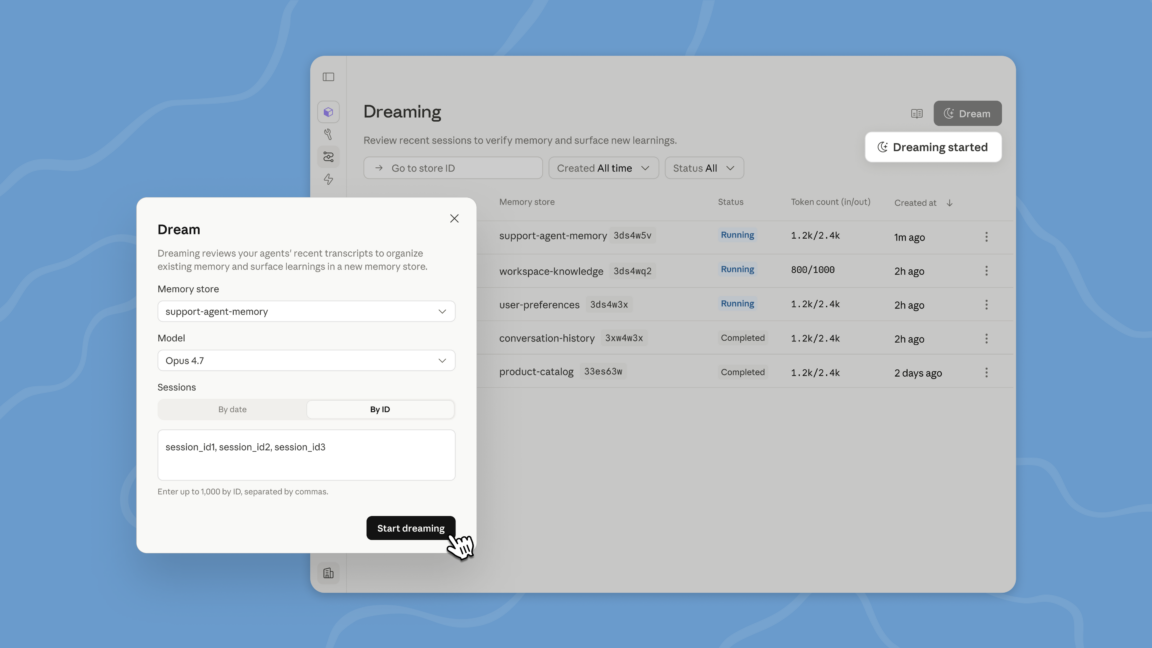
Anthropic introduced 'dreaming' for Claude Managed Agents at its Code with Claude developers' conference. The feature runs as a scheduled process that reviews past sessions and memory stores across multiple agents, identifying patterns worth preserving. Unlike standard context window compaction, which operates within single conversations, dreaming surfaces cross-agent patterns: recurring mistakes, convergent workflows, shared team preferences. Users can choose automatic dreaming or review memory changes manually. The feature addresses a concrete limitation: LLM context windows are finite, and important information gets lost in lengthy multi-agent projects. Dreaming is currently in research preview with limited access. Anthropic also announced wider availability for two previously previewed features—outcomes tracking and multi-agent orchestration—and doubled usage limits for Pro and Max subscribers from five to ten hours, responding to infrastructure constraints that had frustrated heavy users. The announcements focus on managed infrastructure for multi-agent workflows rather than raw model capability improvements.
Managed Agents are Anthropic's pre-built configurable agent harness running in managed infrastructure, distinct from direct API building. Context window compaction is a common technique where lengthy conversations are summarized to preserve relevant information while removing noise.